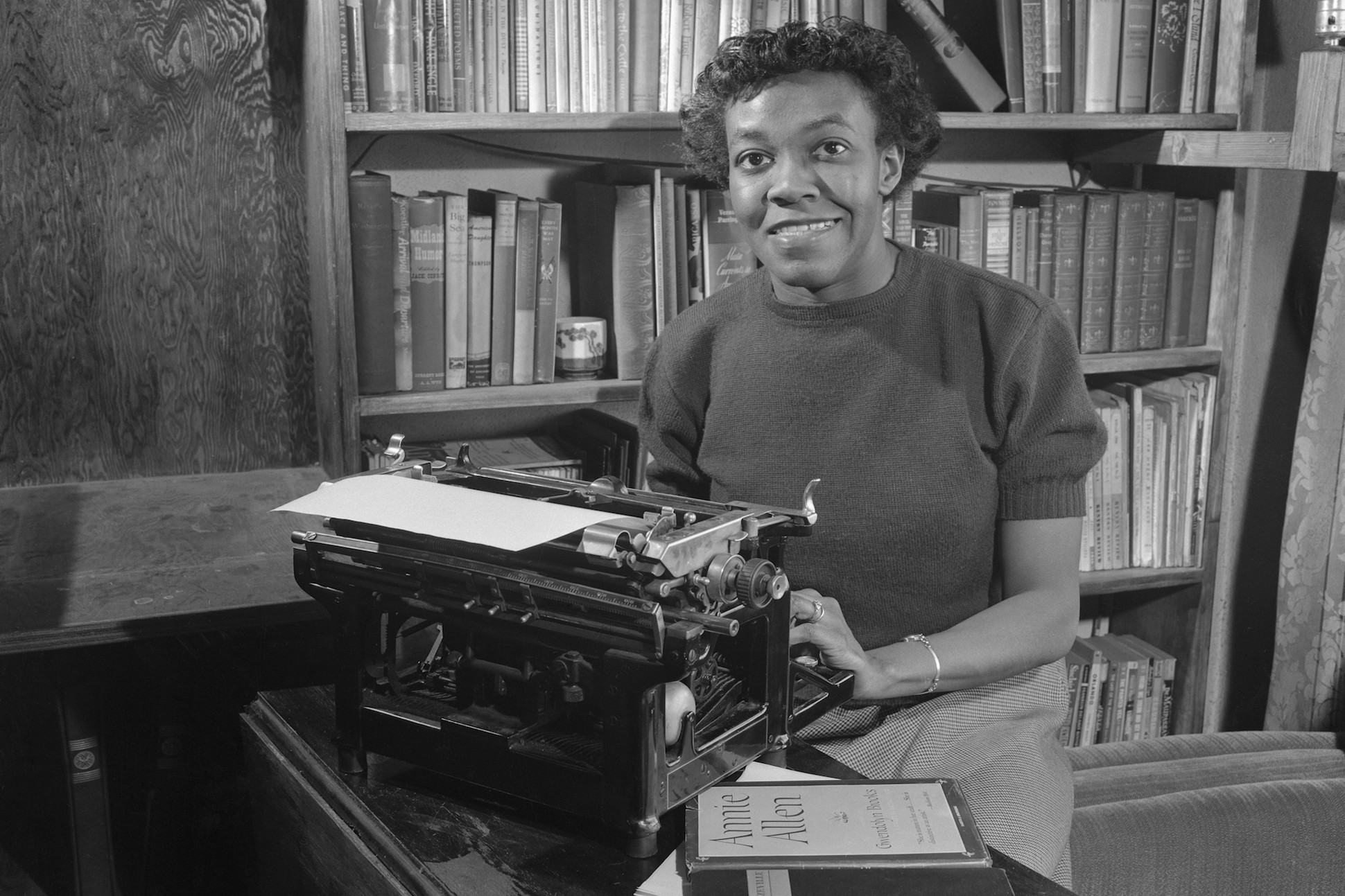
Gwendolyn Brooks
American poet and authorWikipedia
29
MENTIONS
21
EPISODES
19
PODCASTS
Search complete. 29 mentions across 21 episodes found for "Gwendolyn Brooks".
Sep 16, 2026

Gloria BurgessHOST
You can hear more about about the power of poetry by listening to some of my other podcasts.
Gloria BurgessHOST
I have a show about poetry and the power of healing, poetry and leading, another one that highlights and features Pulitzer Prize-winning poet Gwendolyn Brooks.
Gloria BurgessHOST
I also have a podcast of my interview with poet Elizabeth Austin and a show featuring Dr. Maya Angelou.
Gloria BurgessHOST
And yes, I know that folks love my podcast on poetry, and I love researching and creating them, so there's more to come.

JessHOST
I technically already have one done because it's Toni Morrison is part of the collection.
JessHOST
Um, but I, I could, I'd put down Gwendolyn Brooks.
JessHOST
I'll probably do Gwendolyn Brooks, Gayl Jones, Audre Lorde.
JessHOST
I already did Toni.
JessHOST
Sonia Sanchez, and Margaret Walker.

Richard J. PowellGUEST
in a good way, by this incredibly beautiful brown woman from Pittsburgh who, who turns the world upside down.
Richard J. PowellGUEST
In fact, if you go to Gwendolyn Brooks's, I think it's in Maud M- Martha, she touches a passage where she is going to this little theater on M- Michigan Avenue, and that film comes out, and she says, "You know, we saw something that we just had never seen before." And I think that was the case for, you know, Marcel Camus, you know, film, where he, he's showing Brazil during Carnival at the end of the '50s, and he finds this incredibly, not just incredibly beautiful woman, but this incredibly brown woman.
Richard J. PowellGUEST
Who really causes, um, all eyes to, to just, you know, kind of stop [laughs] and, and to be stuck.
Richard J. PowellGUEST
So that, so that in, in the book I, I talk about running into her literally.

Elizabeth AlexanderGUEST
I mean, so there are no...
Elizabeth AlexanderGUEST
There, there are poems by other people in here, Gwendolyn Brooks, Rukeyser.
Elizabeth AlexanderGUEST
Um, there, there's, there's no poetry by me, but I hope that because at core a poet is the writer I am, um, I hope that there's always, um, that incredibly concentrated, um, and precise attention to language and also the willingness to let the metaphor in.
Mitzi RapkinHOST
I cried a lot when I read this.
48 MINS LATER
Mitzi RapkinHOST
Can you read a passage from an author that speaks to you or influences you as a writer?
Elizabeth AlexanderGUEST
Yes.
Elizabeth AlexanderGUEST
I am excited to share Gwendolyn Brooks, who is, um, an extraordinary poet from Chicago, and she has been a tremendous influence on me.
Elizabeth AlexanderGUEST
And this is from her poem The Second Sermon on the Warpland.

LaDonnaHOST
So the book is full of really deep themes, obviously kinship, both natural and chosen, responsibility for each other.
LaDonnaHOST
In fact, the book starts out right out of the gate with a Gwendolyn Brooks quote, We are each other's business.
LaDonnaHOST
We are each other's magnitude and bond.
LaDonnaHOST
Other themes include sexuality, including homosexuality, loyalty, the complexity of being not just a woman, not just a black woman, but a black woman in the South during this era.

Devon HaseGUEST
And, and Yong asked me to quote Ross Gay in this, in this talk, so this is why I thought of this poem.
Devon HaseGUEST
Um, he's been thinking about death, and it's actually, this poem is called Sorrow Is Not My Name, after Gwendolyn Brooks.
Devon HaseGUEST
So I think he's thinking about loss and death and grief.
Devon HaseGUEST
And you can hear him begin with a kind of death contemplation, and then you hear his process of moving into mudita.
Devon HaseGUEST
So Sorrow Is Not My Name, after Gwendolyn Brooks.
Devon HaseGUEST
"No matter the pull toward brink.
Devon HaseGUEST
No matter the florid deep sleep awaits.

Jane Hwang DegenhardtHOST
A number of Black individuals are foregrounded in these discussions.
Jane Hwang DegenhardtHOST
They include Phyllis Wheatley, Gwendolyn Brooks, Nina Simone, Jewel Tyus Williams, Barack Obama, and others.
Jane Hwang DegenhardtHOST
By telling their stories and by honoring the weight of the trauma and violence that has long befallen the Black community, Christopher Freeburg's soul invites its readers to commune with the soul power of people who brought about transformation in the face of seeming impossibility.
Jane Hwang DegenhardtHOST
I'm absolutely delighted to be able to discuss this book with you today, Chris.
Christopher FreeburgGUEST
And that kind of really resonated with me.
Christopher FreeburgGUEST
So I wanted to shift the idea of an ideas book or a philosophical book about the idea of black culture to what it means to actually live live out and practice some of the most important concepts that people that we know and love and some of the people that we don't know and love have and carry with us or teach us or want to pass down.
Christopher FreeburgGUEST
That's why I kept noticing that there's certain concepts that different major figures such as the ones we mentioned, Barack Obama, or Phyllis Wheatley, or Nina Simone, Gwendolyn Brooks, Jewel Tiles Williams, people in my family that they really put a big emphasis on and said, if there's anything that I want you to remember about my life, it's this.
Christopher FreeburgGUEST
And a lot of that had to do with serving others.

Jane Hwang DegenhardtHOST
A number of Black individuals are foregrounded in these discussions.
Jane Hwang DegenhardtHOST
They include Phyllis Wheatley, Gwendolyn Brooks, Nina Simone, Jewel Tyus Williams, Barack Obama, and others.
Jane Hwang DegenhardtHOST
By telling their stories and by honoring the weight of the trauma and violence that has long befallen the Black community, Christopher Freeburg's soul invites its readers to commune with the soul power of people who brought about transformation in the face of seeming impossibility.
Jane Hwang DegenhardtHOST
I'm absolutely delighted to be able to discuss this book with you today, Chris.
Christopher FreeburgGUEST
So my editor, Jennifer Banks, suggested that I work through different people and individuals and and think about more of individualized lived experience.
Christopher FreeburgGUEST
And that kind of really resonated with me.
Christopher FreeburgGUEST
So I wanted to shift the idea of an ideas book or a philosophical book about the idea of Black culture to what it means to actually live out and practice some of the most important and important important concepts that people that we that we know and love and some of the people that we don't know and love have and carry with us or teach us or want to pass down that's why i kept noticing that there's certain kinds of concepts that that different major figures such as the ones we mentioned barack obama or phyllis wheatley Or Anita Simone, Gwendolyn Brooks, Jewel Ties Williams, people in my family that they really put a big emphasis on and said, if there's anything that I want you to remember about my life, it's this.
Christopher FreeburgGUEST
And a lot of that had to do with serving others.

Jane Hwang DegenhardtHOST
A number of Black individuals are foregrounded in these discussions.
Jane Hwang DegenhardtHOST
They include Phyllis Wheatley, Gwendolyn Brooks, Nina Simone, Jewel Tyus Williams, Barack Obama, and others.
Jane Hwang DegenhardtHOST
By telling their stories and by honoring the weight of the trauma and violence that has long befallen the Black community, Christopher Freeburg's soul invites its readers to commune with the soul power of people who brought about transformation in the face of seeming impossibility.
Jane Hwang DegenhardtHOST
I'm absolutely delighted to be able to discuss this book with you today, Chris.
Christopher FreeburgGUEST
And that kind of really resonated with me.
Christopher FreeburgGUEST
So I wanted to shift the idea of an ideas book or a philosophical book about the idea of black culture to what it means to actually live live out and practice some of the most important and important concepts that people that we know and love and some of the people that we don't know and love have and carry with us or teach us or want to pass down.
Christopher FreeburgGUEST
That's why I kept noticing that there's certain kinds of concepts that different major figures such as the ones we mentioned, Barack Obama or Phyllis Wheatley or Anita Savone, Gwendolyn Brooks, Jewel Tiles Williams, people in my family that they really put a big emphasis on and said, if there's anything that I want you to remember about my life, it's this.
Christopher FreeburgGUEST
And a lot of that had to do with serving others.

Jane DeGenhardtHOST
A number of Black individuals are foregrounded in these discussions.
Jane DeGenhardtHOST
They include Phyllis Wheatley, Gwendolyn Brooks, Nina Simone, Jewel Thais-Williams, Barack Obama, and others.
Jane DeGenhardtHOST
By telling their stories and by honoring the weight of the trauma and violence that has long befallen the Black community, Christopher Freeberg's Soul invites its readers to commune with the soul power of people who brought about transformation in the face of seeming impossibility.
Jane DeGenhardtHOST
I'm absolutely delighted to be able to discuss this book with you today, Chris.
Christopher FreeburgGUEST
So, uh, my editor, um, Jennifer Banks, suggested that I work through different people and individuals, uh, and, and, um, and think about more of individualized lived experience, and that kind of really res- resonated, resonated with me.
Christopher FreeburgGUEST
So I wanted to shift the idea of an ideas book or a philosophical book about the idea of Black culture to what it means to actually live, live out and practice, um, some of the most, um, important and important concepts that people that we, that we know and love and some of the people that we don't know and love have and carry with us or teach us or wanna pass down.
Christopher FreeburgGUEST
That's what I kept noticing, that there's certain kinds of concepts that, that different major figures, such as the ones we mentioned, Barack Obama or, um, Phyllis Wheatley or, or, um, Nina Simone, Gwendolyn Brooks, Jewel Thais-Williams, people in my family that they really put a, a big emphasis on and said, "This, if there's something, anything that I want you to remember about my life, it's this." And so, and a lot of that had to do with serving others.
Jane DeGenhardtHOST
Hmm.
11 more episodes mention Gwendolyn Brooks.
Create an account to see the whole feed, search across every transcript, and follow the entities you care about.