Gwangju Uprising
WarWikipedia
8
MENTIONS
5
EPISODES
4
PODCASTS
Search complete. 8 mentions across 5 episodes found for "Gwangju Uprising".
Oct 20, 2026

K.J. NohGUEST
And so that responsibility for both the civilian massacres and the military coups falls firmly in the lap of the United States.
K.J. NohGUEST
And by 1980, the Gwangju Massacre became too embarrassing.
K.J. NohGUEST
So the U.S. said, we have to kind of find a way to pretend we don't have OPCON, but still maintain OPCON.
K.J. NohGUEST
So after years of negotiation, in 1994, they said, we have given OPCON to Korea.

speaker_0HOST
Okay.
speaker_0HOST
To understand the gravity of this book, we have to establish the historical reality of the 1980 Gwangju Uprising.
speaker_1HOST
Right.
speaker_1HOST
Following the assassination of a long-ruling military dictator, a new military faction seized power and declared martial law.

Alexis ParkerHOST
Explain it for the people who didn't grow up in Korea, because I had to look it up.
Giovanni GallucciHOST
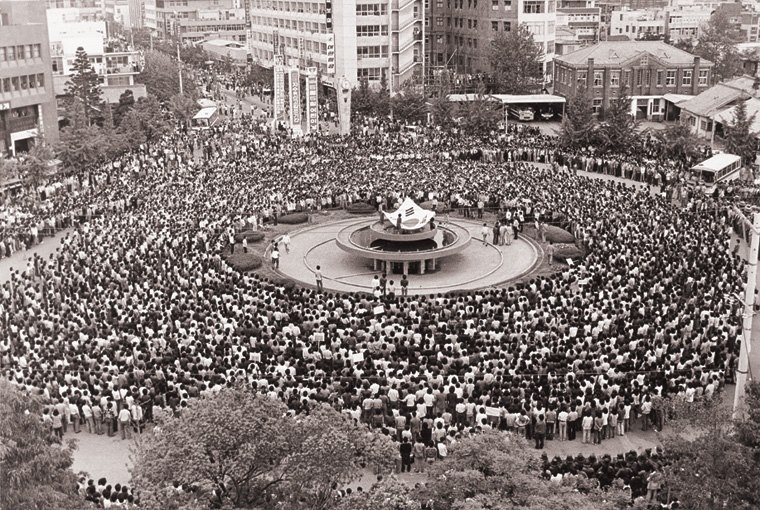
May 18th, 1980, is the start of the Gwangju Uprising.
Giovanni GallucciHOST
Students and citizens in the city of Gwangju stood up against a military dictatorship, and the government sent in troops and tanks.
Giovanni GallucciHOST
Official records count around 200 dead.

Ahn Jae-wooPANELIST
So if you're paying a visit to the UCCN Pavilion at GMAP, do not forget to visit the centuries-old pavilion as well.
Ahn Jae-wooPANELIST
And number two, GMAP is about a five-minute walk away from the historic Geumnam-ro Street, the very place where the May 18 Gwangju Uprising took place back in 1980, which is the historical inspiration behind the very conception of the Gwangju Biennale.
Ahn Jae-wooPANELIST
A few more Gwangju Biennale pavilions are along or nearby the street as well.
Ahn Jae-wooPANELIST
And number three, in this area, plus actually segwaying back to what you asked me earlier, there are indeed a healthy number of fantastic spectacles.
KJ NohGUEST
And these units that served in Vietnam a few years later came back and they initiated a military coup.
KJ NohGUEST
And then they went on to commit the Gwangju Massacre, which was the largest civilian massacre in South Korean history in 50 years.
KJ NohGUEST
And so Korea has a very, very strong military relationship, a horrible one, to Vietnam.
KJ NohGUEST
It enriched itself, engorged itself as a war profiteer during the Vietnam War, but that didn't keep it from having tremendous damage on its own society.
6 MINS LATER
Radhika DesaiHOST
And I think there had already been a massacre and he wanted to have another come down further.
Radhika DesaiHOST
And this is why KCIA chief killed him.
Radhika DesaiHOST
And I thought this was the Gwangju massacre, but maybe I'm mixing things up.
KJ NohGUEST
The Gwangju Massacre came later.