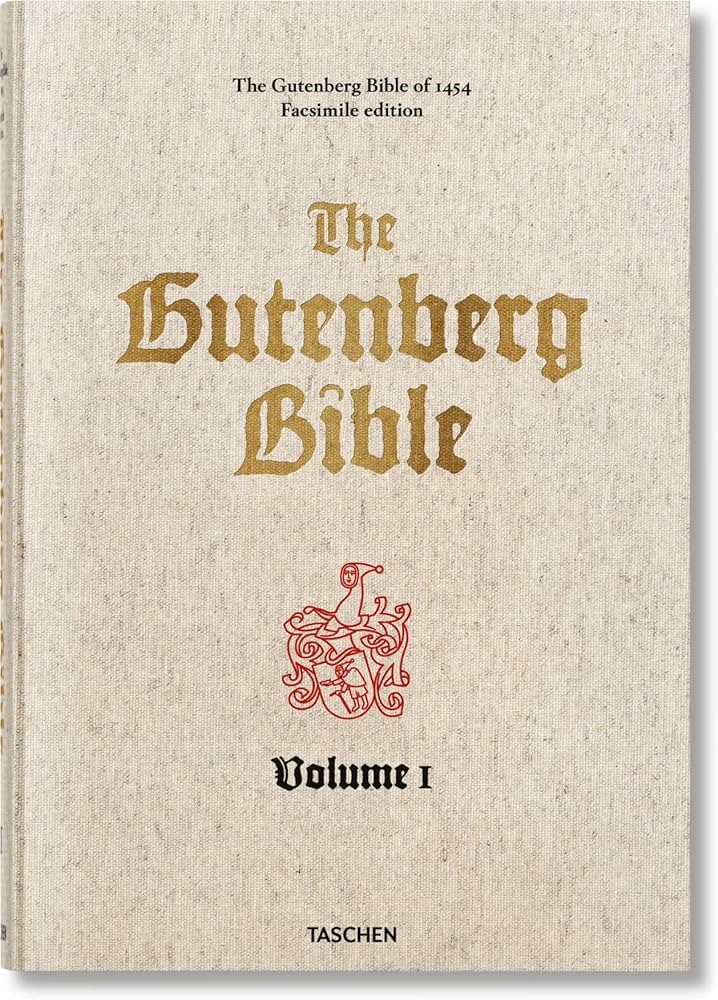
Gutenberg Bible
BookWikipedia
71
MENTIONS
37
EPISODES
36
PODCASTS
Search complete. 71 mentions across 37 episodes found for "Gutenberg Bible".
Sep 20, 2026

David RuizHOST
But I immediately do think of like when I hear the word rare book, perhaps my vision of rare book is exceedingly rare.
David RuizHOST
Gutenberg Bible and the idea of like, they're not going to get one of those.
David RuizHOST
We only have so many of those, but actual rare, limited, fewer than 100 copies type books, books in museums.
David RuizHOST
That's the kind of stuff that immediately is conjured up in my mind as a fearful thing, right? And it may not be that that's the case.

Ben SmithHOST
I'm sort of wondering if Max is like it's like 14, it's like 1457.
Ben SmithHOST
And Max is like a monk running around yelling about Gutenberg Bibles, you know?
Max TaniHOST
Well, yeah, that's so so I want to ask, Max, what do you do? What do you think about Ben's, you know, Ben's idea that these are all just going to essentially and I think this is what Paul Hugo was saying as well, is that eventually these are going to kind of just be the same thing.
Max TaniHOST
And why are we trying to stand in the way of that?

Tim HarfordGUEST
gave us the Reformation, the novel, the newspaper, the scientific paper, all sorts of things.
Tim HarfordGUEST
And then I say, okay, but what are those amazing Gutenberg Bibles printed on? And usually they're printed on paper.
Tim HarfordGUEST
And paper is the invention that makes the printing press economically viable.
Tim HarfordGUEST
I mean, you can print on other surfaces, you can print on animal skin, but it's really expensive.

AaronHOST
The governments and the ruling elites of their day feared the printing press.
AaronHOST
They didn't like the Gutenberg Bible.
AaronHOST
Oh, they certainly didn't.
AaronHOST
Because it put the word of God into the hands of the peasants, and they no longer had to go through the church authority and the elite.

CornHOST
The answer to Daniel's question is that the Library of Congress became much more than a research service for a specific legislator by accident and by design, and the most important parts of it are the parts you can't see.
Herman PoppleberryHOST
The cutting room floor detail I wanted to fit in, the Library of Congress has a Gutenberg Bible, one of the few complete copies in the world.
Herman PoppleberryHOST
It's on permanent display in the Jefferson Building.
Herman PoppleberryHOST
And the library also has the world's largest collection of comic books.
Herman PoppleberryHOST
That's the range.
Herman PoppleberryHOST
A Gutenberg Bible and comic books in the same institution under the same roof.
Herman PoppleberryHOST
The open
CornHOST
question I keep coming back to is whether the library can hold its non-partisan role as political pressure increases.

Mark PepperGUEST
Exactly.
Mark PepperGUEST
I love the analogy is that we are now at the new Gutenberg Bible stage where we've got brand new toys, brand new tools.
Mark PepperGUEST
And we're able to create some very new and neat stuff, particularly with AI, what it can do when combined with actual human knowledge and human skill to guide it.
RenHOST
Yeah.

Travis GobeilGUEST
Absolutely.
Travis GobeilGUEST
Uh, you know, movable type as we call it, right? It was a huge, you know, revolution in how things were made, and then once the computers got involved, now the speed and, uh, you know, obviously, like I could lay out the Gutenberg Bible in 20 minutes if I had-
Glenn SchmelzleHOST
Crazy
Travis GobeilGUEST
... you know, a copy of Gutenberg font and the text.

speaker_1NARRATOR
Taxi! This is the 77 WABC Minicast.
Cindy AdamsGUEST
I have been there since the beginning of the Gutenberg Bible.
Cindy AdamsGUEST
There's nobody been around more than I have.
Cindy AdamsGUEST
So I am going to tell you stuff that I know.

George BanfieldNARRATOR
There is, to be sure, a general impression that the first centuries of printing were given up to folios, the eighteenth century to quartos and octavos, and that only the present period has been characterized by twelvemos and sixteenmos.
George BanfieldNARRATOR
We think of the Gutenberg Bible, the Nuremberg Chronicle, the mighty editions of the Fathers, the polyglot Bibles of Paris, London, and Antwerp, fairly to be called limp teachers' Bibles, the sixteen-eleven Bible, the Shakespeare folios, then of the quarto editions of Addison, Pope, Walpole, and their contemporaries, and the stately octavo editions of the same writers, and finally of the myriad infra that have swarmed from the press during the last century.
George BanfieldNARRATOR
But when we walk through a library that offers a representative collection of books from the invention of printing to the present, we realize that the bigness of the folios and quartos has deceived us as to their relative number, all forms of literature being considered.
George BanfieldNARRATOR
The parent of our present book form, the Roman codex, split from an actual block of wood, had a surface hardly as large as the cover of a little classic.

speaker_17NARRATOR
He was buried in the church which he had built in Aix-la-Chapelle.
speaker_17NARRATOR
His body was placed in the tomb, seated upon a grand chair, dressed in royal robes, with a crown on the head, a sword at the side, and a Bible in the hands.
speaker_17NARRATOR
This famous emperor is known in history as Charlemagne, which is the French word for the German name Karl de Grosse, Charles the Great.
speaker_17NARRATOR
the name by which he was called at his own court during his life the german name would really be a better name for him for he was a german and german was the language that he spoke the common name of his favorite residence aix-la-chapelle also is french but he knew the place as The great empire which Charlemagne built up held together only during the life of his son.
2 HRS 53 MINS LATER
speaker_23NARRATOR
The new types were movable, so they could be set up to print one page, then taken apart and set up again and again to print any number of pages.
speaker_23NARRATOR
But type made of wood did not always print the letters clearly and distinctly, so Gutenberg gave up wood types and tried metal types.
speaker_23NARRATOR
Soon a Latin Bible was printed.
speaker_23NARRATOR
It was in two volumes, each of which had 300 pages, while each of the pages had 42 lines.
27 more episodes mention Gutenberg Bible.
Create an account to see the whole feed, search across every transcript, and follow the entities you care about.