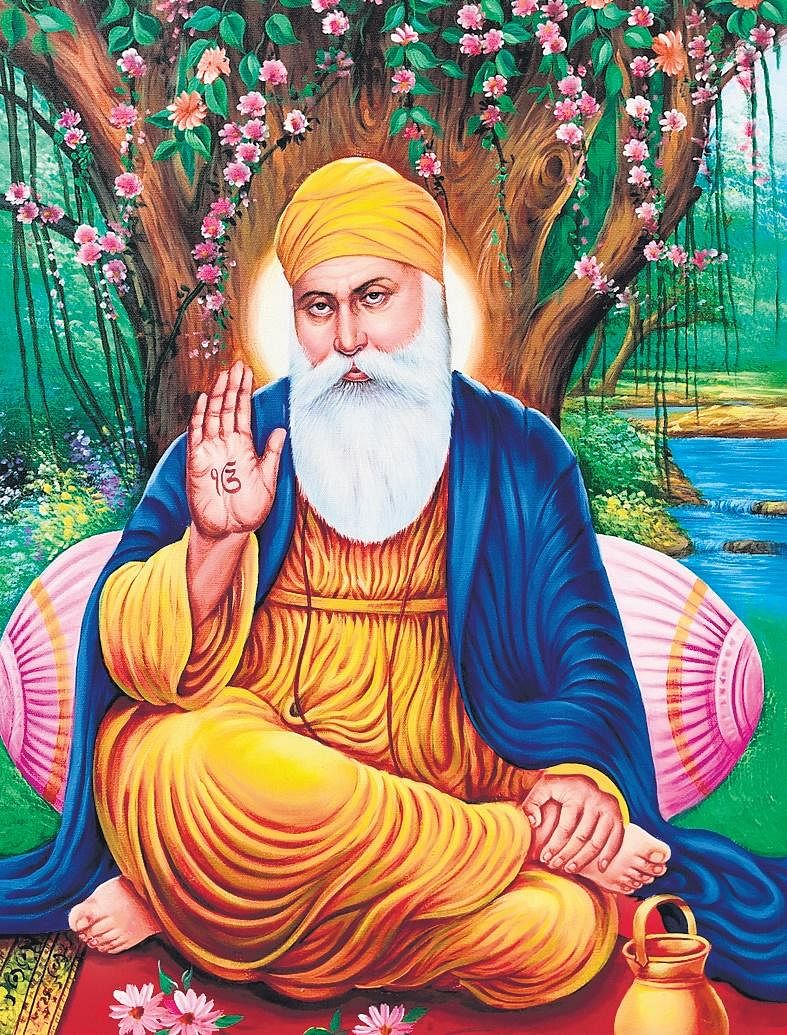
Guru Nanak
GuruWikipedia
213
MENTIONS
28
EPISODES
17
PODCASTS
Search complete. 213 mentions across 28 episodes found for "Guru Nanak".
Sep 19, 2026

speaker_1HOST
Remember one thing, at some point, Shri Chand Varga also said that our grandfather was the grandfather of our grandfather.
speaker_1HOST
Guru Angad said the following, Baba Nanak used to say to Shree Chand, that my father is Guru Nanak.
speaker_1HOST
Guru Angad said, if your father is Guru Nanak, then why don't you go to your father's place and ask him for money.
speaker_1HOST
So this is also something to think about, that how much money we have to spend here.

Alok PandeyHOST
Because you have to get rid of pride.
Alok PandeyHOST
Guru Nanak says very interestingly.
Alok PandeyHOST
He says, Sadho man ka maan tyago.
Alok PandeyHOST
Kaam grodh sangati durjan ki.

Satpal SinghGUEST
We demote Sikhi when we just say, oh there's all these other religions, we're also a book religion.
Satpal SinghGUEST
I don't think Guru Nanak Dev Ji was doing that.
Satpal SinghGUEST
He never was trying to convert people into Sikhi.
Satpal SinghGUEST
And I don't think we've understood Sikhi in that way, that we are not trying to sell you another religion.
26 MINS LATER
Satpal SinghGUEST
This would be an interesting video.
Satpal SinghGUEST
And I remember looking at all the other passengers on the train and looking at people from all different communities and thinking, I wonder what this person is going through.
Satpal SinghGUEST
I wonder what Guru Nanak Sikhi would say to help this person or that person.
Satpal SinghGUEST
So that's kind of how my idea formulated very early on that whatever I was experiencing was not exclusive to Sikhs.

John GreenHOST
For example, Sikhism is one of the most practiced religions in the world, but one that often gets left out of the conversation about major religions.
John GreenHOST
It originated in 16th century India from the teachings of Guru Nanak, who preached about the oneness of God and the equality of all people.
John GreenHOST
But Sikhs are in the minority in India, where they've faced harassment, persecution, and violence.
John GreenHOST
And in the United States, misunderstandings and prejudice have also led to attacks on members of the Sikh community.

David Patrick HarryHOST
And Sikhism is an interesting mix between Islam and Hinduism.
David Patrick HarryHOST
So Guru Nanak, it's the, they wear like the swords and stuff.
David Patrick HarryHOST
Actually, you know, the British kid that was stabbed, the guy that had the Kapoor, his sword, they have the 5Ks, the Sikhs.
David Patrick HarryHOST
He was Sikh.
1 HR 37 MINS LATER
David Patrick HarryHOST
So they were surprised.
David Patrick HarryHOST
I knew about the five Ks.
David Patrick HarryHOST
I knew about Guru Nanak.
David Patrick HarryHOST
I knew about their customs.
John GreenHOST
And he wasn't the only one.
John GreenHOST
From Muhammad to the Buddha to Guru Nanak, many religions owe much of their popularity today to early charismatic leaders.
John GreenHOST
And because of this, the boundary between an institutional religious leader and a charismatic unofficial one is often kind of blurry.
John GreenHOST
Let's go to the Thought Bubble.

LernerHOST
The text concludes with this line.
LernerHOST
It says, Nanak, this is the opportunity to meet the Lord.
LernerHOST
Why don't you remember him in meditation?
speaker_1HOST
And just to quickly clarify the authorship here, the text states, says Nanak.
speaker_1HOST
Manak was the first Sikh guru, but subsequent gurus, including Guru Tegh Bahadur Ji, who wrote the specific text, they use the name Nanak in their writings.
LernerHOST
Oh, interesting.
speaker_1HOST
Yeah.

Satpal SinghHOST
That self-importance, me, me, me.
Satpal SinghHOST
Guru Nanak categorically teaches you meditation is the opposite of me.
Satpal SinghHOST
Your ego and the divine name are in conflict with each other.
Satpal SinghHOST
Both cannot exist in one place.
Satpal SinghHOST
And this leads on to the question around what type of meditation should we be doing and how long should we be doing it.
Satpal SinghHOST
One of the things that we have been taught again and again from the yogic traditions is that you need to silence your mind.
Satpal SinghHOST
Guru Nanak's tradition does not look to silence your mind.
Satpal SinghHOST
And I think this needs to be clarified.
speaker_3AUDIENCE
You sort of touched on it a bit and what you were saying earlier about emptiness.
speaker_3AUDIENCE
I want to know what I guess Guru Nanak and the other gurus spoke about when it comes to what to look for in a person and I ask this because if you look at modern culture it almost feels like we're looking for the divine in another person and you know all the things that we what requirements people have of relationships it just seems impossible and I don't think the gurus were ever looking for their soul mate so I want to know what Sikhi teaches about this So the question is around
Satpal SinghHOST
what to look for in a partner? Yeah, for marriage.
Satpal SinghHOST
What are the qualities to look for in a partner? The Sikh tradition is relatively quiet about marriage and what to look for in a life partner.
11 MINS LATER
Satpal SinghHOST
There are people who blame their past lives when they can't blame anyone else.
Satpal SinghHOST
There are people who don't know who to blame because they don't believe in a God, but they're still walking around with pain.
Satpal SinghHOST
So Guru Nanak and the teachings say do not focus on blame.
Satpal SinghHOST
If you are going to blame anyone, blame your confused mind.

Amar SinghHOST
So you translate cons as stages.
Amar SinghHOST
Now, why did you go with stages rather than rounds and does changing some of those words risk impacting the philosophy that Guru Nanak Dev Ji is proposing and the reason I ask that in relation to this is because with realms you could argue Guru Nanak Dev Ji is providing some type of cosmological order and then if you say stages I guess it kind of is the same but it doesn't necessarily carry the same meaning so how do you balance all of that and then also try to get as close to What some people may argue is the original meaning, although even that is down to interpretation.
Satpal SinghGUEST
So one of the things that I did was when I was looking at the Barney, what was important for me was in translating this, I wanted to find a way to make the verses have a sequence.
Satpal SinghGUEST
And in the Japji Sahib, what I would look at is when you look at the entire verse, what is the one question that it looks like it's answering? So that's how I would place a question before it.
Satpal SinghGUEST
So then the next verse is asking the question, well, what are these steps? And you realize that then the khans can be presented as steps rather than a cosmology.
Satpal SinghGUEST
We can go into a conversation about cosmology.
Satpal SinghGUEST
I fundamentally don't believe Guru Nanak is presenting a cosmology.
Satpal SinghGUEST
I believe he presents a philosophy that works regardless of your cosmology.
18 more episodes mention Guru Nanak.
Create an account to see the whole feed, search across every transcript, and follow the entities you care about.