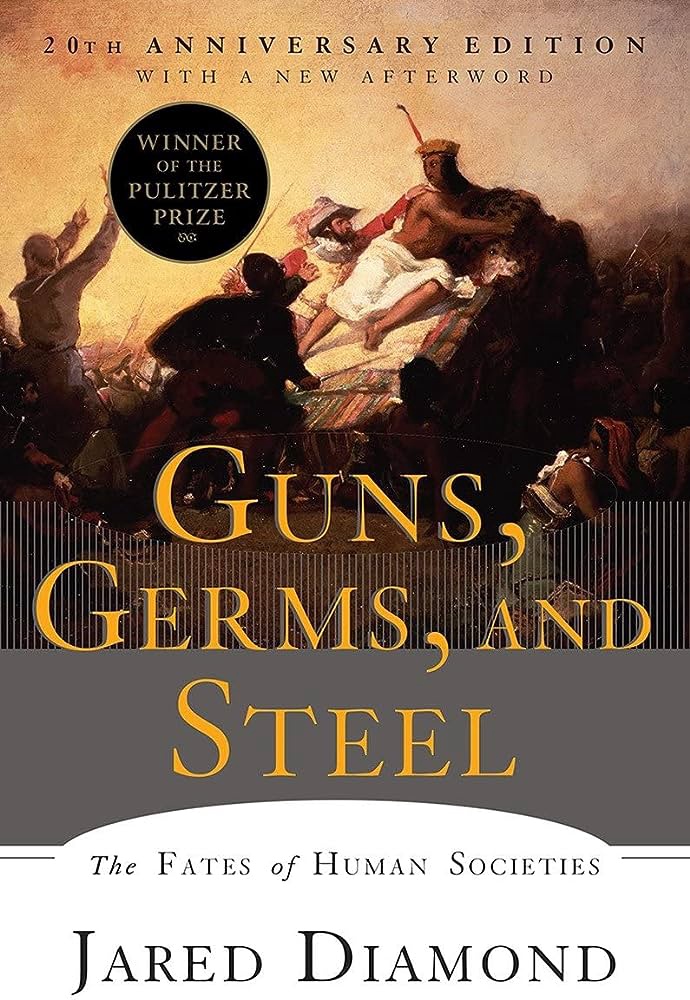
Guns, Germs, and Steel: The Fates of Human Societies
Book by Jared DiamondWikipedia
44
MENTIONS
18
EPISODES
16
PODCASTS
Search complete. 44 mentions across 18 episodes found for "Guns, Germs, and Steel: The Fates of Human Societies".
Sep 11, 2026

Francis TaponHOST
It's a little bit off topic here.
Francis TaponHOST
Another one is Guns, Terms, and Steel, which won him the Pulitzer Prize.
Francis TaponHOST
But I found that when I read that, I was like utterly unconvinced by how strong his argument was.
Francis TaponHOST
You know, he basically posits that geography kind of determines destiny to a large extent.
Francis TaponHOST
And to me, it's much more nuanced and complicated than that.
Francis TaponHOST
And he, you know, he's a geographer and kind of like every, you know, that's your only, if the hammer is your only tool, then everything looks like a nail.
Francis TaponHOST
And that's the kind of thing that he does in that book, Guns, Terms and Steel, where he just tries to explain everything in the world with just this one thing, geography.
Francis TaponHOST
And it's a bit more complicated than that.

Scott RankHOST
The Treaty of Versailles and hyperinflation had already created the conditions for catastrophe, and you mix in a bunch of other latent factors present, and the same thing would have resulted.
Scott RankHOST
So who's right? Is history guided by great men of history, or is it large systems that direct things, like Tolstoy would say in War and Peace? In today's episode, I'm speaking to Jared Diamond, who previously wrote Guns, Germs, and Steel, and is the author of a new book that looks at this question directly and asks who's right.
Scott RankHOST
And the answer is, it depends on the circumstances, and there's not a one-size-fits-all answer, but we can mostly test for it to see whether the leader or society matters more.
Scott RankHOST
Jared's new book is Prophets, Profits, Coaches, and Kings: When Do Leaders Matter? We discuss how the inbreeding of European royal families created a natural experiment proving that monarchs' intelligence directly affected national outcomes, why Botswana's founding president is the clearest modern example of an irreplaceable leader because only he could have given away his own tribe's diamond rights without starting a civil war, and why Genghis Khan's conquests depend on rainfall patterns revealed by tree rings.

Tyler CowenHOST
Do you think that suggests a vision of the world where it's ideas that really matter and somewhat at variance with your own geography-based theories?
Jared DiamondGUEST
My own geography-based theories, people often say, "Jared, have you changed your mind? Here, here's this book about individuals, and your other books, Guns, Germs, and Steel, and so on, are about whole societies for ten thousand years." No, I haven't changed my mind.
Jared DiamondGUEST
It's that I'm asking different questions.
Jared DiamondGUEST
For questions such as, why is it that you and I are now speaking the English language, and you and I evidently of European background, but we're standing on land of Native Americans? That's long-term history.
Jared DiamondGUEST
So that's a question whose answer does not depend upon individual leaders.
Jared DiamondGUEST
Whereas if you want to know why Amazon is now the largest everything store, a store that cares so much about individual customers and doesn't care about paying dividends to its investors, that has everything to do with one person, Jeff Bezos.
Tyler CowenHOST
Is it correct to think of your new book, again, Prophets, Prophets, Coaches, and Kings, as in essence the error term? For Guns, Germs, and Steel?
Jared DiamondGUEST
No, I would just say it's a different book about a different question on a different time scale.

speaker_0NARRATOR
He says he's simply asking different questions on different timescales.
speaker_0NARRATOR
His books like Guns, Germs, and Steel focus on why societies rose through plants, animals, and location over millennia.
speaker_0NARRATOR
This new book examines shorter-term outcomes, like the distinct effect Jeff Bezos had on Amazon.
speaker_0NARRATOR
And he does name specific leaders as significant.

Sean CarrollHOST
We talk a little bit in the podcast about what it means to be a big picture interdisciplinary scientist.
Sean CarrollHOST
And of course he had a very famous book, Guns, Germs, and Steel back in like 1997 I think it was where a very famous big hit, you know a lot of people read it, I read it, won the Pulitzer Prize and it put forward the idea that you know you can't argue that certain areas of the world, certain continents and countries and things like that have kind of dominated a little bit in the last few centuries, have you know taken over other areas and why is that? Is it because the people are just especially clever or have more initiative or whatever? And Diamond argued that no, it had nothing to do, almost nothing to do with the differences between the people in one area or another.
Sean CarrollHOST
It had more to do with geography and the environment, the ability to do agriculture on large scales, the ability to have enough land, enough natural resources, different kinds of plants but then also different kinds of metal and the guns in the title and of course germs, the ability to maintain immunity or resistance to certain diseases that other people elsewhere didn't have.
Sean CarrollHOST
So it was sort of a story where individuals didn't make much of a difference in that big picture sweep.
Sean CarrollHOST
Uh, and I'll, I'll put a link to the book, of course, in the show notes.
Sean CarrollHOST
But famously, you've written other books, and I wanted to kind of use your previous books just as an intro to get into the new one.
Sean CarrollHOST
So, um, many of us have read Guns, Germs, and Steel, for example.
Sean CarrollHOST
Uh, that was a big hit.

Timothy C. WinegardGUEST
So the books you always see in the airport, there's only a select few.
Timothy C. WinegardGUEST
So you get Guns, Germs and Steel and Sapiens, these, you know, these Mary Roach's Grunt or these kind of general books for the masses.
Timothy C. WinegardGUEST
I call them airport books because it's the only ones that are ever in those stores.
Timothy C. WinegardGUEST
And so we sat down and my dad's a medical emergency doctor.

Jared DiamondGUEST
And I acknowledge that individual people can make a difference in politics and in business and in sports and in religion and probably in science and in art.
Jared DiamondGUEST
At the opposite extreme though, Guns, Germs, and Steel had nothing to say about individual leaders, and I was explicit there.
Jared DiamondGUEST
Guns, Germs, and Steel is about the history of the whole world over the last 12,000 years, and it's about the history of large parts of the world.
Jared DiamondGUEST
Over the course of 12,000 years, one individual could not make a difference in the growth of societies in different parts of the world, because growth of societies in different parts of the world depended ultimately on agricultural productivity, on population growth, and agricultural and animal productivity depended upon whether any area had the right plants and animals to domesticate.
Jared DiamondGUEST
No Aboriginal Australian could have propelled Aboriginal Australia to develop atomic bombs in writing, because Australia still today has no domesticable animals.
Jared DiamondGUEST
Aboriginal Australians didn't develop farming.
Jared DiamondGUEST
There were a minimum of domestical plants.
Jared DiamondGUEST
In short, then, Guns, Germs, and Steel was about the history of large areas of the world over the last 10,000 years where...

Jared DiamondGUEST
Great pleasure to meet you.
Joe RoganHOST
I really enjoyed Guns, Germs, and Steel, and, uh, I just got into this yesterday, uh, and today.
Joe RoganHOST
I, I started reading your new book.
Joe RoganHOST
Uh, awesome.
29 MINS LATER
Joe RoganHOST
Yes.
Jared DiamondGUEST
And so Mormonism has done well at, at spreading in Europe and the Pacific.
Jared DiamondGUEST
There's one other thing that, that I'd, I'd like to say here, um, and that is that, that people often ask me, um, "Jared, 'Guns, Germs, and Steel,' um, neglects individual people.
Jared DiamondGUEST
It's about things that happened over the last 10,000 years, um, and 'Guns, Germs, and Steel,' the different outcomes of societies in different continent has nothing to do with any individual." Um, whereas here you've written a book about leaders, about individuals.

Pyrion FlaxHOST
I mean, I know I read it was it was a discredited book by a guy called Jared Diamond.
Pyrion FlaxHOST
I think it's called it was called Guns, Germs and Steel and is apparently certainly from all the historians I've spoken to about it.
Pyrion FlaxHOST
Complete bullshit.
Pyrion FlaxHOST
But he does ask some interesting questions.
speaker_0NARRATOR
You know, when history seems to turn on a single person, the real story is often more complicated.
speaker_0NARRATOR
Take the Joe Rogan interview with Jared Diamond, the author of Guns, Germs, and Steel.
speaker_0NARRATOR
They dove into leadership, religion, language, and what Diamond calls the fragile machinery of civilization.
speaker_1NARRATOR
Right.
speaker_1NARRATOR
And when Rogan joked about Mormonism and community discipline, Diamond made this sharp observation that the teachings are often secondary to structure, literacy, and commitment.
speaker_1NARRATOR
It's the system, not just the message.
speaker_0NARRATOR
Which connects to how Rogan challenged him about guns, germs, and steel.
speaker_0NARRATOR
How do you reconcile a book about long-term environmental forces with a new focus on individuals?
8 more episodes mention Guns, Germs, and Steel: The Fates of Human Societies.
Create an account to see the whole feed, search across every transcript, and follow the entities you care about.