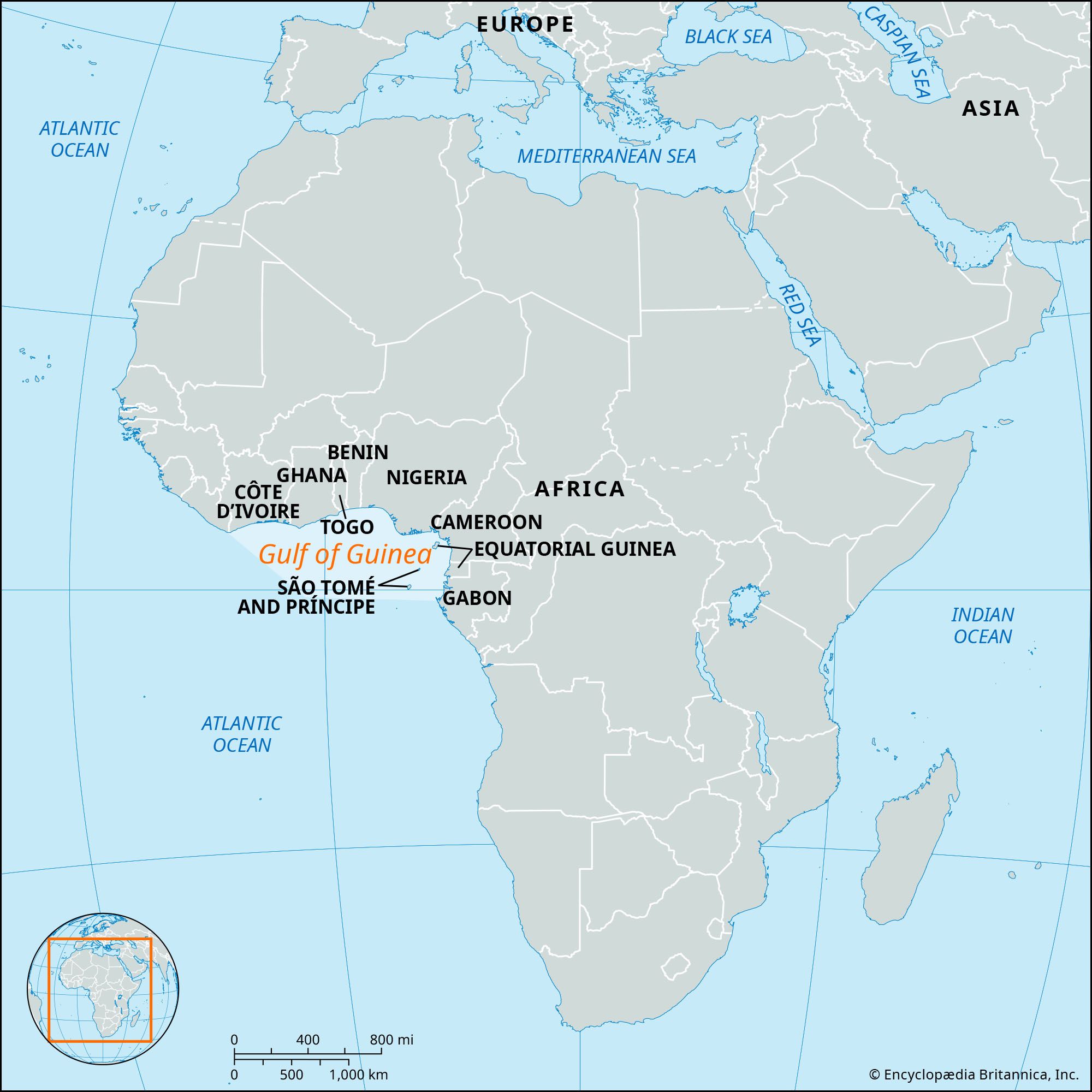
Gulf of Guinea
GulfWikipedia
55
MENTIONS
26
EPISODES
24
PODCASTS
Search complete. 55 mentions across 26 episodes found for "Gulf of Guinea".
Oct 30, 2026

speaker_1NARRATOR
In another instance, Binger reports that an African intermediary placed various lengths of straw on the ground to indicate the distances between localities in the Kong region.
speaker_1NARRATOR
In his exploration of the area between the Niger River and the Gulf of Guinea in the early 1890s, Navy Lieutenant Jean-Baptiste Marchand routinely collected route information from local inhabitants about places he could not visit.
speaker_1NARRATOR
This locally sourced route information, as he described it, appears as dashed lines on his landmark map of the region.
speaker_1NARRATOR
The routes of Marchand and other European explorers appear as solid lines.

Priya ManiGUEST
So literally every recipe in Spiced has a connect to a real person, someone I've met somewhere and I've learned something from them and I think that to me was immensely important.
Gilly SmithHOST
After her huge success with the Visual Encyclopedia of Indian Food, an A to Z, Spiced is a groundbreaking deep dive into a whole world of spices, from Norway to the Greek islands, Yunnan province to the Gulf of Guinea.
Gilly SmithHOST
With essays from friends and esteemed colleagues and a foreword from Harold McGee, this is a modern classic.
Gilly SmithHOST
I began by asking her how she got such a luminary in food science to add his weight to such a project.

Walt GoletGUEST
Some of them just go down into the Slope C and they come right back again, whereas others go all the way to the Med and come back.
Walt GoletGUEST
We also have a contingent of fish now, some really good data of these fish going to Morocco off of Western Africa, even in the Northern reaches of the Gulf of Guinea off of that region, Cape Verde and things like that.
Walt GoletGUEST
So those are some of the kind of the neat things.
Walt GoletGUEST
I don't know if it's a surprise as much as it is just a really cool finding, the application of close kin to determine population abundance and how that population estimate came out a fair bit different than our standard assessments have come out.

James FanellGUEST
Chinese warships operating in the Mediterranean and the Baltic.
James FanellGUEST
in the Atlantic, the Gulf of Guinea.
James FanellGUEST
So they're now pushing out and achieving their goal of becoming a global navy, which matches Xi's global security initiative and global governance initiative desire to end states.
Kerry DunstCORRESPONDENT
And as we start to finish up, to those who think that we overblow the threat of China or maybe don't think it's a top three thing that should be discussed amidst all the other things that are happening with elections, et cetera, how do you frame that to those types of people? And with the secretary now at the ASEAN meeting, how important are our local partnerships so that we don't have to act alone?

John Dramani MahamaSOUNDBITE_SPEAKER
Ghana offers opportunities in cocoa, cashew, shea nuts, horticulture, mineral processing and manufacturing.
John Dramani MahamaSOUNDBITE_SPEAKER
Our institutions and our strategic location on the Gulf of Guinea provides a foundation for investment.
John Dramani MahamaSOUNDBITE_SPEAKER
And as host of the Secretariat of the African Continental Free Trade Area, Ghana is also well-placed to support businesses seeking opportunities across the continent.
John Dramani MahamaSOUNDBITE_SPEAKER
in accordance with the agreement's rules and implementation arrangements.

speaker_0NARRATOR
In his sermon, Padgett said, quoting, As the state of those in hell is described by a worm that torments them and never dieth, so those that live in this torrid zone in guinea have often and ordinarily a worm of strange and incredible length that breedeth in their flesh as those that travel thither have both seen and felt and in their flesh have brought home from thence unto their own countries and have had the same drawn out from under their skin after their return end quote As the association with Africa grew, the name guinea worm began to emerge as a common term for the disease.
speaker_0NARRATOR
By the 18th century, English-speaking Europeans documented high rates of this parasite along the Gulf of Guinea, especially in present-day Ghana and Nigeria.
speaker_0NARRATOR
However, this was not the sole reason for the name.
speaker_0NARRATOR
When enslaved Africans were transported to the New World, many carried the disease.
speaker_0NARRATOR
These factors ultimately led British doctors to associate the disease with the Guinea region.
speaker_0NARRATOR
A widely circulated myth claims an unnamed Swiss traveler first named the parasite after visiting Africa's west coast in 1611.
speaker_0NARRATOR
However, the name Guinea Worm likely became established due to repeated reports of enslaved people from the Gulf of Guinea experiencing its symptoms in Europe and the Caribbean, rather than from a single declaration.
speaker_0NARRATOR
Regardless of its origins, the name persisted and remained widely used until 1726, when British physician Richard Towne formally explained its meaning and origins in writing.
James FanellGUEST
We're seeing Chinese vessels operate in the Gulf of Aden on a day-for-day basis since December of 2008.
James FanellGUEST
Chinese warships operating in the Mediterranean, in the Baltic, in the Atlantic, the Gulf of Guinea.
James FanellGUEST
So they're now pushing out and achieving their goal of becoming a global navy, which matches Xi's global security initiative and global governance initiative desire to end states.
KerryHOST
And as we start to finish up, to those who think that we overblow the threat of China or maybe don't think it's a top three thing that should be discussed amidst all the other things that are happening with elections, et cetera, how do you frame that to those types of people? And with the secretary now at the ASEAN meeting, how important are our local partnerships so that we don't have to act alone?

Chris ChristensenHOST
Why are we going there?
Rebecca MerrellGUEST
So the unique part about these two countries, which reside on the equator in the Gulf of Guinea... are the amazing wildlife that they have to offer in Gabon.
Rebecca MerrellGUEST
And in São Tomé, São Tomé was a former Portuguese colony where they planted a lot of cacao and coffee.
Rebecca MerrellGUEST
So it is... known as the Chocolate Islands.

speaker_2NARRATOR
You follow the trade winds east and south, past the bulge of West Africa.
speaker_2NARRATOR
past the Gulf of Guinea, past the equatorial forests of the Congo Basin, and you arrive at the Zambezi River, where it forms the border between Zambia and Zimbabwe.
speaker_2NARRATOR
The river here is wide.
speaker_2NARRATOR
It moves with a deceptive calm, spreading across a broad floodplain lined with riverine forest.

speaker_0HOST
Especially near Nigeria.
speaker_1HOST
Yeah, particularly the ones splaying out into the Gulf of Guinea right near Nigeria.
speaker_1HOST
These huge cracks and fissures in the Earth's crust created these sort of shielded gullies and deep open basins on the ancient seafloor.
speaker_0HOST
Like natural traps.
16 more episodes mention Gulf of Guinea.
Create an account to see the whole feed, search across every transcript, and follow the entities you care about.