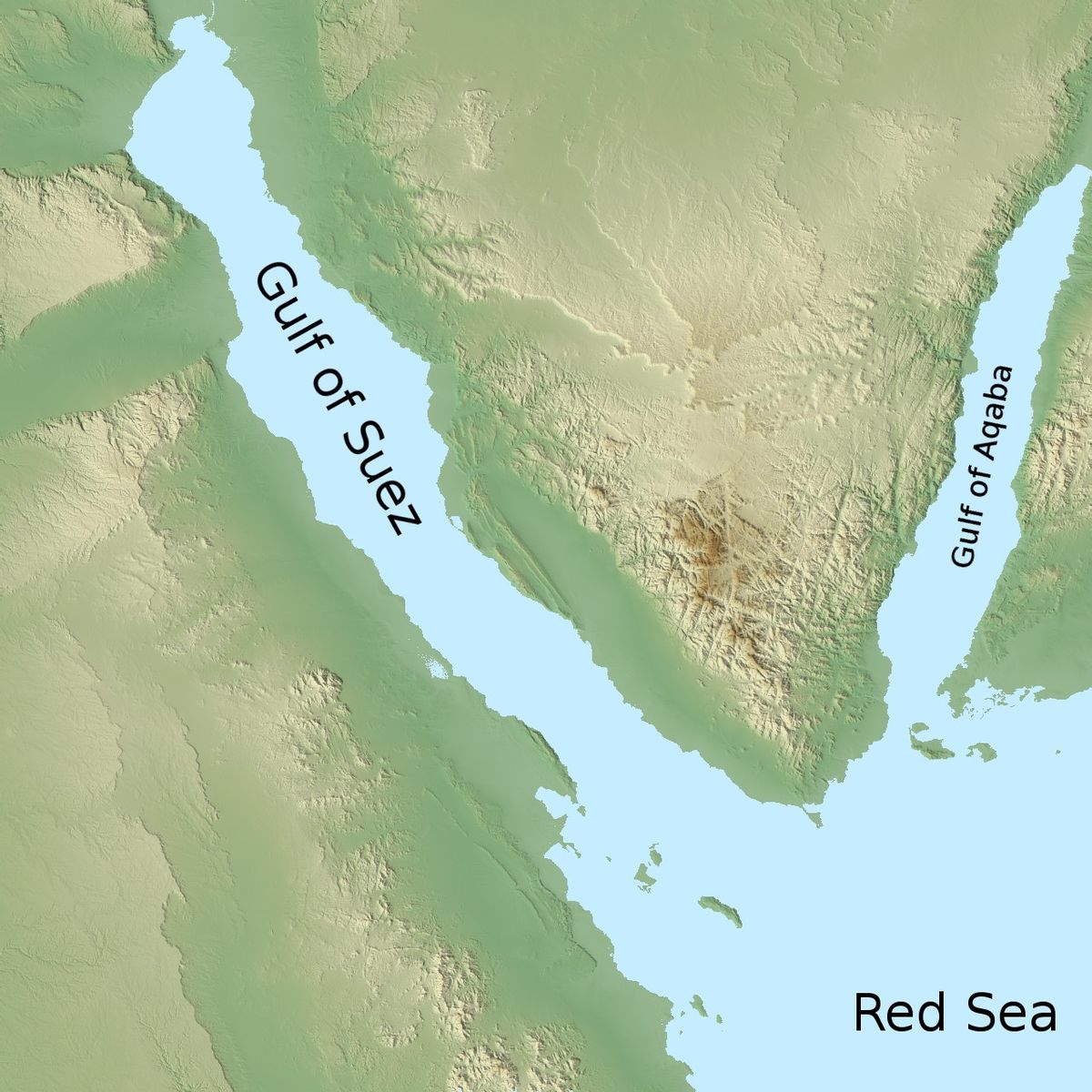
Gulf of Aqaba
GulfWikipedia
50
MENTIONS
37
EPISODES
36
PODCASTS
Search complete. 50 mentions across 37 episodes found for "Gulf of Aqaba".
Sep 21, 2026

SalHOST
Matter of fact, I will go ahead and for those that aren't familiar with it, we'll go ahead and share that on the live chat.
SalHOST
It's right there where you come out of the Red Sea and go into the Gulf of Aqaba.
SalHOST
And that was anything coming from the Pacific, the need to get to Israel, needs to go through that strait.
SalHOST
And kind of, it's even tighter than the southern entrances of the Red Sea.

Jay ShapiroHOST
The ink flag, that image became one of the defining photographs of the War of Independence.
Jay ShapiroHOST
The Negev Brigade Commander at that time, Sarig, and Golani Brigade Commander, Nochem Golan, later transmitted a message to the Israeli government announcing that the brigades were presenting the Gulf of Eilat to the State of Israel as a gift.
Jay ShapiroHOST
So this Yohanan El Yishuv as one of the last survivors of the War of Independence, died this week at the age of 95, and I think that's something that should be noted.
Jay ShapiroHOST
Now, I want to go on to another topic.

Preston StewartSOUNDBITE_SPEAKER
and saying that is the reason for this retaliation because the Americans killed our own civilians.
Preston StewartSOUNDBITE_SPEAKER
They say in response to this heinous act, the brave fighters of the IRGC launched a heavy barrage of ballistic missiles at the American Marine Base in Jordan, known as Camp Titan, located on the coast of the Gulf of Aqaba.
Preston StewartSOUNDBITE_SPEAKER
A large number of American forces were neutralized and several important facilities and enemy attack helicopters were destroyed.
Preston StewartSOUNDBITE_SPEAKER
Now, we did see some footage from Jordan earlier tonight that appears to show missiles bypassing air defense.

Daniel TurnerGUEST
Another same little narrow passage to get into the Red Sea.
Daniel TurnerGUEST
Problem there, or the Gulf of Aqaba, actually, but same idea.
Daniel TurnerGUEST
The problem there, though, is that now you have these Houthi rebels.
Daniel TurnerGUEST
And we've heard that name a bunch, the Houthi rebels, the Houthi rebels in Yemen.

James CrosslandHOST
And he builds what are basically kit ships, five of them, I think.
James CrosslandHOST
and transports them on camelback across the desert to the Gulf of Aqaba, builds these ships up, launches them into the Red Sea, and starts plundering and destroying coastal ports, ships.
James CrosslandHOST
His raiders are sent inland into what is today Saudi Arabia to threaten Mecca, the holiest site of Islam.
James CrosslandHOST
And eventually Saladin, you know, because Saladin is not expecting this.

Jacob PraschHOST
That was another factor.
Jacob PraschHOST
They wanted Israel involved in this kind of sharing of an economic development of major proportions that would take place at the northern end of the Gulf of Aqaba.
Jacob PraschHOST
The Saudis wanted to have something where there would not be strict Sharia, so it had to be far from Mecca and Medina, that would be a Saudi response to Abu Dhabi and to Dubai.
Jacob PraschHOST
They did not want to lose that kind of a commercial position to the Emirates, so they tried to build their own, and they would have benefited tremendously from Israeli participation in that.

Isaac ZileSOUNDBITE_SPEAKER
Now, in order to understand this move from Nasser, we have to go back to 1956, when Israel illegally invaded Egypt and only withdrew from Egyptian territory after Egypt accepted the aforesaid UN emergency force to be stationed in Sharm el-Sheikh to physically guarantee free Israeli
speaker_5SOUNDBITE_SPEAKER
passage through the Straits of Tehran and in and out of the Gulf of Aqaba.
Isaac ZileSOUNDBITE_SPEAKER
Prior to Israel's 1956 invasion, as we've already been over, Nasser pointed to the overarching state of war between Israel and Egypt to justify refusing Israel its peacetime rights, including free passage through Egypt's territorial waters.
Isaac ZileSOUNDBITE_SPEAKER
Since no formal peace treaty was signed after the 1948 war and only a ceasefire was put in place, Nasser argued that he was legally entitled to do this.
Isaac ZileSOUNDBITE_SPEAKER
Article 16 of this Convention explicitly expanded the traditional definition of a strait to accommodate the Straits of Tehran.
Isaac ZileSOUNDBITE_SPEAKER
Believe it or not, the Straits of Tehran, despite their name, weren't clearly legally considered straits at the time because they don't connect two open high seas, which was the legal requirement.
Isaac ZileSOUNDBITE_SPEAKER
Instead, they connected the high seas to the Gulf of Aqaba and then Israeli territorial waters while running through sovereign Egyptian territorial waters.
Isaac ZileSOUNDBITE_SPEAKER
It was because of this, Nasser argued that Egypt had the right to assert belligerent jurisdiction and refuse Israeli peacetime access through Egyptian territorial waters.

Phil FieldsHOST
From the laying of the foundation of the Lord's temple to its completion, all the work had been successful.
Phil FieldsHOST
Then Solomon went to Ezion-Geber and Elath, ports on the shore of the Gulf of Aqaba in the land of Edom.
Phil FieldsHOST
King Hiram sent him ships under the command of his own officers and with experienced sailors.
Phil FieldsHOST
They sailed with Solomon's officers to the land of Ophir and brought back to Solomon about 16 tons of gold.

speaker_7GUEST
Many of the archaeologists talk in terms that there must have been a single location where the crops were domesticated.
speaker_7GUEST
And so we see the 10 probable centers of domestication running down from Turkey down to the Gulf of Aqaba, where we're finding the very earliest seeds and the dates for those bees.
speaker_7GUEST
So we have a package of the bees, the beans, the vetches, the fig, the wheats, the barleys.
speaker_7GUEST
all in that area.
27 more episodes mention Gulf of Aqaba.
Create an account to see the whole feed, search across every transcript, and follow the entities you care about.