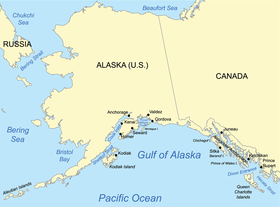
Gulf of Alaska
Body of waterWikipedia
82
MENTIONS
51
EPISODES
31
PODCASTS
Search complete. 82 mentions across 51 episodes found for "Gulf of Alaska".
Oct 30, 2026

speaker_4NARRATOR
accounts differ on how much sight matters and later tags found active pursuit guided by sound with no steady body angle of the kind that hunting for silhouettes against the light above would need one sperm whale was caught on camera at close range though in an unusual setting.
speaker_4NARRATOR
In the Gulf of Alaska, a whale came in to a fishing longline carrying sablefish, also called black cod, and a camera and a microphone caught it at the same moment.
speaker_4NARRATOR
The whale was side-on to the camera.
speaker_4NARRATOR
It sat at a known distance as it touched the line, so the stretch from the tip of its nose to the hinge of its jaw could be worked out, and from that, its total length.

speaker_0NARRATOR
It stretches from the Alaska Range in the north to the Talkeetna Mountains in the east and the rolling hills of the western interior, an area roughly the size of West Virginia, with a population that could fit in a mid-sized high school gymnasium.
speaker_0NARRATOR
To the southeast, the Chugach Mountains form another wall of ice and rock, younger and more compressed than the Alaska Range, pushed up by the same tectonic forces, but closer to the coast, so they catch the moisture-laden air coming off the Gulf of Alaska and convert it into staggering amounts of snow.
speaker_0NARRATOR
The Thompson Pass area near Valdez holds the Alaska record for snowfall in a single season, eighty-one feet in the winter of 1952 to 1953.
speaker_0NARRATOR
That is not a typo.
speaker_0NARRATOR
Eighty-one feet of snow in one winter.
speaker_0NARRATOR
The weight of that snow compresses into the glaciers that flow down from the Chugach peaks, and those glaciers, in turn, carve into Prince William Sound and the coastal fjords, dropping house-sized chunks of ice into water that is 38 degrees Fahrenheit and will kill an unprotected human in about 15 minutes.
speaker_0NARRATOR
Beyond the Chugach, Cook Inlet opens toward the Gulf of Alaska, a body of water known for some of the most extreme tidal variations in the world, tides that can swing 35 feet between high and low, exposing miles of mudflats that look like solid ground but behave like quicksand, trapping anyone who steps onto them and holding them in place while the tide comes back in at a pace that can outrun a person on foot.
speaker_0NARRATOR
To the north of the Alaska Range, the interior stretches toward the Brooks Range and the Arctic.

Fritz ColemanGUEST
And now you have atmospheric rivers where it's just this constant deluge from the north.
Fritz ColemanGUEST
Most of our storms come from the Pacific Northwest and in the Gulf of Alaska and then work their way southeast.
Fritz ColemanGUEST
And they do these hookups.
Fritz ColemanGUEST
They used to call them a pineapple express because they would be a plume of moisture from Hawaii up to Southern California.

Don DayCORRESPONDENT
Yeah, there's a lot going on.
Don DayCORRESPONDENT
Really? Yeah, the Gulf of Alaska, the northern, the polar jet, we call it, it's getting more busy.
Don DayCORRESPONDENT
And so as we go into the end of October, into early November, the Pacific is going to be throwing stuff at us.
Don DayCORRESPONDENT
It's going to keep us busy.

Dennis BraggHOST
We've seen that sort of split track.
Dennis BraggHOST
where we're getting the moisture coming up out of the Great Basin in the southwest, and then we're getting the cold air and the moisture coming from, you know, our normal course out of Alaska, the Gulf of Alaska, and then occasionally coming across the divide from Canada.
Dennis BraggHOST
So we have, like, all three in play right now.
Nick ChristensenHOST
For those that don't know what an El Nino is, like, what should we, what are they kind of predicting for winter just in general?

Spencer ChristianCORRESPONDENT
As a matter of fact, we've got calm conditions once again today, much like we had yesterday.
Spencer ChristianCORRESPONDENT
But you can see up north up at the Gulf of Alaska.
Spencer ChristianCORRESPONDENT
As a matter of fact, we have a low pressure system and some clouds moving slowly southward in our direction so we will have changes in our weather pattern by the middle of the week and certainly by the end of the upcoming week.
Spencer ChristianCORRESPONDENT
But right now we've got bright and breezy conditions with gusts up to 24 miles per hour in Hayward, but just generally breezy in other locations right now.

RebeccaHOST
We're also seeing some strong winds out in the west as well.
RebeccaHOST
We kind of have a pressure gradient going on with a low pressure system way out in the Bering Sea right here, bringing 78 mile per hour winds into Shemya and even down into the Gulf of Alaska.
RebeccaHOST
That's where we're watching a high pressure system.
RebeccaHOST
So again, that's kind of why we're seeing such strong winds right in this pressure gradient here.

Joanne RideoutHOST
And that will bring showers and cool temperatures to our region.
Joanne RideoutHOST
Then he says, we also have an intense upper level low over the northern Gulf of Alaska.
Joanne RideoutHOST
And Cliff says this is the perfect configuration to further moisten our region.
Joanne RideoutHOST
Like I said, sometimes our weather comes to us from up in the Alaska area.
Spencer ChristianCORRESPONDENT
We will be again tomorrow as high pressure is still the dominant feature in our weather.
Spencer ChristianCORRESPONDENT
However, over the next couple of days, we'll see low pressure dropping down from the Gulf of Alaska.
Spencer ChristianCORRESPONDENT
That's going to bring us cooler weather and an increasing cloudy pattern.
Spencer ChristianCORRESPONDENT
starting Monday.
speaker_3NARRATOR
To the southeast, the Chugach Mountains form another wall of ice and rock.
speaker_3NARRATOR
Younger and more compressed than the Alaska Range, pushed up by the same tectonic forces but closer to the coast, so they catch the moisture-laden air coming off the Gulf of Alaska and convert it into staggering amounts of snow.
speaker_3NARRATOR
The Thompson Pass area near Valdez holds the Alaska record for snowfall in a single season, eighty-one feet in the winter of 1952 to 1953.
speaker_3NARRATOR
That is not a typo.
speaker_3NARRATOR
Eighty-one feet of snow in one winter.
speaker_3NARRATOR
The weight of that snow compresses into the glaciers that flow down from the Chugach peaks, and those glaciers, in turn, carve into Prince William Sound and the coastal fjords, dropping house-sized chunks of ice into water that is thirty-eight degrees Fahrenheit and will kill an unprotected human in about fifteen minutes.
speaker_3NARRATOR
Beyond the Chugach, Cook Inlet opens toward the Gulf of Alaska, a body of water known for some of the most extreme tidal variations in the world, tides that can swing thirty-five feet between high and low, exposing miles of mudflats that look like solid ground but behave like quicksand, trapping anyone who steps onto them and holding them in place while the tide comes back in at a pace that can outrun a person on foot.
speaker_3NARRATOR
To the north of the Alaska Range, the interior stretches toward the Brooks Range and the Arctic.
41 more episodes mention Gulf of Alaska.
Create an account to see the whole feed, search across every transcript, and follow the entities you care about.