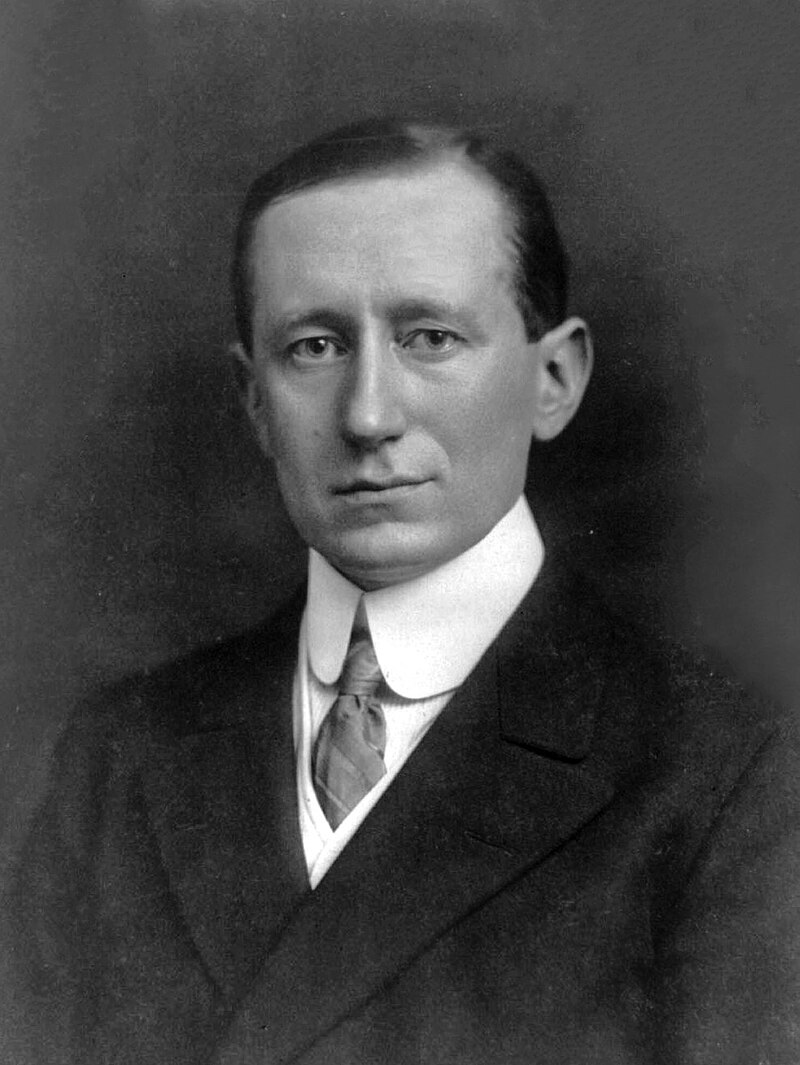
Guglielmo Marconi
Electrical engineer and former Senator of the Kingdom of ItalyWikipedia
142
MENTIONS
31
EPISODES
29
PODCASTS
Search complete. 142 mentions across 31 episodes found for "Guglielmo Marconi".
Nov 3, 2026

SengaHOST
Newfoundland, Anno Domini, 1901.
SengaHOST
Inventor, Guillermo Marconi, successfully receives the first transatlantic transmission.
SengaHOST
However, he is not the only one.
SengaHOST
Deep in the dark space between galaxies, an unknown threat detects the signal and sets course for Earth.

speaker_6NARRATOR
He enhanced the value of his device by the vital discovery that the conductivity bestowed upon filings by electric dischargers could be destroyed by simply shaking or tapping them apart.
speaker_6NARRATOR
in a homely way the principle of the coherer is often illustrated in ordinary telegraphic practice an operator notices that his instrument is not working well and he suspects that at some point in his circuit there is a defective contact a little dirt or oxide or dampness has come in between two metallic surfaces to be sure they still touch each other but not in the firm and perfect way demanded for his work accordingly he sends a powerful current abruptly into the line which clears its path thoroughly brushes aside dirt oxide or moisture and the circuit once more is as it should be in all likelihood the coherer is acted upon in the same way among the physicists who studied it in its original form was dr oliver j lodge he improved it so much that in eighteen ninety four at the royal institution in london he was able to show it as an electric eye that registered the impact of invisible rays at a distance of more than forty yards he made bold to say that this distance might be raised to half a mile as early as eighteen seventy nine professor d e hughes began a series of experiments in wireless telegraphy on much the lines which in other hands have now reached commercial as well as scientific success professor hughes was the inventor of the microphone and that instrument he declared affords an unrivalled means of receiving wireless messages since it requires no tapping to restore its non-conductivity in his researches this investigator was convinced that his signals were propagated not by electromagnetic induction but by aerial electric waves spreading out from an electric spark early in eighteen eighty he showed his apparatus to professor stokes who observed its operation carefully his dictum was that he saw nothing which could not be explained by known electromagnetic effects this erroneous judgment so discouraged professor hughes that he desisted from following up his experiments and thus in all probability the birth of the wireless telegraph was for several years delayed The coherer, as improved by Marconi, is a glass tube about one and one-half inches long and about one-twelfth of an inch in internal diameter.
speaker_6NARRATOR
The electrodes are inserted in this tube so as almost to touch.
speaker_6NARRATOR
Between them is about one-thirtieth of an inch filled with a pinch of the responsive mixture which forms the pivot of the whole contrivance.
speaker_6NARRATOR
No device of the trigger class is comparable with this in delicacy.
speaker_6NARRATOR
An instant after a signal has taken its way through the coherer, a small hammer strikes the tiny tube, jarring its particles asunder.
speaker_6NARRATOR
so that they resume their normal state of high resistance we may well be astonished at the sensitiveness of the metallic filings to an electric wave originating many miles away but let us remember how clearly the eye can see a bright lamp at the same distance as it sheds a sister beam thus far no substance has been discovered with a mechanical responsiveness to so feeble a ray of light in the world of nature and art the coherer stands alone The electric waves employed by Marconi are about four feet long, or have a frequency of about 250 million per second.
speaker_6NARRATOR
Such undulations pass readily through brick or stone walls, through common roofs and floors, indeed through all substances which are non-conductive to electric waves of ordinary length.
Adam MarceticNARRATOR
The Adventures of Inventors and Engineers by Russell Doubleday.
Adam MarceticNARRATOR
contents chapter i how guglielmo marconi telegraphs without wires chapter two santos dumont and his airship chapter three how a fast train is run Chapter 4, how automobiles work.
Adam MarceticNARRATOR
Chapter 5, the fastest steamboats.
Adam MarceticNARRATOR
Chapter 6, the life savers and their apparatus.
Adam MarceticNARRATOR
The Adventures of Inventors and Engineers by Russell Doubleday.
Adam MarceticNARRATOR
Chapter 1.
Adam MarceticNARRATOR
How Guglielmo Marconi Telegraphs Without Wires.
Adam MarceticNARRATOR
a nineteen-year-old boy just a quiet unobtrusive young fellow who talked little but thought much saw in the discovery of an older scientist the means of producing a revolutionizing invention by which nations could talk to nations without the use of wires or tangible connection no matter how far apart they might be or by what they might be separated the possibilities of guglielmo william marconi's invention are just beginning to be realized and what it has already accomplished would seem too wonderful to be true if the people of these marvellous times were not almost surfeited with wonders it is of the boy and man marconi that this chapter will tell and through him the story of his invention for the personality the talents and the character of the inventor made wireless telegraphy possible It was an article in an electrical journal describing the properties of the Hertzian waves that suggested to young Marconi the possibility of sending messages from one place to another without wires.

speaker_3NARRATOR
Entonces, ¿qué podías hacer? Entra en escena la comunicación inalámbrica.
speaker_3NARRATOR
Guglielmo Marconi fue un inventor italiano que consiguió un avance decisivo en 1895, cuando logró transmitir señales inalámbricas a distancias superiores a una milla desde la casa de su padre en Italia.
speaker_3NARRATOR
No fue el primero en pensar en la transmisión inalámbrica.
speaker_3NARRATOR
Heinrich Hertz había descubierto las ondas de radio durante la década de 1880 y los científicos estaban teorizando sobre sus posibilidades.

Onno VK6FLABCORRESPONDENT
You might ask, does all this apply to receive or transmit antennas? To which I'll say, yes.
Onno VK6FLABCORRESPONDENT
This arrangement of antennas is called a phased array, and was first demonstrated as a three-element array in 1905 by Nobel laureate Carl Ferdinand Braun, who shared the 1909 Nobel Prize in Physics with Guglielmo Marconi, in recognition of their contributions to the development of wireless telegraphy.
Onno VK6FLABCORRESPONDENT
While I've been talking about two antennas side by side, you can orient as many antennas as your budget allows in whatever shape you require.
Onno VK6FLABCORRESPONDENT
For example, the square kilometre array being constructed around the corner from me, well, about 550 kilometres away, is planned to have a total of 131,072 log periodic dipole antennas.

speaker_2HOST
So what could you do? Enter wireless communication.
speaker_2HOST
Guglielmo Marconi was an Italian inventor who achieved a decisive breakthrough in 1895, when he succeeded in transmitting wireless signals over distances greater than a mile from his father's house in Italy.
speaker_2HOST
He was not the first to think about wireless transmission.
speaker_2HOST
Heinrich Hertz had discovered radio waves during the 1880s, and scientists were theorising about their possibilities.
speaker_2HOST
But Marconi was different.
speaker_2HOST
While other scientists focused on theory, Marconi focused on practical applications.
speaker_2HOST
He worked tirelessly to increase transmission distances and turn this theoretical concept into something genuinely useful.
speaker_2HOST
His wireless telegraphy system was based on Hertz's theoretical work, but he brought it into the real world.

John LienhardHOST
In 1893, Nikola Tesla sent a wireless signal across a room.
John LienhardHOST
In 1901, Guglielmo Marconi sent one across the Atlantic, but neither signal transmitted sound.
John LienhardHOST
Indeed, we were soon calling this new medium wireless telegraphy, because we could send only telegraphic dots and dashes.
John LienhardHOST
Writer William Zwill tells how the little-known inventor Reginald Fessenden solved the problem of sending sound.
John LienhardHOST
He'd become chief chemist just as depression forced Edison to make cutbacks.
John LienhardHOST
Over the next ten years, Fessenden taught college, he worked for Westinghouse, and he invented.
John LienhardHOST
Then, in 1900, before Marconi, the U.S.
John LienhardHOST
Weather Bureau went to him.

speaker_0NARRATOR
Through his work with the Tesla coil, he began to perceive the invisible tapestry of the universe.
speaker_0NARRATOR
He was the first to grasp the fundamental concepts of radio, conceptualizing the transmission of intelligence through the ether long before Guglielmo Marconi entered the public consciousness.
speaker_0NARRATOR
Tesla understood that electrical energy could be broadcast in resonant frequencies, much like a tuning fork causes another to vibrate across a room.
speaker_0NARRATOR
He patented the basic components of radio transmission, the tuning circuits, the antennas, the grounding, years before Marconi successfully sent a signal across the Atlantic.

Steve BelguleNARRATOR
all induction coils and transformers see chapter 24 are operated by effects produced through the ether from the primary to the secondary coil but through very short distances In 1880, Professor Trowbridge transmitted an electrical current through the earth for one mile so as to produce signals in a telephone.
Steve BelguleNARRATOR
In 1881 to 1882, Professor Dolbear used for a short distance, 50 feet, substantially the same arrangement as Marconi now uses, except that the former used a telephone as a receiver.
Steve BelguleNARRATOR
He used an induction coil, having one end of the secondary wire connected with the earth, while the other was attached to a wire running up into the air.
Steve BelguleNARRATOR
at the receiving end a wire starting from the earth extended into the air passing through a telephone which acted as a receiver in eighteen eighty six he used a kite to elevate the wire through which electrical discharges of high voltage were made into the air to produce ether waves the receiver being two thousand feet away dolbert's experiments were public fourteen years ago but at that time there was no interest in such matters so that his work received little or no attention In 1887, Dr. Hertz of Germany made some experiments in producing and detecting aether waves, and he did a great deal to awaken an interest in the subject, so that others began investigations that have led to its present use as a means of telegraphing to a distance of many miles.
Steve BelguleNARRATOR
In 1891, Professor Branly of Paris invented the coherer, In 1894, it was improved by Lodge and by him used as a detector of aether waves.
Steve BelguleNARRATOR
In 1896, ten years after Dolbear had used it with the kite at the transmitting end and telephone at the receiving end, Marconi, an Italian, substituted the coherer of Branly for the telephone of Dolbear.
Steve BelguleNARRATOR
This coherer is constructed and operated as follows.
Steve BelguleNARRATOR
it consists of a glass tube of comparatively small diameter loosely filled with metal filings of a certain grade this body of metal dust is made a part of a local battery circuit in which is placed an ordinary electric bell or telegraphic sounder The resistance of this body of filings is so great that current enough will not pass through it to ring the bell or actuate the sounder until an ether wave strikes it and the wire attached to it, when the metal particles are made to cohere to such an extent that the conductivity of the mass is greatly increased, so that a current of sufficient volume will now pass through the bell magnet to ring it.
21 more episodes mention Guglielmo Marconi.
Create an account to see the whole feed, search across every transcript, and follow the entities you care about.