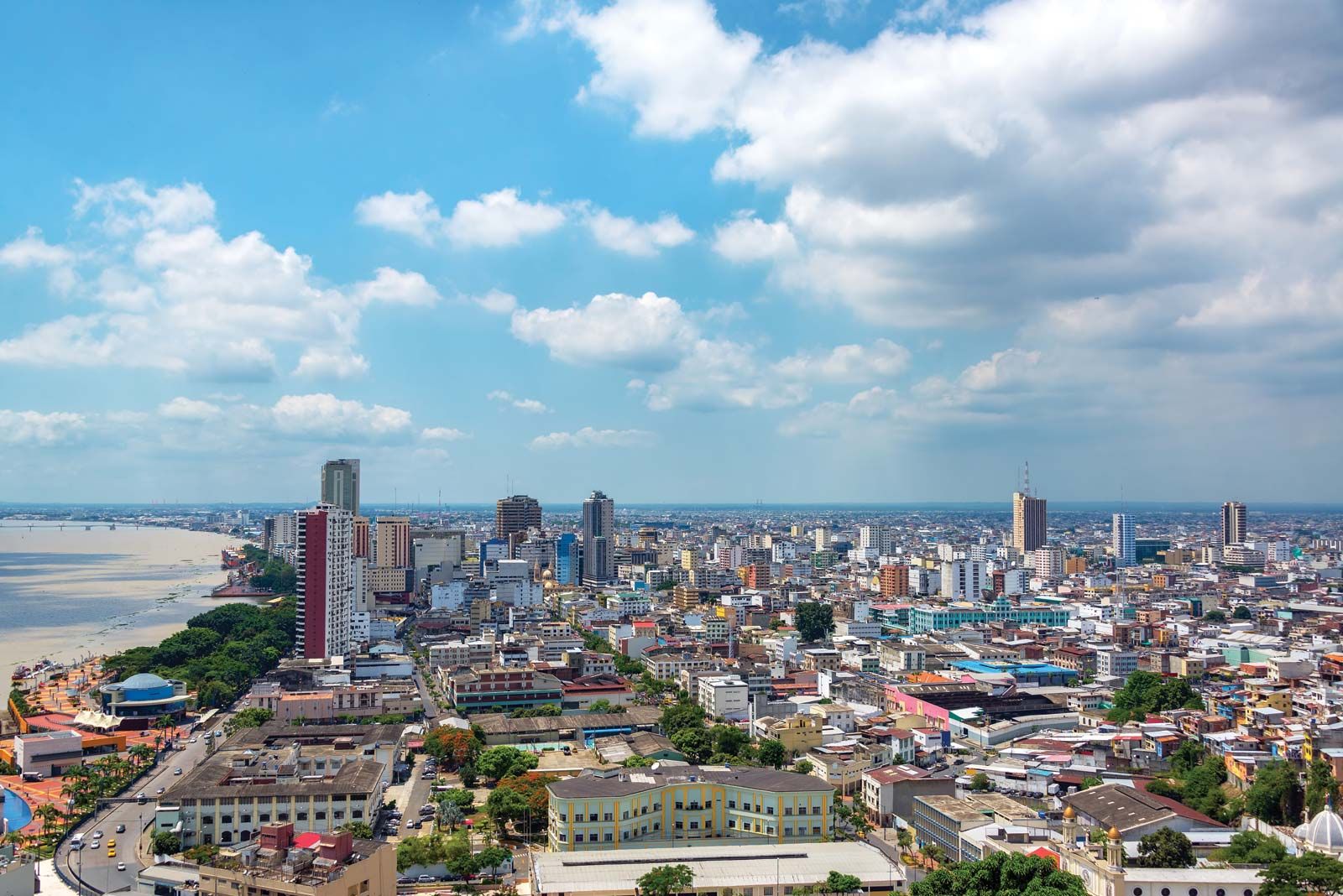
Guayaquil
City in EcuadorWikipedia
462
MENTIONS
45
EPISODES
40
PODCASTS
Search complete. 462 mentions across 45 episodes found for "Guayaquil".
Sep 26, 2026

Tony LloydHOST
Are they raised more on the Ecuadorian side or more the U.S. side? What's happening there?
Pamela PhoenixGUEST
So my oldest son was born in Guayaquil.
Tony LloydHOST
Okay.
Pamela PhoenixGUEST
And then my second son was born in Florida.

Evan EllisGUEST
You have a number of different routes, some that come like right over the border and then flow out through ports in the north, such as Esmeraldas.
Evan EllisGUEST
You've got others that go farther to the south, such as Manta in Guayaquil.
Evan EllisGUEST
So one of the Ecuadorian ports.
Evan EllisGUEST
areas around the greater Guayaquil area, a poorer community called Duran has become one of the major sources of fighting because where the river meets the city, it's become a logical area to essentially load up narco boats to take off, you know, to transport away from Ecuador in.
Evan EllisGUEST
So it's been very difficult to interrupt all of those routes.
Evan EllisGUEST
And again, the criminal groups have been pushing back with violence, local gang based violence in those urban areas, as well as attacks by the groups against security, not only national level, but also local level security across the different coastal provinces in Guayas and in other places.

speaker_8NARRATOR
And thither indeed men came, a family or so of Peruvian half-breeds fleeing from the lust and tyranny of an evil Spanish ruler.
speaker_8NARRATOR
Then came the stupendous outbreak of Mindobamba, when it was night in Quito for seventeen days, and the water was boiling at Yaguachi, and all the fish floating dying even as far as Guayaquil.
speaker_8NARRATOR
Everywhere along the Pacific slopes there were landslips and swift thawings and sudden floods, and one whole side of the old Arauca crest slipped and came down in thunder, and cut off the country of the blind forever from the exploring feet of men.
speaker_8NARRATOR
But one of these early settlers had chanced to be on the hither side of the gorges when the world had so terribly shaken itself, and he perforce had to forget his wife and his child and all the friends and possessions he had left up there, and start life over again in the lower world.
Evan EllisGUEST
Uh, you have a number of different routes, so some that come, like, right over the border and then, uh, flow out, uh, through ports in the north, such as Esmeraldas.
Evan EllisGUEST
You've got others that go far to the, the south, such as Manta and Guayaquil.
Evan EllisGUEST
So, uh, one of the, uh, Ecuadorian, um, uh, the, the, uh, areas around, uh, the, the greater Guayaquil area, a, uh, poor, uh, community ca- called Durán, has become one of the major sources of fighting because, uh, in, uh, where the, where, where the river meets, uh, the, uh, the, the city, uh, it's become a, a logical area to essentially load up, load up, uh, narco boats to, to, to take off, uh, you know, to, to transport away from Ecuador.
Evan EllisGUEST
And so it's, um, so it's been very difficult to interrupt all of those routes.
Evan EllisGUEST
And, and again, the criminal groups have been, uh, you know, pushing back with violence, uh, you know, local gang-based violence in those urban areas, as well as, uh, attacks, uh, you know, by the groups against, uh, security, um, not only national level, but also, uh, local level security across the, the different coastal provinces in, in, in Guayas and i- in other places.

Abril MacíasGUEST
And like, first of all, like introduce them because they were like many different kinds of foods that people in the city had never tried or even seen.
Abril MacíasGUEST
So it's been, I guess, a 15-year-long process of them reaching out to chefs in Quito, in Guayaquil, in Cuenca, and getting them familiarized with what these things are, how you can cook them, what's their value also.
Abril MacíasGUEST
the food chain, production chain.
Abril MacíasGUEST
And it's been like very, you know, little by little that they've done what they've done.

James K. WhiteNARRATOR
On the 1st of April, they saw the red appearance in the sea mentioned before.
James K. WhiteNARRATOR
On the 2nd, they took two small prizes, but this being only trifling work and regarded as a loss of time, they came to the resolution of landing and making an attempt upon Guayaquil.
James K. WhiteNARRATOR
On the 15th, they saw a French ship belonging to Lima and sent two boats well manned to capture her.
James K. WhiteNARRATOR
She stood well on her defense.
James K. WhiteNARRATOR
The captains Rogers and Courtney left the two barks, and pulled for the island of Puna, where they hid their boats under the mangrove branches until evening, when they seized two bark logs and all the canoes lying there.
James K. WhiteNARRATOR
But an Indian made his escape and alarmed the town, yet they succeeded in securing the lieutenant and twenty others, while the remainder escaped into the neighboring woods.
James K. WhiteNARRATOR
On the twenty-second, before one in the morning, they arrived before Guayaquil in their boats with a hundred and ten men on board.
James K. WhiteNARRATOR
They judged the town had got the alarm, as they saw a great fire on the top of an adjoining hill, and a great many lights in the streets.

Michael PackardNARRATOR
Colonel Staunton of Ingham University, Leroy, New York, F. S. Williams, Esquire of Albany, New York, and Messrs. P. V. Myers and A. Bushnell of Williams College.
Michael PackardNARRATOR
We sailed from New York July first, 1867, and after crossing the Isthmus of Panama and touching at Paita, Peru, our general route was from Guayaquil to Quito over the eastern cordillera, thence over the western cordillera and through the forests on foot to Napo, down the Rio Napo by canoe to Pibas on the Marañon, and thence by steamer to Para.
Michael PackardNARRATOR
Nearly the entire region traversed by the expedition is strangely misrepresented by most recent geographical works.
Michael PackardNARRATOR
On the Andes of Ecuador, we have little besides the travels of Humboldt on the Napo, nothing, while the Marañon is less known to North Americans than the Nile.
Michael PackardNARRATOR
Unlike the usual portrait, an old man in Berlin, this presents him as a young man in Prussian uniform traveling on the Andes.
Michael PackardNARRATOR
We desire to express our grateful acknowledgments to the Smithsonian Institution, the Honorable William H. Seward, Honorable James A. Garfield of Washington, to Cyrus W.
Michael PackardNARRATOR
Field, Esquire, and William Pitt Palmer, Esquire, of New York, to C.P. Williams, Esquire, of Albany, to Reverend J.C. Fletcher, now United States Consul at Apoorto, to Chaplain Jones of Philadelphia, to Dr. William Jameson of the University of Quito, to J.F. Reeve, Esquire, and Captain Lee of Guayaquil, to the Pacific Mail Steamship Panama Railroad and South Pacific Steam Navigation Companies, to the officers of the Peruvian and Brazilian steamers on the Amazon, and to the eminent naturalists who have examined the results of the expedition.
Michael PackardNARRATOR
Note.

speaker_3NARRATOR
I saw it all from first to last.
speaker_3NARRATOR
I was on the steamer Ecuador from Panama to Guayaquil.
speaker_3NARRATOR
Maria Valenzuela is my cousin.
speaker_3NARRATOR
i have known her always she is very beautiful i am a spaniard an ecuadoriano true but i am descended from pedro patino who was one of pizarro's captains they were brave men they were heroes did not pizarro lead three hundred and fifty spanish cavaliers and four thousand indians into the far cordilleras in search of treasure and did not all the four thousand indians and three hundred of the brave cavaliers die on that vain quest but pedro patino did not die he it was that lived to found the family of the patino i am ecuadoriano true but i am spanish i am manuel de jesus patino i own many haciendas and ten thousand indians are my slaves though the law says they are free men who work by freedom of contract the law is a funny thing we ecuadorianos laugh at it it is our law we make it for ourselves i am manuel de jesus patino remember that name it will be written some day in history there are revolutions in ecuador we call them elections it is a good joke is it not what you call a pun john harned was an american i met him first at the tivoli hotel in panama he had much money this i have heard he was going to lima but he met maria valenzuela in the tivoli hotel maria valenzuela is my cousin and she is beautiful it is true she is the most beautiful woman in ecuador but also she is most beautiful in every country in paris in madrid in new york in vienna always do all men look at her and john harned looked long at her in panama he loved her that i know for a fact she was ecuadoriano true but she was of all countries she was of all the world she spoke many languages she sang ah like an artiste her smile wonderful divine her eyes ah have i not seen men look in her eyes they were what you english call amazing they were promises of paradise men drowned themselves in her eyes maria valenzuela was rich richer than i who am accounted very rich in ecuador but John Harned did not care for her money.
speaker_3NARRATOR
He was a fool.
speaker_3NARRATOR
He did not go to Lima.
speaker_3NARRATOR
He left the steamer at Guayaquil and followed her to Quito.
speaker_3NARRATOR
She was coming home from Europe and other places.

David MartinNARRATOR
We sailed right through the storm center, where we had no wind but a terrific and very confused sea, and here we saw hundreds of seabirds of all kinds.
David MartinNARRATOR
At Valparaiso, we obtained a charter to load cocoa at Guayaquil.
David MartinNARRATOR
We had a lovely cruise up the coast, and the sail up the river to Guayaquil was heavenly.
David MartinNARRATOR
We had the panorama of the Andes on our right, with the richly verdured island of Puna on the other hand.
David MartinNARRATOR
Flocks of flamingos were wading in the shallow sea channels, and pelicans were busy fishing along the margins of the sandbanks.
David MartinNARRATOR
At Guayaquil, we had some good crocodile shooting, not the easiest game to bag.
David MartinNARRATOR
These reptiles had to be stalked in the most approved fashion.
David MartinNARRATOR
Although they lay seemingly basking and asleep in the sun, with their great mouths wide open, their ears were very much on the alert, and it was most difficult to come within shot.

speaker_0ADVERTISER
year?
Simon WhistlerHOST
Cities like Chicago, Guayaquil, and Bogota can get to that number in a matter of weeks, if not days.
Simon WhistlerHOST
However, Europe has historically been much safer than the US or Latin America, so Sweden's numbers really stand out, especially when countries like Denmark had 18 gang-related shootings and four deaths from gang violence in 2022, the same year that Sweden hit its peak.
Simon WhistlerHOST
All of this raises an interesting question.
35 more episodes mention Guayaquil.
Create an account to see the whole feed, search across every transcript, and follow the entities you care about.