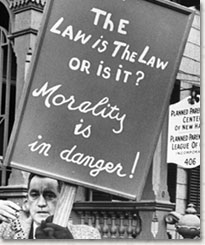
Griswold v. Connecticut
Court caseWikipedia
19
MENTIONS
8
EPISODES
8
PODCASTS
Search complete. 19 mentions across 8 episodes found for "Griswold v. Connecticut".
Oct 30, 2026

Michael PakalukGUEST
There's been a succession.
Michael PakalukGUEST
You begin with Griswold v. Connecticut, which articulated the right to privacy, but it did so on a kind of very skewed understanding of the family as the basic self-society.
Michael PakalukGUEST
So it said, you know, there's a kind of protection there, and a husband and wife could use contraception if they wanted because of this right to privacy.
Michael PakalukGUEST
And the right to privacy within, you know, five, six, seven, eight years was used to justify abortion, and then it was used to, you know, essentially to overturn traditional marriage.

Patrick CoffinGUEST
It's the safety net of the High Wire Act known as contraception.
Patrick CoffinGUEST
So only eight years went by between the Griswold v. Connecticut decision in America, which legalized the sale and distribution and advertising of birth control products, and Roe v.
Patrick CoffinGUEST
Wade.
Patrick CoffinGUEST
In fact, Roe v.
Patrick CoffinGUEST
Wade appeals to a very strange concept that was written of in the justices in Griswold v. Connecticut, and it's the right to privacy.
Patrick CoffinGUEST
There's no right to privacy in the Constitution.
Patrick CoffinGUEST
That term does not exist.

Brandon JulienHOST
For this June the 7th.
Brandon JulienHOST
Highlight of this day came in 1965 when the U.S. Supreme Court in Griswold v. Connecticut struck down 7-2, a Connecticut law used to prosecute a Planned Parenthood clinic in New Haven for providing contraceptives to married couples.
Brandon JulienHOST
In 1712, Pennsylvania's Colonial Assembly voted to ban the further importation of slaves.
Brandon JulienHOST
In 1776, Richard Henry Lee of Virginia offered a resolution to the Continental Congress stating that these United Colonies are and of right ought to be free and independent states.

Aziz HuqGUEST
Magazine.
Aziz HuqGUEST
It's also reflected in legal and institutional changes such as the recognition on the part of the US Supreme Court in a case called Griswold v. Connecticut of a right to contraception, right? So there are these stacked changes to the demography of the country, the workforce, the effectual politically active population, and the relative status of men and women that are happening simultaneously.
Aziz HuqGUEST
This propels a change in or it propels a reaction, a culturally conservative reaction that is channeled through the Republican Party and that in its turn generates a counter-reaction from the Democratic Party.
Aziz HuqGUEST
And if you think about the historical sequence of the emergence of polarization and asymmetrical polarization in terms of this historical story, which I've partly drawn from Mason, but partly is my own main up thing, is I think it is possible to see that the even-handed sense that pocks on all their houses sense of polarization is misleading.

Aziz HuqGUEST
Magazine.
Aziz HuqGUEST
It's also reflected in legal and, and institutional changes such as the recognition on the part of the US Supreme Court in a case called Griswold v. Connecticut of a right to co- uh, to contraception, right? So there are these, uh, uh, stacked changes to the demography of the country, the workforce, the effectual politically active population, and the, uh, the relative status of men and women that are happening simultaneously.
Aziz HuqGUEST
This propels a change in, or it propels a reaction, a culturally conservative reaction that is channeled through the Republican Party, and that, in its turn, generates a counter-reaction from the Democratic Party.
Aziz HuqGUEST
And, and if you think about the historical sequence of the emergence of polarization and asymmetrical polarization in terms of, uh, of this historical story, which I've partly drawn from Mason, but partly is my own made-up thing, um, is I, I, I think you s- I th- I think it is possible to see that the even-handed sense, the pox-on-all-their-houses sense of polarization is misleading.

Aziz HuqGUEST
Magazine.
Aziz HuqGUEST
It's also reflected in legal and institutional changes such as the recognition on the part of the US Supreme Court in a case called Griswold v. Connecticut of a right to contraception, right? So there are these stacked changes to the demography of the country, the workforce, the effectual politically active population, and the relative status of men and women that are happening simultaneously.
Aziz HuqGUEST
This propels a change in or it propels a reaction, a culturally conservative reaction that is channeled through the Republican Party and that in its turn generates a counter-reaction from the Democratic Party.
Aziz HuqGUEST
And if you think about the historical sequence of the emergence of polarization and asymmetrical polarization in terms of this historical story, which I've partly drawn from Mason, but partly is my own main up thing, is I think it is possible to see that the even-handed sense that pocks on all their houses sense of polarization is misleading.

BradHOST
And this we actually talked about a few weeks ago, actually a couple months ago.
BradHOST
On our September 2nd show on the Ninth Amendment, we talked about a Supreme Court case, Griswold v. Connecticut.
BradHOST
And one of the things in that case that we talked about was in Griswold v. Connecticut, they talked about the penumbra of rights and that you get certain core rights in the Bill of Rights.
BradHOST
And then they have in order to guarantee those rights, they have this shadow that's cast that gives these sort of adjacent rights.
BradHOST
And, yeah, they're not specifically enumerated, but they are sort of.
BradHOST
Ideally.
BradHOST
Yeah, that is, yeah, that's basically what you get up across.
BradHOST
And what the Supreme Court has in varying times throughout the country's history, though more so in the 19th or more so in the 20th century especially, sort of said is that, yeah, you have these, you know, Jason rights and yeah, whatever the government's doing in this particular case feels really icky.

BeaHOST
So like, that's why it's so hard.
SamHOST
Okay, so here are two major Supreme Court decisions that were really important when it came to contraceptives in the U.S. One was in 1965, Griswold v. Connecticut.
SamHOST
Connecticut had a law prohibiting contraception.
SamHOST
Blanket statement.