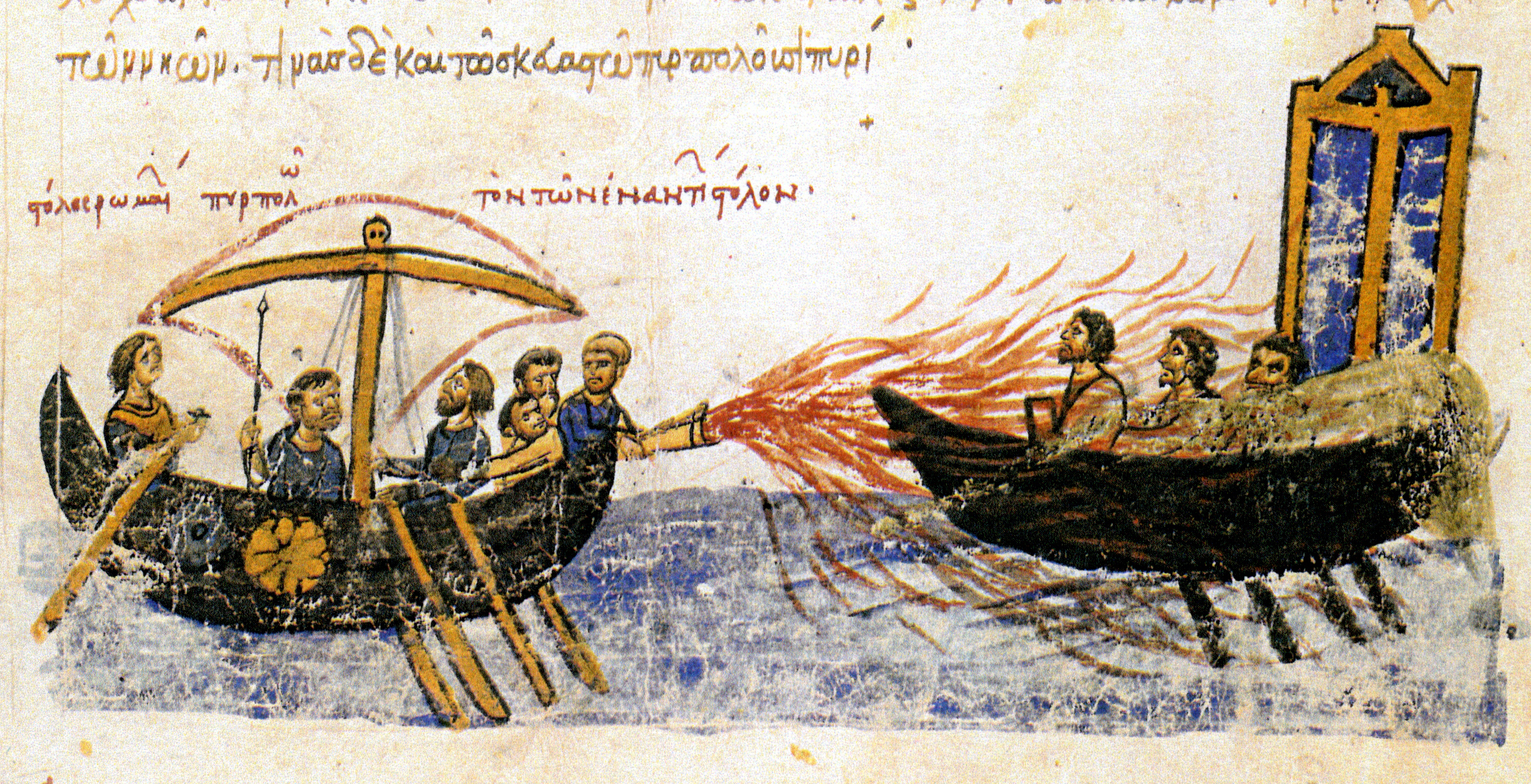
Greek fire
19
MENTIONS
4
EPISODES
4
PODCASTS
Search complete. 19 mentions across 4 episodes found for "Greek fire".
Nov 2, 2026

SpencerHOST
Gimme, gimme, gimme...
SpencerHOST
Greek fire, Greek fire, noun from 1788.
SpencerHOST
It is an incendiary composition used in warfare by the Byzantine Greeks that is said to have burst into flame on wetting.
SpencerHOST
Well, I am very confused by this.
SpencerHOST
I have never heard of Greek fire before.
SpencerHOST
Oh, by the way, The Greek flag, it's showing me, because I have the word Greek in my browser.
SpencerHOST
In addition to the blue and white stripes, it has the Greek cross in it.
SpencerHOST
It's kind of like the American flag.

RymHOST
We'll make some money or whatever.
RymHOST
And then, of course, it goes off the rails, which this one immediately goes off the rails with Greek Fire, a.k.a. Napalm, like immediately.
RymHOST
But...
RymHOST
As it progresses, there's a lot of moments where you hit some magical stuff.

Hanael ParksGUEST
And then time going by, alchemy becomes something most linked with aphorism, with war too.
Hanael ParksGUEST
The most infamous example is Feu Grégeois.
Hanael ParksGUEST
It's how to create fire on water.
Hanael ParksGUEST
It's a more epic one.

CaveatNARRATOR
In many cases, earlier writers have discovered passages which they consider prove the use of firearms and gunpowder.
CaveatNARRATOR
In reality, these refer to Greek fire and similar compositions which were used as projectiles, being thrown from machines or catapults, and not as propellants.
CaveatNARRATOR
Gunpowder as a mixture of ingredients may have been known from remote times, as undoubtedly were other simple pyrotechnic compositions, but all evidence goes to show that its use as a propellant was not known until well into the Christian era.
CaveatNARRATOR
The composition of Greek fire, known in ancient times as naphtha, was a mixture of pitch, resin, and sulphur, with the addition in some cases of crude saltpeter.
CaveatNARRATOR
It may be considered that in the absence of the latter ingredient the mixture does not constitute a pyrotechnic composition, but from the description of the use of naphtha in early writings it appears at least likely that it was generally present.
CaveatNARRATOR
The fire was either enclosed in hollow stones or iron vessels and thrown from a catapult, or sometimes filled into the end of arrows and assisted to propel them forward or sustain their flight.
CaveatNARRATOR
Philostratus, 17 to 250 AD, writing of the Indian campaign of Alexander the Great, BC 326, relates that the inhabitants of a town on the river Hephestus, bees, defended themselves by means of thunder and lightning which darted upon their besiegers.
CaveatNARRATOR
This has been considered as evidence of the use of firearms, but is more probably the first reference to Greek fire.