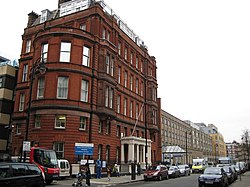
Great Ormond Street Hospital
Children's hospital in London, EnglandWikipedia
95
MENTIONS
55
EPISODES
55
PODCASTS
Search complete. 95 mentions across 55 episodes found for "Great Ormond Street Hospital".
Sep 14, 2026

Simon JackHOST
At the start of the trial, he broke down in tears, which he said was because of absolute total frustration with the newspapers.
Simon JackHOST
But he won, and he donated the hundred thousand pounds in damages to Great Ormond Street Hospital, which is a, a famous children's hospital.
Zing TsjengHOST
By two thousand, he was done with the club.
Zing TsjengHOST
He sold part of his stake to the investment group ENIC for nearly twenty-two million pounds, selling his remaining stake seven years later for twenty-five million pounds.
Simon JackHOST
So he knew how popular it was in the US because of his home there.
Simon JackHOST
Part of his motivation, he said, was that he wanted to be a role model.
Simon JackHOST
He requested no payment for the show, and when the BBC insisted to give him some money, he gave that money to the Great Ormond Street Hospital.
Simon JackHOST
He has said, "I wish to avoid people saying, 'What's he doing that for? Hasn't he got enough money?' I really hate that feeling, so if I write an article for the newspapers or do an advert, you will always see Sir Alan's fee for this article has been donated to charity."

Nick KnowlesGUEST
We- 'cause we've obviously done a lot of community jobs as well as, um, as well as individual homes for people.
Nick KnowlesGUEST
So we put a garden on the top of Great Ormond Street because it's, uh, as I'm sure you know-
Ian BothamHOST
Yeah, yeah
Nick KnowlesGUEST
... it's a series of tower blocks.

Michael CantyGUEST
And if you are, you can then be referred to a specialist center.
Michael CantyGUEST
So in the UK at the moment, the UK center is in Great Ormond Street.
Michael CantyGUEST
But there is another center in Leuven in Belgium.
Michael CantyGUEST
And actually the way commissioning has been set up is that roughly half of the UK will be referred to Great Ormond Street and half will be referred to Leuven.
Michael CantyGUEST
And everywhere in the north of the country, north of England and ourselves in Scotland, our patients go to Leuven, where they can be assessed and managed, and then they come back here for, for ongoing management.
Michael CantyGUEST
So that's been a really interesting development in the management of these kids.

Glyn ElwynHOST
For many years, he served as the chief executive officer, um, of the International Society for Quality in Healthcare.
Glyn ElwynHOST
Before that, he led the quality program of the very well-known Great Ormond Street Hospital in London.
Glyn ElwynHOST
He also happens to be a pediatrician.
Chris TrimbleHOST
Glynn, as is our habit, let's give our listeners three questions to consider as they listen today.

speaker_20SOUNDBITE_SPEAKER
And then they asked me if that was the guy I served, and I said, yes, it was him, because he had the same cap.
Trevor McDonaldHOST
After two days on the run, Hardy was recognized by a retired policeman in a secluded smoking room in Great Ormond Street Hospital.
speaker_21SOUNDBITE_SPEAKER
The door opens, and in walks Mr. Hardy, carrying his world of goods and chattels with him.
speaker_21SOUNDBITE_SPEAKER
sits down in the corner behind my sons, finishes his cigarette, and it's time to go back to the ward.

Kleopas KleopaMODERATOR
And today we are happy to have as guest Professor Joe Eng, who is Senior Research Fellow at the University College London, Queen's Square Institute of Neurology.
Kleopas KleopaMODERATOR
Professor Eng has started her career with an MRC Clinical Research Training Fellowship after completing Pediatric Neurology Training at Great Ormond Street Hospital for Children and Then she went on to complete a PhD in gene therapy at UCL and combining her clinical experience of managing children with incurable life-threatening and life-limiting neurogenetic disorders without any impactful treatments, And combining with her research experience, she decided to combine this in her career and develop a gene therapy for these rare neurogenetic disorders in order to improve the therapeutic landscape for patients with neurological diseases.
Kleopas KleopaMODERATOR
So she has developed considerable expertise in translational AAV gene therapy, and has been able to bring some of these treatments all the way to clinical testing and first in human trials.
Kleopas KleopaMODERATOR
So we're very excited to hear her voice and I will start.

Lee EvansHOST
They were scattered.
Lee EvansHOST
And his ashes were scattered at the base of the Peter Pan statue at Great Ormond Street Hospital for Children in London.
Lee EvansHOST
I'll come on to why that was in a moment.
Lee EvansHOST
But one of the quite touching things about Jim Callaghan's death is that at the time that it happened, Dennis Healy, who would go on to live for quite a bit longer still, but was, of course, Chancellor in Callaghan's government, said, it was only last week that I was at his wife Audrey's funeral with him, and he was looking very unwell then.
Lee EvansHOST
They went for Wilson.
Lee EvansHOST
But Callaghan's time did come.
Lee EvansHOST
On this association with Great Ormond Street Hospital, I've done some digging to try and find out what was going on there.
Lee EvansHOST
And basically, it's less his connection than it is Audrey Callaghan's.

Chris SmithHOST
Untreated craniosynostosis can lead to serious complications, but the development of a new modeling system and a newly engineered set of metal springs to push the skull bones apart has enabled surgeons to fix the problem in a minimally invasive way and even practice the procedure many times over before going anywhere near young Rory himself.
Chris SmithHOST
It's the work of UCL biomedical engineer Silvia Schivano, whom we'll hear from in just a minute, and Great Ormond Street neurosurgeon, Owais Jillani.
Owais JillaniGUEST
Rory has a condition called craniosynostosis.
Owais JillaniGUEST
So wh- when a baby's born, the baby's brain does a lot of its growth in the first few years of life.
9 MINS LATER
Owais JillaniGUEST
And as Silvia mentioned, you know, Rory's our first case, and we're immensely proud of him and how things have progressed.
Owais JillaniGUEST
But this technology has the potential to help thousands and thousands of other children right across the world.
Chris SmithHOST
It's a brilliant story, isn't it? Oais Gelani from Great Ormond Street Hospital, and before him, Silvia Schivano from UCL.
Chris SmithHOST
An AI researcher has sparked an international media frenzy by quitting his job and accusing the artificial intelligence giants OpenAI and Anthropic of acting irresponsibly.

FayeHOST
He was put onto a life-saving treatment called ECMO, where effectively his blood was taken out of the body, re-oxygenized, and then pumped back into the body.
FayeHOST
This, of course, meant that he had to have tubes that were put down into his heart and they went in through the neck obviously this is a baby that's only just been born he was he was put onto ECMO was he 12 hours old by then he was born at two o'clock in the morning maybe roughly about 12 hours old if that he so basically my son was taken off to Great Ormond Street and because I'd had the emergency cesarean and there weren't any beds available At that time when he needed to be transferred, I had to wait back at our local hospital whilst he went off to Great Ormond Street and had this insane life-saving treatment.
FayeHOST
So needless to say...
FayeHOST
That wasn't the quick, easy water bath that I was expecting to have in the Easter break and get back to uni and just finish up, like literally tie up the first year of my joint English and drama degree and get back for like full force in like September, October when you go back, right? So it was just a crazy journey.

JessGUEST
And then the doctors had no idea what it was.
JessGUEST
So I got sent up to Great Ormond Street in London.
JessGUEST
They were like, well, you've got venous malformation.
JessGUEST
And that was that.
45 more episodes mention Great Ormond Street Hospital.
Create an account to see the whole feed, search across every transcript, and follow the entities you care about.