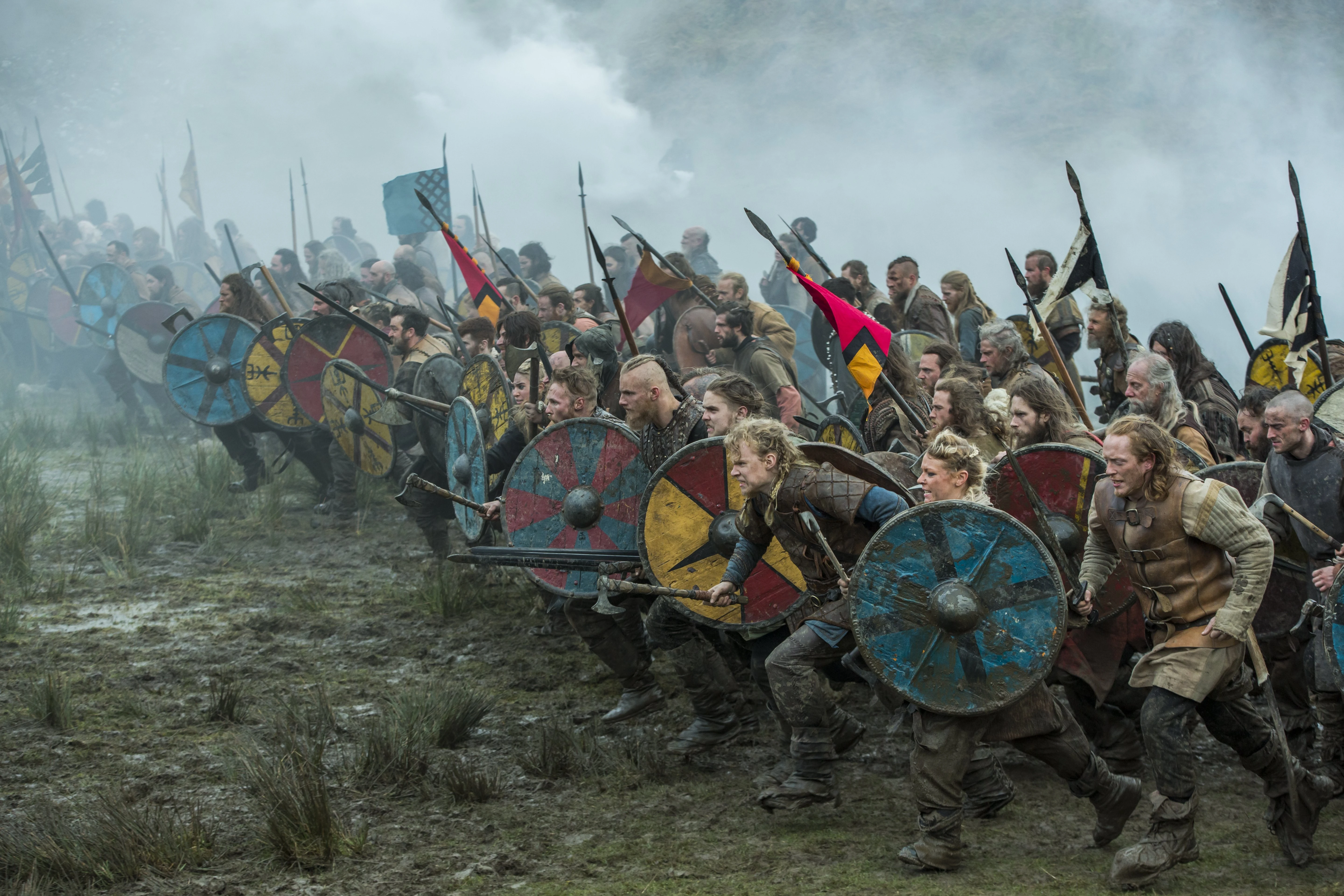
Great Heathen Army

Great Heathen Army

WarriorWikipedia

Search complete. 48 mentions across 23 episodes found for "Great Heathen Army".

Sep 14, 2026

OllieHOST
2:01
First came the raiders, then came an army.
OllieHOST
2:05
In the year 865, the great heathen army swept across England.
OllieHOST
2:10
Led by legendary Viking warlords, including Haft and Ragnarsson, it shattered Northumbria, seized York, and ended the rule of its old Anglo-Saxon kings.
OllieHOST
2:23
From the ruins rose a new Viking kingdom in the north.
OllieHOST
3:49
and a brother to Ivar the Boneless, Abba, Bjorn Ironside, and Sigurd Snake-in-the-Eye.
OllieHOST
3:56
Some accounts have also linked him to a ruler who shared dominion in Denmark, perhaps over the windswept lands of Jutland.
OllieHOST
4:05
In the year 865, the great heathen army descended upon England.
OllieHOST
4:10
This was a host of invasion, commanded by Viking kings and hardened warriors, who had crossed the northern seas with ships beneath them, horses awaiting them, and conquest burning in their hearts.

Unknown podcast

The Great Heathen Army and the Making of Early English State

Sep 14 · 6 Mentions

speaker_0UNKNOWN
0:00
[intro music] Welcome to the Proper British History Podcast.
speaker_0UNKNOWN
0:13
Today, we examine the Great Heathen Army as a coordinated invasion that transformed northern England and learn how the evidence we have today differs from the popular myth.
speaker_0UNKNOWN
0:24
When historians talk about the Viking Age, most of us picture a handful of raiders on longships looting monasteries.
speaker_0UNKNOWN
0:32
But in the mid-19th century, scholars uncovered that by seven hundred and ninety-three and beyond, there was already a deliberate, organized invasion that reshaped northern England.
speaker_0UNKNOWN
0:42
We're calling it the Great Heathen Army.
speaker_0UNKNOWN
0:44
The term itself was coined by archaeologists studying burial sites and written sources, not because Vikings were a monolithic force, but to emphasize the scale of their coordinated effort across multiple regions Northumbria, Mercia, East Anglia, and Wessex in a single campaign that would later be remembered as the birth of Anglo-Saxon resistance.
speaker_0UNKNOWN
1:07
The Great Heathen Army was not a single Viking king's personal army, but rather the amalgamation of several leaders, most famously Hasting or Harald from the dynasty that would become known as the Ragnarrson or Son of Ragnar tradition, who were recruited after the Danish chieftains found fertile ground to exploit in eight hundred and sixty-five following the death of Æthelred of Northumbria.
speaker_0UNKNOWN
1:31
These leaders brought with them a contingent that ranged from seasoned seafarers adept at winter-long sea campaigns to hard-nosed farmers eager to claim new lands, making the army a formidable and diverse force.

Unknown podcast

The Seven Kingdoms – How England Began as a Patchwork of Realms

Sep 14 · 1 Mention

speaker_1UNKNOWN
3:26
East Anglia, to the east, had its own story.
speaker_1UNKNOWN
3:29
The kingdom thrived under Sigeher and later Eorpwald until it was toppled by the Great Viking Army in eight sixty-nine.
speaker_1UNKNOWN
3:36
The Battle of Eddington is often cited as decisive, but archaeological evidence suggests a more gradual erosion rather than a single blow.
speaker_1UNKNOWN
3:45
Essex, which might have started as a sub-kingdom within Kent, developed its own identity under kings like Sigbert the Little.

Unknown podcast

Alfred the Great: Warrior, Reformer, and the Real Foundations of Early England

Sep 12 · 1 Mention

speaker_3UNKNOWN
1:29
His name survived because of later generations, not simply because he wrote epic poems on parchment.
speaker_3UNKNOWN
1:36
The real drama began with the Great Heathen Army, which had been raiding north before it turned its sights to Wessex.
speaker_3UNKNOWN
1:43
By mid-August 878, the Vikings had seized Winchester, Alfred's capital, and threatened his very existence as king.
speaker_3UNKNOWN
1:51
Faced with a superior force and little support from neighboring realms, Alfred chose exile rather than surrender.

Unknown podcast

Jorvik: The Viking Town That Shaped Medieval England

Sep 12 · 1 Mention

speaker_2UNKNOWN
5:20
In fact, it was Cnut's residence here before he crowned himself King of England in ten sixteen, a clear demonstration of how pivotal this city was for Scandinavian ambition.
speaker_2UNKNOWN
5:32
Even earlier, Viking raiders and settlers under leaders like the Great Heathen Army established themselves in Jorvik following raids on nearby monasteries.
speaker_2UNKNOWN
5:42
Those first settlers would have come with a pragmatic mindset, building a permanent base to secure loot, land, and new trade routes.
speaker_2UNKNOWN
5:50
Their settlements show a degree of integration between Norse and Anglo-Saxon practices.

Unknown podcast

Northumbria: Britain's Forgotten Early‑Medieval Superpower

Sep 11 · 1 Mention

speaker_1UNKNOWN
4:39
The Viking threat loomed on Northumbrian shores from the eight-forties onward, first with raids that took monastic communities and wealth but eventually turned into sustained incursions.
speaker_1UNKNOWN
4:51
The Great Heathen Army landed near York in eight and sixty-five and quickly seized control of northern England for about a decade, marking the beginning of what later became known as the Danelaw.
speaker_1UNKNOWN
5:03
While the Vikings brought destruction, some historians point to them as inadvertent catalysts for the eventual unification under a stronger English kingdom.
speaker_1UNKNOWN
5:13
The loss of key monasteries, Lindisfarne fell in seven ninety-three and Jarrow was also attacked, sent shockwaves through the religious life that had sustained Northumbria's cultural dominance.

Unknown podcast

Flora MacDonald: A Highlander Who Hid Bonnie Prince Charlie

Sep 11 · 1 Mention

speaker_2UNKNOWN
8:21
He wasn't just a warrior king, he was also a scholar who translated Latin works into Anglo-Saxon for his own people.
speaker_2UNKNOWN
8:29
His first real test came in 878 when the Great Heathen Army pushed into his lands.
speaker_2UNKNOWN
8:35
Alfred fled into the Somerset marshes of Athelney, turning a retreat into an ingenious campaign of guerrilla tactics.
speaker_2UNKNOWN
8:43
From those hidden ditches, he rallied his men and surprised Guthrum at Edington.

Unknown podcast

William of Mortain: The Rise and Fall of a Norman Baron

Sep 11 · 1 Mention

speaker_0UNKNOWN
10:25
The Norse were already raiding Dublin, then moving up the Liffey, and by the early ninth century they’d carved out strongholds in what is now Ireland, setting up a long-term Viking presence.
speaker_0UNKNOWN
10:37
Ivar the Boneless, whose very nickname survives only through myth, was at that time a real force, leading the Great Heathen Army to take York and to confront King Æthelred.
speaker_0UNKNOWN
10:48
Some contemporary annals even record brutal raids.
speaker_0UNKNOWN
10:52
But the Vikings weren’t just marauders.

Unknown podcast

Sedgemoor 1685: The Night That Failed a Rebellion

Sep 11 · 1 Mention

speaker_1UNKNOWN
26:24
But by the late eighth and into ninth centuries, Viking incursions turned the political field again.
speaker_1UNKNOWN
26:30
The Great Heathen Army toppled Northumbria in eight hundred and sixty-seven, and Wessex found itself under siege at places like Ashdown and Edington before Alfred rose to the challenge.
speaker_1UNKNOWN
26:42
Alfred's victory at Edington in eight and seventy-eight not only secured Wessex but also forced a Danish leader to convert, showing how warfare, faith, and diplomacy intersected.
speaker_1UNKNOWN
26:52
His later reign established a navy, fortified burhs, and set the stage for Edward, Æthelstan, and the eventual unification of England under one ruler.

Unknown podcast

The Princes in the Tower: What Do We Actually Know?

Sep 11 · 1 Mention

speaker_1UNKNOWN
26:27
Lindisfarne was a high-profile target because it stored wealth and symbols that could be sent home to convince others the Vikings were mightier than they seemed.
speaker_1UNKNOWN
26:38
Then in the mid-8th century, the Great Heathen Army arrived, a coalition of warriors led by figures like Ivar and Halfdan, who pressed into East Anglia and Northumbria with the aim of carving up all four English kingdoms.
speaker_1UNKNOWN
26:52
The Chronicle records that they wintered at places such as Thetford, then marched north to take York in 866, turning what had been an episodic raiding culture into a sustained military occupation that forced the existing rulers to negotiate.
speaker_1UNKNOWN
27:09
By 878, Alfred the Great managed to defeat them at Edington.

13 more episodes mention Great Heathen Army.

Create an account to see the whole feed, search across every transcript, and follow the entities you care about.

We value your privacy

We use cookies to understand how you use our platform and to improve your experience. Click “Accept All” to consent, or “Decline non-essential” to opt out of non-essential cookies. Read our Privacy Policy.