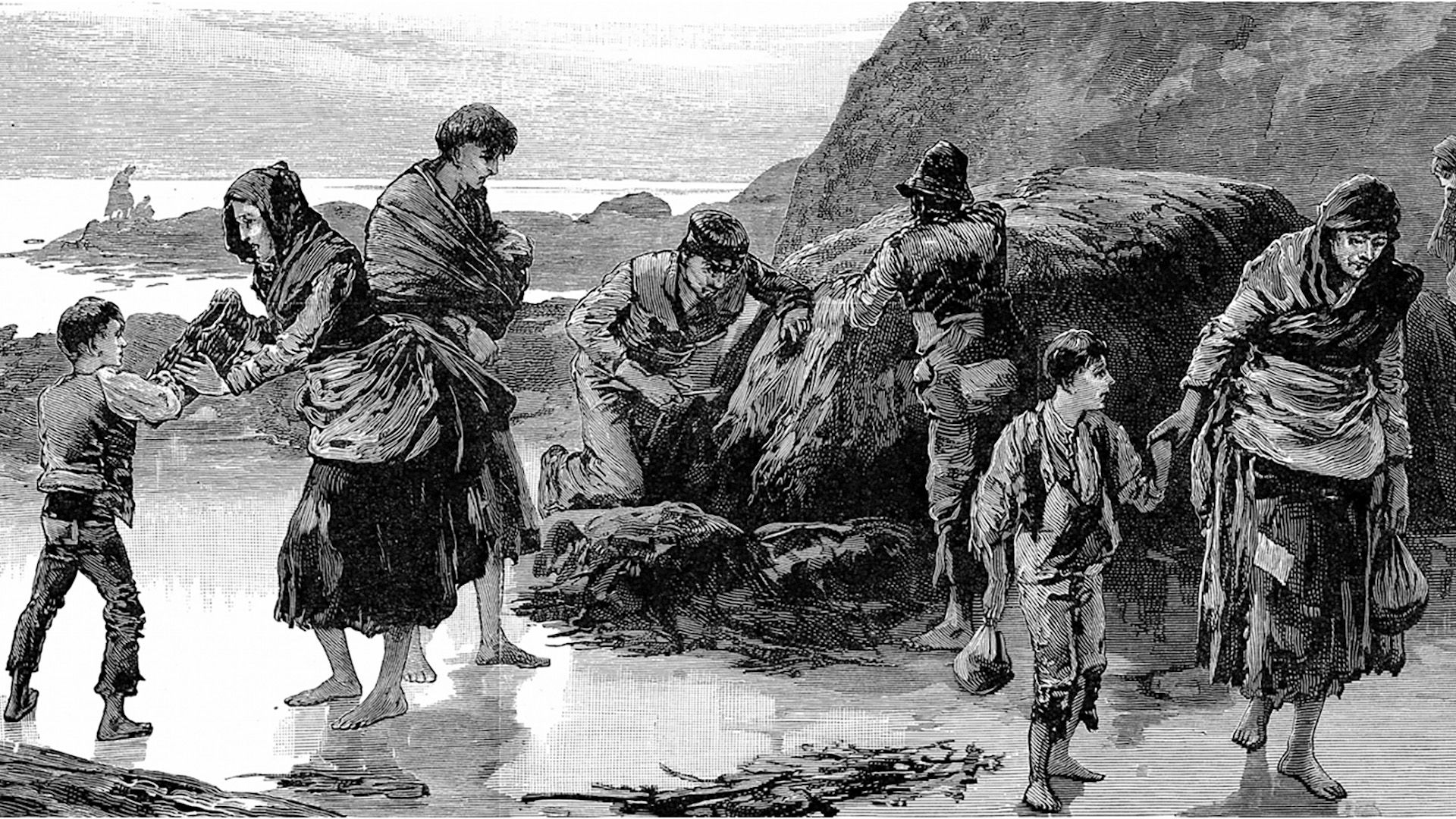
Great Famine
FamineWikipedia
100
MENTIONS
69
EPISODES
60
PODCASTS
Search complete. 100 mentions across 69 episodes found for "Great Famine".
Oct 31, 2026

Sam WinchesterVOICE_ACTOR
European immigrants brought their customs with them, and Irish and Scottish traditions played an important role in Halloween's development in North America.
Sam WinchesterVOICE_ACTOR
The large influx of Irish immigrants during the 19th century, particularly during and after the Great Famine of the 1840s, helped spread those traditions.
Dean WinchesterVOICE_ACTOR
So people brought their celebrations with them when they came to America.
Sam WinchesterVOICE_ACTOR
Yes, but they didn't simply reproduce everything exactly as it had been back home.

Daisy LyonsNARRATOR
His name was John McQuinn and he has an incredibly sad story.
Daisy LyonsNARRATOR
Don McQuinn was a nine-year-old boy who died of smallpox the day he arrived to Otley from Ireland as his family fled the Great Hunger.
Daisy LyonsNARRATOR
His mother and father carried his body on the back of a door.
Daisy LyonsNARRATOR
They were wearing rags as that was all they had, only his brother and sister at his side, so that was it for the congregation.
Daisy LyonsNARRATOR
So a little boy in raggedy Victorian clothing was spotted early December just a few years ago by a group of four friends passing through.
Daisy LyonsNARRATOR
He reportedly gave them a smile and a wave before fading into the trees on the western side of the churchyard.
Daisy LyonsNARRATOR
Could this have been John McQuinn? Could it have been another child lost throughout the years of the Great Hunger? Could it have been a modern day school child trying to escape the required Christmas caroling on the date of the Victorian Fair? That's around the corner and all actually, put that in your diary too.
Daisy LyonsNARRATOR
In 2001, the Famine Memorial was placed in the churchyard, commemorating the hundreds of Irish families who came over to Otley in the 1800s and the 79, at least, people from the community buried in this very graveyard.

Louise OrdHOST
who the Fenians were.
Louise OrdHOST
He's in Ireland in 1862 and this is only a decade and a half after the start of the Great Potato Famine or more accurately I guess is how Irish people or a lot of Irish people would prefer you call it the Great Hunger.
Louise OrdHOST
And so the Irish potato famine or the Great Hunger in a nutshell was that the potatoes got blight.
Louise OrdHOST
They got a disease that started in 1845, meaning that the potato crop in Ireland failed.
Louise OrdHOST
It was the main foodstuff of many people in Ireland, but particularly the sort of rural poor.

Ariel LawhonGUEST
Yeah, I got to interview her, and she is a genius.
Ariel LawhonGUEST
And that book is perfect and beautiful and, as you know, set in Ireland during the Great Potato Famine.
Ariel LawhonGUEST
So just a couple hundred years after...
Ariel LawhonGUEST
Grace's story takes place.

Matt KassonHOST
Sure.
Matt KassonHOST
Thinking back, what inspired that seismic shift in your career path? And I wonder, you're Irish, right? Did growing up in Ireland, where obviously like the history of the Great Famine have an impact on you as a kid? And is that something that's instilled in everyone that's Irish? Never forget the Great Famine and its effect on our people and the place where we live and call home.
David HughesGUEST
Yeah, that's huge.
David HughesGUEST
In the Irish language, it's on Gortormor, the great hunger brought famine.

Nicole OleaHOST
Halloween underwent another transformation as it became more established in the United States.
Nicole OleaHOST
Irish and Scottish immigrants brought their customs with them, especially during the 19th century when the Irish immigrated to the United States due to the Great Famine.
Nicole OleaHOST
But American Halloween wasn't always the family-friendly candy festival we know today.
Nicole OleaHOST
By the late 19th and early 20th centuries, Halloween had developed a reputation for pranks and vandalism, which I guess it still does today, but maybe not to the extreme.

Colum TyrrellGUEST
Family meals suddenly turn to illness or loss.
Colum TyrrellGUEST
I think the country's history might explain that appetite for melancholy, the Great Famine, the death toll, mass
Joe RoganHOST
emigration.
Joe RoganHOST
That weight is still there.

Patrick J. HoulihanGUEST
So Catholic Relief Services and the relevance of Irish Americans to the leadership of The main point here is that Irish Americans were the dominant force in American Catholic leadership before Vatican II.
Patrick J. HoulihanGUEST
And with a specific history, a legacy of the Great Famine, immigration, diaspora, and race allowed Irish Americans to become Catholic leaders in American society in the pre-Vatican II era.
Patrick J. HoulihanGUEST
These were clerical leaders with Irish heritage.
Patrick J. HoulihanGUEST
They had the historical experiences with the threat of famine, as well as social progressivism, rebuilding and acculturation processes of the immigrant experience of East Coast cities in the United States.
Patrick J. HoulihanGUEST
And if we really want to understand communism, the capitalism, we have to get back, well, from the Cold War back into the 19th century, the social question.
Patrick J. HoulihanGUEST
And here we focus on the essential leadership role of Irish Americans and their historically informed experience and understanding of hunger politics to understand how European civilization was stabilized and reconstructed during and after World War II.
Patrick J. HoulihanGUEST
Now, the Great Famine or the Irish Potato Famine resulted in waves of immigration in the 1850s, mostly to the United States of America.
Patrick J. HoulihanGUEST
The point for American history, too, is that Irish immigrants got in at the right time before the frontiers closed, before immigration quotas of the late 19th and early 20th century.

JasonHOST
Sure.
JasonHOST
And while there were some versions of Halloween brought over from England when the colonies were sort of being populated, it wasn't until a wave of Irish immigrants came across the sea in 1820 fleeing the Great Famine that Halloween began to take hold.
JasonHOST
Irish girls peeled apples, roasted nuts, unraveled yarn.
JasonHOST
stared into mirrors, dipped their hands into a series of bowls while blindfolded, cooked dinners in silence, and played with fire to find out whether and whom they would marry.

Christopher FeinsteinHOST
Disguises, bonfires, lanterns carved from turnips, and a lot of fortune-telling.
Christopher FeinsteinHOST
The Scots-Irish carried some of those customs down the wagon road in the 1700s, but a lot of them were Presbyterians who didn't care for anything that smelt like a Catholic holiday, so the customs didn't survive as a big public festival.
Christopher FeinsteinHOST
They survived his games.
Christopher FeinsteinHOST
Things you did in the kitchen with apples.
59 more episodes mention Great Famine.
Create an account to see the whole feed, search across every transcript, and follow the entities you care about.