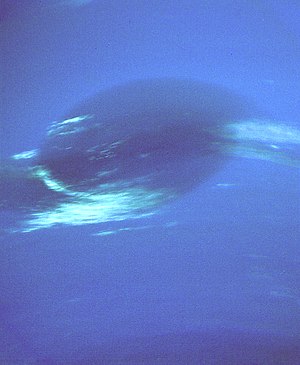
Great Dark Spot
18
MENTIONS
6
EPISODES
5
PODCASTS
Search complete. 18 mentions across 6 episodes found for "Great Dark Spot".
Oct 23, 2026

Matt O'DowdHOST
The largest and oldest storm in the solar system is Jupiter's Great Red Spot, stretching an incredible two to three times the diameter of the planet Earth.
Matt O'DowdHOST
Meanwhile, the fastest winds ever measured, clocking 1,500 miles per hour, once raged in Neptune's Great Dark Spot.
Matt O'DowdHOST
Saturn's polar vortex is a 20,000-mile-wide monster shaped like a hexagon.
Matt O'DowdHOST
Even plain-looking Uranus hides USA-sized hurricanes below its methane haze.
Matt O'DowdHOST
With such a wide range of molecular species driving an incredibly deep convection cycle, there's no danger of a Jovian storm system running out of molecules to condense.
Matt O'DowdHOST
Even high pressure outward blowing storms don't dry up like they do on Earth.
Matt O'DowdHOST
In fact, all of the famous storms like the Great Red Spot, Neptune's Great Dark Spot, and Saturn's polar vortex are, or were, anticyclonic.
Matt O'DowdHOST
Gas giant storms can last for many years.

Phil PlaitHOST
It's thought that the low temperatures in the atmosphere reduce friction, allowing the winds to gather to such amazing speeds.
Phil PlaitHOST
Voyager saw a huge storm marring Neptune's face, called, for some reason, the Great Dark Spot.
Phil PlaitHOST
A few years later, when Hubble was used to observe the pl-
speaker_4ADVERTISER
Visible puts the ultimate wireless hack in the palm of your hand.

speaker_3NARRATOR
Additionally, the internal heat radiating from Neptune's core may drive convective currents that generate the atmospheric circulation patterns responsible for these incredible winds.
speaker_3NARRATOR
During its 1989 flyby, NASA's Voyager 2 spacecraft discovered a massive storm system on Neptune that scientists immediately dubbed the Great Dark Spot.
speaker_3NARRATOR
The spacecraft sent back pictures of two giant storms brewing in Neptune's southern hemisphere, stunning astronomers with the sheer scale and intensity of the atmospheric disturbances.
speaker_3NARRATOR
similar to jupiter's famous great red spot the great dark spot is an anticyclonic storm though far more transient in nature this colossal storm measured thirteen thousand kilometers by six thousand six hundred kilometers across with its longer dimension roughly equivalent to earth's diameter A single storm of this magnitude would dwarf even the largest hurricanes that form on our planet.
speaker_3NARRATOR
Accompanying the Great Dark Spot were bright, wispy clouds thought to comprise methane ice crystals scattered around the edges of the grey vortex.
speaker_3NARRATOR
The storm was characterised by its deep, slate-coloured appearance, which created a striking contrast against the surrounding bright blue atmosphere.
speaker_3NARRATOR
The methane ice crystal clouds created delicate, wispy patterns around the storm's boundaries, giving the Great Dark Spot a distinctive visual appearance in images captured by the Voyager spacecraft.
speaker_3NARRATOR
The storm was unlike anything previously observed in the outer solar system, a tempest of almost unimaginable proportions that continued to swirl and churn as the spacecraft flew past.

Alex McColganHOST
This planet is home to colossal storms.
Alex McColganHOST
When Voyager 2 passed by in 1989, it saw the Great Dark Spot, a storm about the size of Earth, passing through its atmosphere.
Alex McColganHOST
This turbulent storm seemed to be rotating counterclockwise, just like the Great Red Spot on Jupiter, and exhibited winds reaching up to 2,400 kilometers per hour, the strongest recorded in the solar system.
Alex McColganHOST
One NASA analyst, Ken Bollinger, commented on the findings in 1989 saying, "Every day what you see is brand new.
Alex McColganHOST
Having never visited the Neptunian system before, Voyager 2 beamed back images that left the scientific world completely stunned.
Alex McColganHOST
Not only was the planet itself far more dynamic than first thought, with an Earth-sized storm named the Great Dark Spot, supersonic winds, and a faint ring system, Voyager 2 measured Triton's surface temperature to be -235 degrees Celsius, making it the coldest known place in the solar system at the time.
Alex McColganHOST
Even more shockingly, Triton's surface was unexpectedly almost completely devoid of impact craters, and in planetary geology, a lack of craters means one thing: youth.
Alex McColganHOST
Triton's surface is estimated to be less than 100 million years old, and in some regions, perhaps only 6 million.

speaker_1UNKNOWN
with
Richard C. HoaglandGUEST
the latitude of the Great Dark Spot on Neptune, which we did.
Richard C. HoaglandGUEST
In a paper we published in CompuServe two weeks before Voyager 2 arrived at Neptune, predicated on the reality of a set of structures on another planet, unless the structures are real, unless the mathematical logic chain is real, unless the predictions have real power.
Richard C. HoaglandGUEST
So that's why I can say we're still positive, backed