Gravitational microlensing
Astronomical discovery techniqueWikipedia
3
MENTIONS
3
EPISODES
3
PODCASTS
Search complete. 3 mentions across 3 episodes found for "Gravitational microlensing".
Oct 19, 2026

speaker_1HOST
They noted that the 5-10 Earth mass requirement needed to explain the ETNO anomalies perfectly overlaps with an unexpected excess of microlensing events observed in a five-year dataset by the Optical Gravitational Lensing Experiment, or OGLE.
GorgorodHOST
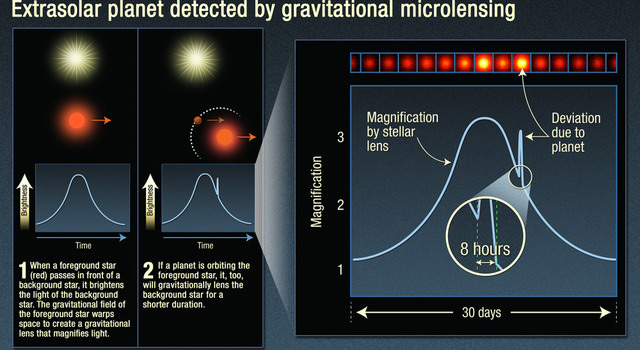
Micro-lensing is when a dark, invisible object passes in front of a distant background star, and its gravity acts like a magnifying glass, bending the starlight and making it temporarily brighter, right?
speaker_1HOST
Exactly.
speaker_1HOST
These OGLE micro-lensing events are traditionally attributed to those free-floating rogue planets we discussed earlier drifting through the galaxy.

Eamonn KerinsGUEST
And that means that these two methods- Transits is a great method for looking at the closer in planets.
Eamonn KerinsGUEST
Microlensing focuses on the further out planets around their host star.
Eamonn KerinsGUEST
So these two methods will allow us to span the entire demographic range of planetary distances from their host.
Eamonn KerinsGUEST
And microlensing will even be able to find planets that aren't bound to any host star.

David KippingHOST
Okay, great.
David KippingHOST
So we have a number for the number of stars, but how many planets are there around these stars? Thanks to a planet-hunting technique called gravitational microlensing, which is really sensitive to cold, distant exoplanets, we've determined that every star, on average, has one cold planet.
David KippingHOST
Looking at another planet-hunting technique called transits, which looks at close-in warm planets around their star, we find on average, one warm planet per star.
David KippingHOST
Now, remember the way this averaging is working out is that there could be some stars out there which have no planets, and there could be some stars which are chocked full of them.