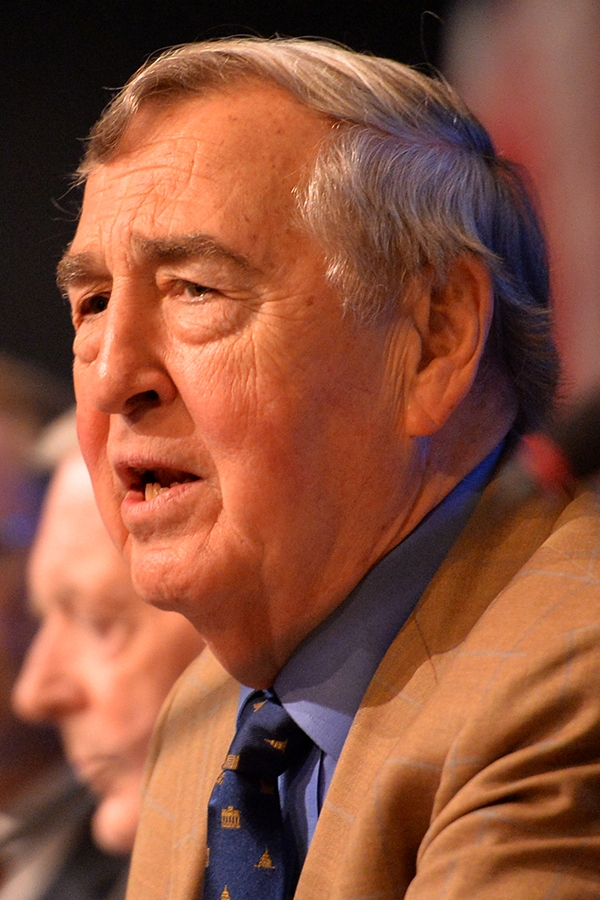
Graham T. Allison
American political scientist
10
APPEARANCES
10
PODCASTS
Aug 11, 2026


Graham AllisonGUEST
Well, thank you very much, and it's great to be talking to Ivo as well about the topic.
Graham AllisonGUEST
You've been interested in the questions for a long time, as I have, and my article mainly poses four questions that I'm confident we should be asking.
Graham AllisonGUEST
So first, I think most Americans haven't appreciated the extent to which the U.S. economy today is a highly leveraged hedge fund bet on an AI miracle.
Graham AllisonGUEST
Now, I believe in miracles, and I would hope that this would turn out to be one, but I think the extent of which AI is the driver today of American economic growth, American economic investments, and the great increases in the stock market.
14 MINS LATER

Graham AllisonGUEST
Well, thank you very much and it's, uh, great to be talking to Ivo as well about the topic.
Graham AllisonGUEST
And my article mainly poses four questions that I'm confident we should be asking.
Graham AllisonGUEST
So, uh, first, I think most, uh, most Americans haven't appreciated the extent to which the US economy today is a highly leveraged, uh, hedge fund bet on an AI miracle.
Graham AllisonGUEST
Now, I believe in miracles, and I would hope that this would turn out to be one, but I think the extent of which AI is the driver today of American economic growth, American economic investments, and the, uh, great increases in the stock market.
13 MINS LATER

David RothkopfHOST
Um, and so the, you know, the question is, how do you get the policy community up to speed on a series of major sweeping developments that are happening faster than any sweeping developments have ever happened before? This is happening faster than the speed of government.

Leslie VinjamuriMODERATOR
Fair play.
Graham AllisonGUEST
Uh, I was heartened by the summit, and we'll come to that in a second, because it started with what I think is a proper diagnosis of the problem.
Graham AllisonGUEST
An answer actually to your question when President Xi said to President Trump, "The question is, are we gonna be able to overcome Thucydides' Trap?" I think that's a right definition, a diagnosis, a clear-eyed diagnosis of the problem.
Graham AllisonGUEST
So what's the problem? And you c- again, simplistically put, a great contradiction in which there are simultaneously two compelling sets of imperatives.
Graham AllisonGUEST
China is a meteoric rising power, and as far as I can see, is gonna continue to rise.
Leslie VinjamuriMODERATOR
[laughs]


Rune LykkebergHOST
You know, apart from some good fortune, and of course, which I think is very important, the collective memory of not one but two world wars, what did it, in your view, take to build this long and historically unique peace?
Graham AllisonGUEST
So I think most of us, having lived our whole lives in an era without great power wars, have somehow come to believe that peace is a natural condition of mankind.
Graham AllisonGUEST
The fact that, uh, we saw in this century, in the last century, World War I in Europe, uh, the period 1914 to 1918, that basically took a continent that had previously been the, the driver of civilization and burned it down, and almost came to the end of the Europe at, as it had been as the center, you know, the, the, the central focal point of civilization for the previous five hundred years.
Graham AllisonGUEST
Then within a single generation came World War II, starting in Europe in 1938.
Graham AllisonGUEST
So when we came to the end of World War II in 1945, the, uh, people we now revere as wise men, uh, reflecting on what happened in World War II, in which we had killed about fifty million people, in World War I with maybe twenty-five million deaths.
17 MINS LATER

Alfred JohnsonHOST
How does the background and our collective histories impact the way that both sides are approaching this present moment?
Graham AllisonGUEST
That's a great question, and it-- you're absolutely right that that's something that Lee Kuan Yew observed.
Graham AllisonGUEST
So in the Chinese story, which he would always say Americans needed to study more, China's history says China was the center of the universe for all of history until the last two hundred years, when Westerners with technology showed up to humiliate China in what they call the Century of Humiliation.
Graham AllisonGUEST
So in that way, the leadership of China, Xi Jinping and the people who work for him, and most thinking Chinese see what happening now, they call it making China great again.
Graham AllisonGUEST
Xi Jinping's version of this, which was out before Trump's, was called the, quote, "Great Rejuvenation of the Great Chinese People." So that's what they think is happening.
Graham AllisonGUEST
So we've grown up in the American century in which an America that led the world in defeating Nazism and Japan in World War II then created a whole new international security order, a pretty amazing international security order in which we, or my s-- people as old as I am, have had an opportunity to live our whole lives without great power war.
18 MINS LATER
Alfred JohnsonHOST
If, if we were to get to the hundred-hundred-nine world and get from this unstable equilibrium that we're in today to re-equilibration of some kind, what would need to happen?

Megan O'SullivanMODERATOR
Some of our students, you know, may not have the perspective that you have.
Graham AllisonGUEST
Well, th- thank you, Meghan, and it's an honor to be part of such a distinguished panel inaugurating this, uh, the Carnesale Gatherings.
Graham AllisonGUEST
Let me d- do a quick, uh, uh, three hoo-rahs for Dan Poneman for his initiative in, in making this happen, which is truly w- extremely well-deserved, but wouldn't have happened otherwise.
Graham AllisonGUEST
And to Meghan, for keeping at the top of the flagpole the issue of nuclear security, which was actually the issue that got Paul Doty interested in this idea to begin with, and the rest of us piece by piece as we've, as we've come between.
Graham AllisonGUEST
And so I w- I wanted to just to, again, for people that haven't followed it or haven't been thinking about it lately, to start with a pop quiz, and then I'll give you a little tidbit of history, and then we'll go from there.
Graham AllisonGUEST
So the quiz is, uh, so nine is the answer to one of the most significant questions about the international security order today.
John F. KennedySOUNDBITE_SPEAKER
I regard that as the greatest possible danger and hazard.


Graham AllisonGUEST
China believes that it was the center of the universe forever in its history until Westerners a couple of hundred years ago, including in particular the Brits, showed up with technology that humiliated China, and that now China is rising in to its natural place.
Graham AllisonGUEST
That, that's a, a, a Thucydidean rivalry, as I say, the fiercest of all times.
Graham AllisonGUEST
But they also recognize the contradictory, uh, imp- imperative, uh, to cooperate a-as partners in avoiding misunderstandings, miscalculations, misjudgments that could lead them into a war that would be catastrophic each for himself.
Graham AllisonGUEST
It was, uh, F. Scott Fitzgerald, the Great Gatsby guy, said, "The test of a first-class mind is to be able to hold two contradictory ideas in your head at the same time and also function," and I think that's what they're struggling with.


Graham AllisonGUEST
First point, most important point, is that there's more questions than answers, though there's a huge level of uncertainty currently about what's happening and about what's likely to happen.
Graham AllisonGUEST
Part of this is Clausewitz's famous fog of war, but it's a fog of war that's actually increased because we got two big fog machines, uh [chuckles] adding to the confusion, uh, namely Trump and the administration on the one hand and Bibi on the other, and then we got all the chattering class around this.
Graham AllisonGUEST
So I would say, why did Trump decide to go to war now? There's six different reasons he and the administration have given, and each one they back around.
24 MINS LATER


Tracy AllowayHOST
But why is that? And does it mean that you need to reconsider the Thucydidean framework?
Graham AllisonGUEST
And in the book that I wrote called, uh, uh, Destined for War: Can the US and China Escape Thucydides's Trap?, I look at the last 500 years and find 16 incidents, or 16 cases, in which a rising power seriously threatens a ruling power.
Graham AllisonGUEST
So in these, sometimes before the rising power has actually overtaken the ruling power, something happens.
32 MINS LATER
Tracy AllowayHOST
What's the underlying motivation there? Because most people would look at a headline like, "The UK wants to make its own bullets" (laughs) as, you know, a predecessor maybe to, to some sort of military conflict.


Fareed ZakariaHOST
Tell us, give us a little bit more of a sense of what it is that you and your co-author, Mike Morell, saw that made you worry.
Graham AllisonGUEST
Well, we, we found ourselves just in our private conversations, uh, c- confessing to each other that we were hearing echoes of the sort that we had heard before 9/11, the terrible attack on the World Trade Center and the Pentagon that killed 3,000 people.
Graham AllisonGUEST
So what kind of t- what kind of, of echoes or warning lights? First, the Mideast on fire.
Graham AllisonGUEST
Chaos is where Islamic, uh, groups, uh, regroup, and when we're seeing a regrouping of them in Afghanistan with ISIL-K, in Syria, in, uh, Iraq, uh, in the wars through the region.
Graham AllisonGUEST
Secondly, uh, every day as Avril Haines, as the director of National Intelligence has said, every day that the war in Gaza goes on, uh, you're seeing a, a sea change in the Islamic and Palestinian world as they think about, you know, their future, their lives.
Graham AllisonGUEST
Third, uh, here in the US, there's been this almost normalization of violence with more and more people being deranged and deluded and therefore possible, uh, possibly attracted as this, uh, Texas, uh, uh, driver who, who killed the 14 people in New Orleans, so a co- confluence of factors.
Fareed ZakariaHOST
Is this a losing battle in a sense that you can't stop people having access to weapons that are very deadly?