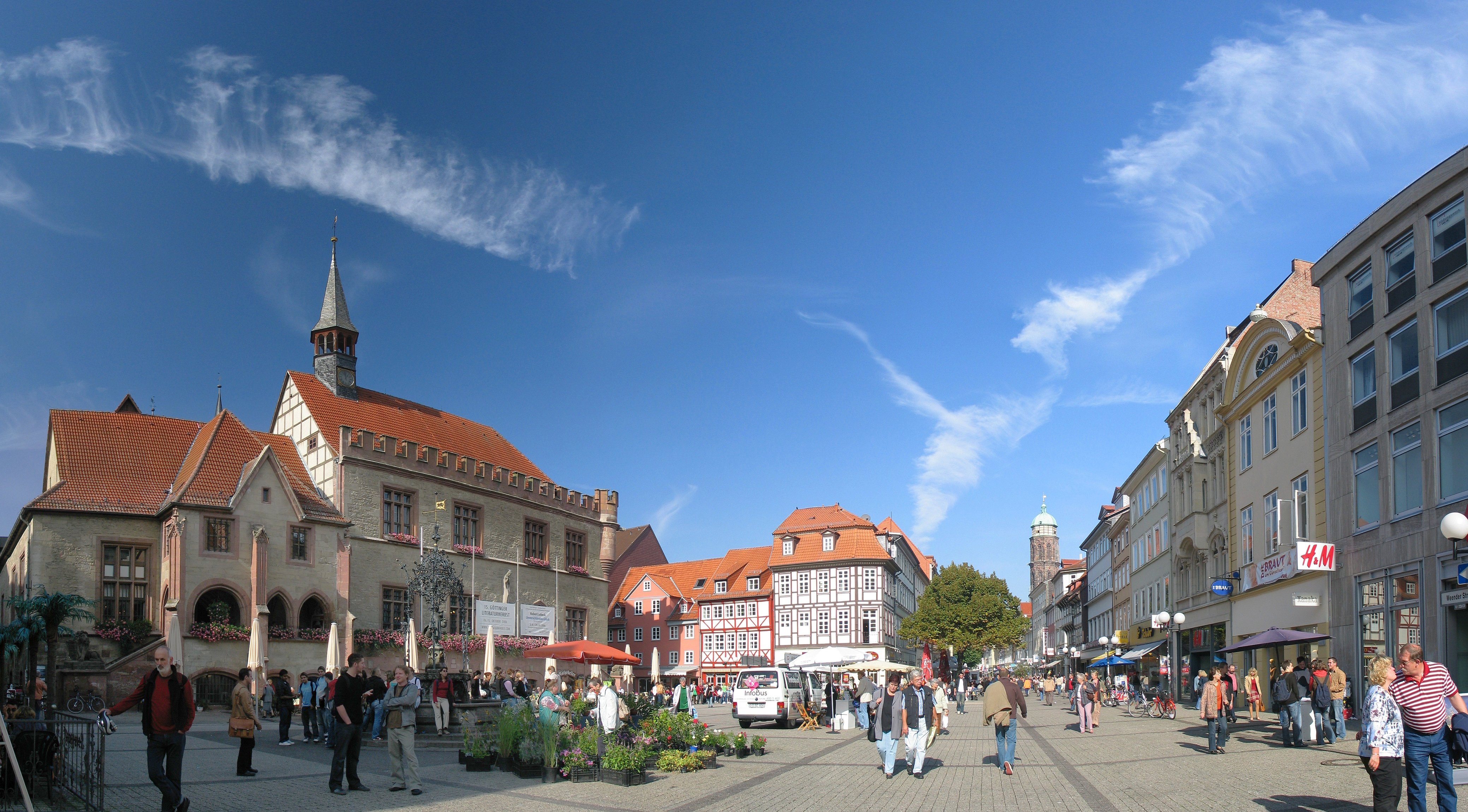
Göttingen
City in GermanyWikipedia
111
MENTIONS
66
EPISODES
62
PODCASTS
Search complete. 111 mentions across 66 episodes found for "Göttingen".
Sep 16, 2026

Andrea GambarottoGUEST
And my story, um, was again focused on the concept of teleology.
Andrea GambarottoGUEST
And my, my, my, the thesis that I was defending i- in an historical argument was that, well, biology as a s- as a science in Germany was in, to a large part, a result of a conceptual shift that happened between Kant on the one hand and the post-Kantians, so both these Göttingen people and natural, and, and the philosophers of nature.
Andrea GambarottoGUEST
And for them, teleology was to be understood as a constitutive feature of biological systems, and this is what differentiates a biological object from a physical object and what justifies the label of, uh, biology as a science of living beings, which emerges and is formulated as such only in 1802.
Andrea GambarottoGUEST
It was not there before.

speaker_2HOST
Oh, yeah.
speaker_2HOST
Gerlach Adolph was instrumental in founding the University of Göttingen in 1734.
speaker_1HOST
Wow.
speaker_2HOST
And in the 18th century, founding a university wasn't just some administrative task.
18 MINS LATER
speaker_1HOST
But he had brains.
speaker_2HOST
Despite his modest background, he was an undeniable genius, a true polymath.
speaker_2HOST
He managed to secure a rigorous education at the prestigious universities of Göttingen and Leipzig.
speaker_1HOST
The resume this guy builds is staggering.

JudithHOST
So she couldn't really get high up with what she wanted to do.
JudithHOST
So she switched to Göttingen, which is another big university town.
JudithHOST
This is always in the region, the state of Hesse.
JudithHOST
And in Göttingen, that was a bigger university, and she was one of five women Compared to how many male students? 300.
JudithHOST
Wow.
JudithHOST
Yes.

speaker_6VOICE_ACTOR
He can only have been an ass after all.
Marian MarkiticNARRATOR
End of the Mule, read by Marian Margititsch, Hungary, on March 8, 2006, Göttingen, Germany.
Marian MarkiticNARRATOR
Aesop's Fables.
Marian MarkiticNARRATOR
The Hound and the Fox.

Thomas777GUEST
That seminar method of a university lecture, that, that, that, that's, that's the German way of doing things, and specifically it came out of the German historical school.
Thomas777GUEST
Um, and, uh, von Ranke, building on the Göttingen school's conventions, he established this ongoing historical seminar, you know, um, where he emphasized original source documents, you know, primary sources, narrative history, and in understanding the role of economics in the state system, which again, was a paramount interest of his, because he wasn't an economist.
Thomas777GUEST
You know, at base, he was a historicist and a political theory guy.
Thomas777GUEST
You know, he, he said, "Okay, what, what's the narrative history of this people in question? How do they interact in the international system in their epoch? And what's their impression of their role within those systems?" And, uh, this was so impactful on the continent, in the UK, and even in American academe.

speaker_10NARRATOR
He can only have been an ass after all.
Marian MargititschNARRATOR
End of the Mule, read by Marian Margititsch, Hungary, on March 8, 2006, Göttingen, Germany.
Marian MargititschNARRATOR
Aesop's Fables.
Marian MargititschNARRATOR
The Hound and the Fox.

Theo WrenfieldNARRATOR
In the summer of 1925, a young German physicist named Werner Heisenberg found himself struggling with hay fever so severe that he could barely work.
Theo WrenfieldNARRATOR
The 23 year old had been wrestling with the problems of atomic theory in Göttingen under Max Born.
Theo WrenfieldNARRATOR
But the pollen laden air was making him miserable.
Theo WrenfieldNARRATOR
Seeking relief, Heisenberg decided to escape to Heligoland, a small treeless island in the North Sea where the air was clear and the landscape stark.
Theo WrenfieldNARRATOR
He walked down to the southern tip of the island and waited for sunrise, watching the sky lighten over the sea.
Theo WrenfieldNARRATOR
He later recalled feeling that he had glimpsed a deep structural layer of nature, something beautiful and strange beneath the familiar surface of the world.
Theo WrenfieldNARRATOR
When Heisenberg returned to Göttingen and showed his work to Max Born, the older physicist immediately recognized the mathematical structure.
Theo WrenfieldNARRATOR
The arrays of numbers Heisenberg had invented were matrices, mathematical objects that had been studied by mathematicians but rarely used in physics.

David WalesNARRATOR
He was born on the 14th of September, 1769, and is therefore now in his 80th year.
David WalesNARRATOR
After going through the ordinary course of education at Göttingen, and having made a rapid tour through Holland, England, and France, he became a pupil of Werner at the Mining School of Freiburg, and in his 21st year published an essay on the basalts of the Rhine.
David WalesNARRATOR
though he soon became officially connected with the mining corps he was enabled to continue his excursions in foreign countries for during the six or seven years succeeding the publication of his first essay he seems to have visited austria switzerland italy and france his attention to mining did not however prevent him from devoting his attention to other scientific pursuits among which botany and the then recent discovery of galvanism may be especially noticed botany indeed we know from his own authority occupied him almost exclusively for some years but even at this time he was practising the use of those astronomical and physical instruments which he afterwards turned to so singularly excellent an account the political disturbances of the civilized world at the close of the last century prevented our author from carrying out various plans of foreign travel which he had contemplated and detained him an unwilling prisoner in europe in the year seventeen ninety nine he went to spain with the hope of entering africa from cadiz but the unexpected patronage which he received at the court of madrid led to a greater alteration in his plans and decided him to proceed directly to the spanish possessions in america and there gratify the longings for foreign adventure and the scenery of the tropics which had haunted him from boyhood but had all along been turned in the diametrically opposite direction of asia After encountering various risks of capture, he succeeded in reaching America, and from 1799 to 1804 prosecuted there extensive researches in the physical geography of the New World, which have indelibly stamped his name in the undying records of science.
David WalesNARRATOR
Accepting an excursion to Naples with Gailusac and Van Boeck in 1805, the year after his return from America, The succeeding twenty years of his life were spent in Paris, and were almost exclusively employed in editing the results of his American journey.

Pamela NagamiNARRATOR
We have therefore only two towns in the electorate of any considerable size.
Pamela NagamiNARRATOR
Next to these are Stade, Verden, Zell, Clausthal, and Göttingen, where at a later date George I founded a famous university.
Pamela NagamiNARRATOR
The bishopric of Bremen contained no very large town, for the city of Bremen was an independent free town and did not go with the bishopric.
Pamela NagamiNARRATOR
But Stade from its neighbourhood to the mouth of the Elbe was of considerable importance.
2 HRS 18 MINS LATER
Pamela NagamiNARRATOR
The promotion of Bishop Butler, the author of the Analogy, stands to her credit.
Pamela NagamiNARRATOR
It is usual to speak contemptuously of George II and especially of his indifference to literature and culture.
Pamela NagamiNARRATOR
It is only fair to remember that acting upon the advice of his Hanoverian ministers, he was the founder of the University of Göttingen, which is properly called after him Georgia Augusta.
Pamela NagamiNARRATOR
For a long time Göttingen held the highest rank among the universities of Germany, and though not now the first, is still of considerable importance.

Mario KrennGUEST
And several people have done that.
Mario KrennGUEST
There were ideas in the 1990s with St. Stephan Hell, who is now at Göttingen, who got the Nobel Prize for Chemistry for this work, for breaking this 100-year limit.
Mario KrennGUEST
upper limit, resolution limit.
Mario KrennGUEST
And we also tried to use AI for finding new ways how one could do that.
56 more episodes mention Göttingen.
Create an account to see the whole feed, search across every transcript, and follow the entities you care about.