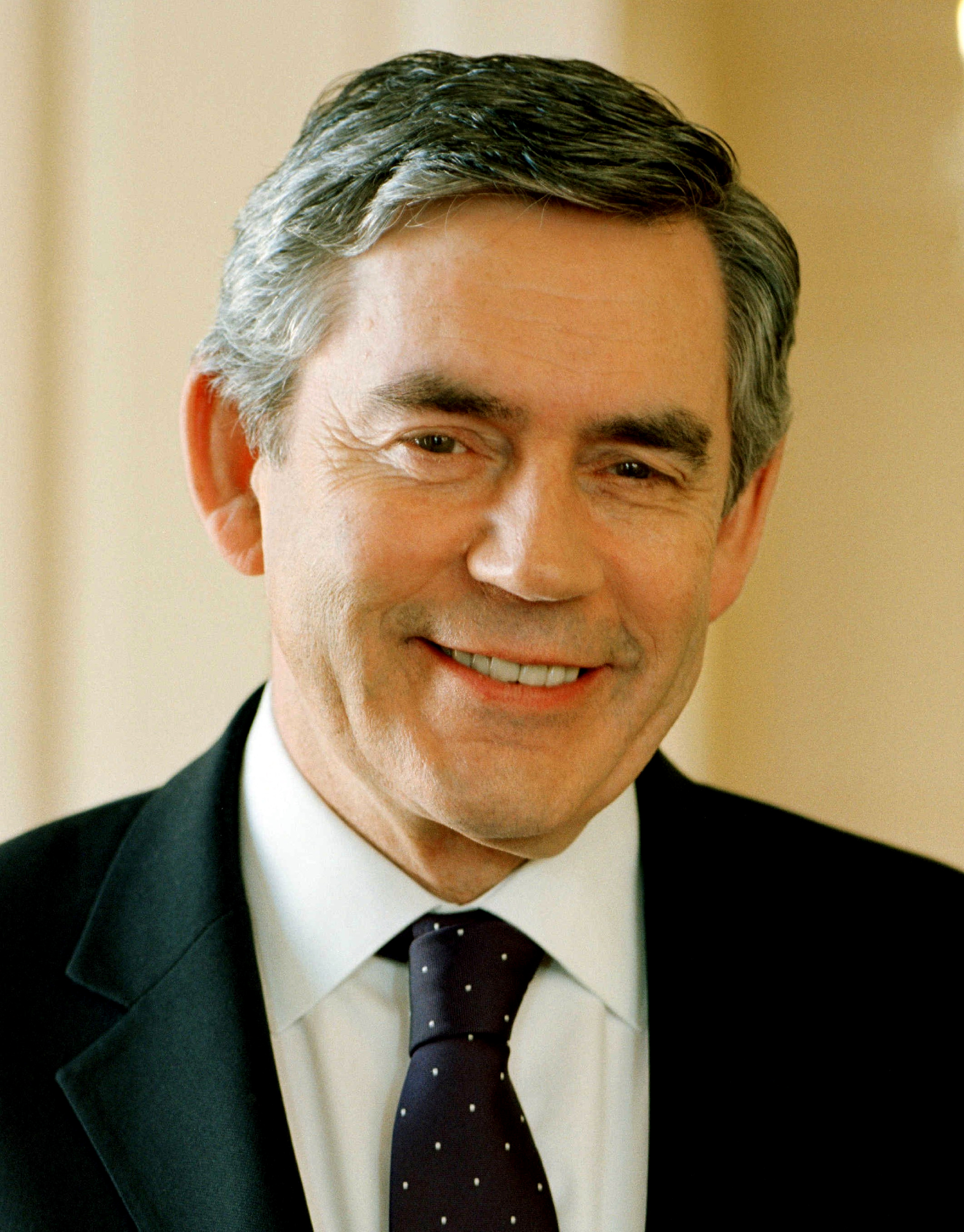
Gordon Brown
Former Prime Minister of the United Kingdom
9
APPEARANCES
9
PODCASTS
Sep 20, 2026


Rory StewartHOST
What's your advice to the seventh in terms of how he addresses these two things, the global breakdown and the civic breakdown?

Gordon BrownGUEST
Well, I r- realized when I was prime minister and we had the global financial crisis, that there were two things that were absolutely crucial, uh, for leadership, and the first is you've got to get to the root of the problem that you're dealing with.
Gordon BrownGUEST
You know, during the financial crisis, people thought it was a liquidity problem that the banks had.
Gordon BrownGUEST
It was actually a solvency problem, and we had to understand that before we could deal with it.
Gordon BrownGUEST
So you've got to think two steps ahead, three steps ahead, and that's what we tried to do during the financial crisis, and I, I think that's where we are at the moment.
12 MINS LATER
20:35

There's just much more money to pump into these big AI startups, and that one of the problems that European and British firms are facing is a general sense that if they need investment, they need to go to the next stage, they have to go to the United States.


Gordon BrownGUEST
Well, can I say, first of all, I'm delighted to appear not with Bronwyn only, but with Francis Fukumar.
Gordon BrownGUEST
And I do believe that he's made an outstanding contribution to our scholarship over these 40 years.
Gordon BrownGUEST
And he's recognized and admired not just in this country and continent, but every continent.
Gordon BrownGUEST
suggests that there are 88 democracies and 91 autocracies and that three quarters of the world is now living in less than democratic circumstances.
9 MINS LATER


Gordon BrownGUEST
You yourself, uh, Steph, I know for a fact you do great, uh, community work and you're very much involved in many organizations that are helping people rebuild their lives or live better lives.
Gordon BrownGUEST
I do think, um, I can talk about my own communities, uh, a mining community that was a textile linoleum town, and where the jobs have actually gone, and where the biggest employer is probably now the National Health Service and maybe the local, uh, uh, college, and where you have struggled to find the kind of jobs in manufacturing, uh, that were, uh, quite well paid in the past, uh, and where people have had to emigrate or people have had to leave the town to other parts of the United Kingdom to get the kind of jobs that they, they, they want.
Gordon BrownGUEST
So I think we're describing a post-industrial future that is hitting, uh, towns and, and, and villages and cities right across the West.
Gordon BrownGUEST
So economic, uh, improvement is of course really important, and what I do concentrate on in the book is how is it that the British economy has so much innovative, uh, uh, strength and genius? How have we been at the center of so many medical advances and still are technology, quantum computing as well as AI.
Gordon BrownGUEST
Equally, uh, you look at the, um, environmental technologies, wind and wave power, which is the Northeast renewables, uh, the, of England are doing well in that, and then the cultural industries where Britain is leading the world.
Gordon BrownGUEST
How can we make more of that in the creation of jobs, not just in the Golden Triangle, but right across the country? And how can we prevent companies that are sort of scaling up, uh, being sold off to America and losing control where there's research and development, also the jobs go away from Britain.
23 MINS LATER

Robert PestonHOST
Is that because in your view, it is Mark Carney, who has m- pretty much more than anybody else, stood up to Donald Trump in a pretty explicit way? Uh, and do you think Andy Burnham could take a lesson from that?

2:13

Just spell out for us, obviously the whole book is on this, but in a nutshell, what is the connection as you see it?
Gordon BrownGUEST
I think we've got to start from what has happened to civic association over the last 50 years.
Gordon BrownGUEST
We've got to look at why people who used to go to churches and faith groups, why people who were involved in trade unions, why people who were in working men's clubs and in women's institutes and mothers' unions and a whole range of uniformed organizations for young people why all these organizations in most countries in the world, not all countries in the world, but in most countries of the world, particularly in the West, has been weakening.
Gordon BrownGUEST
And you've got to look then at what it is that is encouraging people to be more individualistic and less communitarian in their attitudes.
Gordon BrownGUEST
And this is something that I will come on to say is not, in my view, common or a part of the Jewish community where community life is very strong.
Gordon BrownGUEST
But what has happened is that whether because of suburbanization or deindustrialization or whether it's because of the rise of television and then the rise of the Internet, people have ceased to participate in the way they used to in active community organizations.
Gordon BrownGUEST
So our findings are that half the citizens of most cities countries, particularly the advanced economies, are not involved in any single activity whatsoever, whether it's a social club, a cultural club, a faith group, or a trade union.
13 MINS LATER


Gordon BrownGUEST
Um, 1984, you may remember that the government of the day, um, decided all the trust banks throughout New Zealand should combine and become Trust Bank and would be, uh, listed on the stock exchange.
Gordon BrownGUEST
Taranaki refused to do that at the time, uh, despite enormous pressure, and went alone.
Gordon BrownGUEST
Of course, Trust Bank was later l- uh, became a reality, listed on the stock exchange and was bought by Westpac and Trust Bank, all the trustee banks throughout the country disappeared.
Gordon BrownGUEST
Taranaki, the T- through the TSB Bank thought, "Right, we are going on our own, so let's set up a charitable founder or, sorry, a community-based, uh, trust to hold its shares," and the TSB Community Trust was formed with the sole intention of ensuring the bank could never be sold.


Bob McDevittHOST
Do you want to tell us a little bit about this new novel, Dark Accords, that you'll be talking about?

Gordon BrownGUEST
So Mr. Robertson's actually got something to do with this book because I can't remember if it's nine or 10 years ago when I was at Bute Noire, promotionally, I decided to write a short story about something that had 10 years, it is 10 years, I thought it was.
Gordon BrownGUEST
I wrote a short story about something that supposedly happened in Ireland which was five women were accused of witchcraft and four of them were executed and one of them escaped to Kilmarnock and the downside to that is she then returned 12 years later back to Bute and was hung which either says a lot about Kilmarnock or something I didn't know but that story sat for ages and then what happened was when I got the new deal for the Blake Glover books I was sitting with two books ready to go And I just said to the agent, do you think there's a longer story in this? And I took the short story and turned it into a novel.
Gordon BrownGUEST
crosses the country and eventually ends up in Dundee where she meets a guy called Sir George Mackenzie who is known in Scottish history as Bloody Mackenzie so it's a real person and he helps her and one of his friends to overcome the accusations of witchcraft and then mixed in there as well is there's a threat to kill the prince of the UK, James, who will eventually become James II.
22 MINS LATER

Dawn GeddesHOST
When it comes to, so that's the events that you guys are involved in, but what about the events you're most looking forward to? Gordon, what are you most looking forward to this year?


Gordon BrownGUEST
Can I make a quick comment there, please? It's undeniable that the merger will probably go ahead and we're fighting it because sometimes you don't want to merge with a particular entity.
Gordon BrownGUEST
And yes, it started Ashburton, South Canterbury Finance, and Merrick Finance, and a few others.
Gordon BrownGUEST
But after this mega merger is done, guess what position we will hold? The answer, we will then become the seventh biggest bank still.
Gordon BrownGUEST
And Simon, you've got far more knowledge on banking than me, but one thing I have found out, along with others, is that the Reserve Bank of New Zealand has reduced common equity requirements across the system by $5 billion, freeing up capital for smaller banks and deposit takers to compete more effectively with the big four.


Gordon BrownGUEST
You know, I think it's, it's, it's a very, um, kind of foggy view on, on what's happening in the industry.
Gordon BrownGUEST
It's terrible that people have lost their jobs, that people have lost their businesses.
Gordon BrownGUEST
The b- the pandemic exposed a lot of people's flaws when it comes to, you know, distributing too far, looking at...
Gordon BrownGUEST
You know, the Modern Times is that story that I, that I hate to tell, but it's like, it was very eye-opening to me because I felt they were top of the world, right? One of the best brands in the US, let alone in, in, on the West Coast.
12 MINS LATER


Gordon BrownGUEST
And he was very kind to them and I persuaded them both to wear ties for that day.