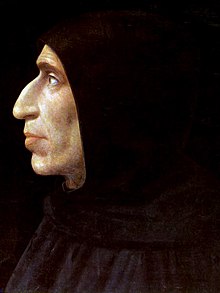
Girolamo Savonarola
Italian friarWikipedia
184
MENTIONS
43
EPISODES
41
PODCASTS
Search complete. 184 mentions across 43 episodes found for "Girolamo Savonarola".
Oct 27, 2026

Phil BensonNARRATOR
It is the name given to the symbol of the protector of Florence, and carries us back to the days of the Romans, when the city was supposed to be under the protection of Mars, the god of war.
Phil BensonNARRATOR
as we have seen a statue of this god stood near the ponte vecchio but it was washed away by a flood thereafter a lion symbolic of strength and majesty was substituted for the figure of the god and the animal was represented as seated and guarding the arms of the city the marzocco wearing an enamelled crown set in gold was placed in front of the palazzo vecchio as a symbol visible to all of the strength and power of the florentine republic and as such was kissed by prisoners of war in token of submission in mediaeval days a ringhiera or platform was built in front of the palace for the use of the signoria who sat in state upon it to watch the festers held in the square beneath or to hear the proclamations which they desired to issue read by their officers to the attendant citizens It was from this platform, which was demolished in 1812, that the fathers of the city watched the martyrdom of Savonarola and his two companions on the 23rd of May 1498, and it was in the grim old palace behind that the great preacher and his two friends spent their last night on earth, and partook of their last communion before they were led out to die.
Phil BensonNARRATOR
today the ringhiera is replaced by a flight of stone steps and as we mount them and take our seats alongside some of the beggars and loafers who alas are unhappily so common in italy on the broad stone ledge which runs around the palace it is difficult to picture to ourselves the dire happenings of these olden times so very different are the scenes on which we are looking down true there is a loggia dei lanci at right angles to us across the corner of the square forming part of the uffizi palace recalling to our minds the turbulent age when even the medici did not feel themselves safe without their own private bodyguard of swiss lancers but now it is filled with statuary and forms a shaded refuge from the noonday sun for tired workmen who take their siesta here It also serves as a convenient place where tourists can read or write their letters, for the general post office is just round the corner, and the ubiquitous cellar of picture postcards is never far off, while the little street Arabs make of it a special playground, chasing each other with childish unconcern, round the base of the Perseus of Cellini, the Judith and Holofernes of Donatello, and the rape of the Sabines of Gianda Bologna.
Phil BensonNARRATOR
In the morning especially, the whole square is full of life and movement.

Donald Gray BarnhouseSOUNDBITE_SPEAKER
Eternal truth may become associated with our names even in this day.
Donald Gray BarnhouseSOUNDBITE_SPEAKER
Yes, it is Paul's gospel, and it was the gospel of Augustine, of Savonarola, of Tyndale and Huss, of Wycliffe and Peter Waldo.
Donald Gray BarnhouseSOUNDBITE_SPEAKER
It was the gospel of Luther and Calvin, of Wesley and Whitefield, of Moody and Torrey.
Donald Gray BarnhouseSOUNDBITE_SPEAKER
It is my gospel, thank God, and I trust by the grace of the Lord that you can bow your head and say, Lord Jesus, it is also my gospel.

Jeff WinkleHOST
Is this about the plague? It's about kind of the center is the conflict between the Medici
David NoeHOST
and Savonarola.
David NoeHOST
Oh.
David NoeHOST
Which is fascinating.
Jeff WinkleHOST
You have this friar who is kind of preaching apocalyptic things.
David NoeHOST
Yes.
Jeff WinkleHOST
What I find most fascinating about this is about how Savonarola is trying to preach Florence back to a kind of simple pre-Constantine
David NoeHOST
Christianity.

Doug NormanNARRATOR
And yet when he got there, they executed him.
Doug NormanNARRATOR
And then later, Savonarola, another early reformer.
Doug NormanNARRATOR
So what changed in 1517? Well, there were four forces that converged.
Doug NormanNARRATOR
Printing could spread the message faster than church authorities could contain it.

Jordan CooperGUEST
And he's saying, well, this has a forensic meaning.
Jordan CooperGUEST
He's not the first, Savonarola, for example, comes up, comes to a very similar conclusion about justification.
Jordan CooperGUEST
And so I think with the doctrine of justification, you see a mutual interplay there, right? Like Luther is really understanding grace while Melanchthon is doing this careful textual study of what justification language means in Paul.
Jordan CooperGUEST
So they're constantly, you know, helping one another to discover things.

Jim HedrickNARRATOR
Thus it happens that whenever those who are hostile have the opportunity to attack, they do it like partisans, while the others defend lukewarmly, in such wise that the prince is endangered along with them.
Jim HedrickNARRATOR
it is necessary therefore if we desire to discuss this matter thoroughly to inquire whether these innovators can rely on themselves or have to depend on others that is to say whether to consummate their enterprise have they to use prayers or can they use force in the first instance they always succeed badly and never compass anything but when they can rely on themselves and use force then they are rarely endangered hence it is that all armed prophets have conquered and the unarmed ones have been destroyed besides the reasons mentioned the nature of the people is variable and whilst it is easy to persuade them it is difficult to fix them in that persuasion and thus it is necessary to take such measures that when they believe no longer it may be possible to make them believe by force if moses cyrus theseus and romulus had been unarmed they could not have enforced their constitutions for long which happened in our time to fra girolamo savonarola who was ruined in his new order of things immediately the multitude believed in him no longer and he had no means of keeping steadfast those who believed or of making the unbelievers to believe Therefore, such as these have great difficulties in consummating their enterprise, for all their dangers are in the ascent, yet with ability they will overcome them.
Jim HedrickNARRATOR
But when these are overcome, and those who envied them their success are exterminated, they will begin to be respected, and they will continue afterwards powerful, secure, honored, and happy." to these great examples i wish to add a lesser one still it bears some resemblance to them and i wish it to suffice me for all of a like kind it is hiero the syracusan this man rose from a private station to be prince of syracuse nor did he either owe anything to fortune but opportunity for the syracusans being oppressed chose him for their captain afterwards he was rewarded by being made the prince he was of so great ability even as a private citizen that one who writes of him says he wanted nothing but a kingdom to be a king this man abolished the old soldiery organized the new gave up old alliances made new ones and as he had his own soldiers and allies on such foundations he was able to build an edifice thus whilst he had endured much trouble in acquiring he had but little in keeping chapter seven concerning new principalities which are acquired either by the arms of others or by good fortune those who solely by good fortune become princes from being private citizens have little trouble in rising but much in keeping a top they have not had any difficulties on the way up because they fly but they have many when they reach the summit such are those to whom some state is given neither for money or by the favor of him who bestows it as happened to many in greece in the cities of ionia and of the hellespont where princes were made by darius in order that they might hold the cities both for his security and his glory as also were those emperors who by the corruption of the soldiers from being citizens came to empire such stand simply elevated upon the good-will and the fortune of him who has elevated them two most inconstant and unstable things neither have they the knowledge requisite for the position because unless they were men of great worth and ability it is not reasonable to expect that they should know how to command having always lived in a private condition.
Jim HedrickNARRATOR
Besides, they cannot hold it, because they have not forces which they can keep friendly and faithful.

Timon ClineHOST
Yeah.
Timon ClineHOST
And he's sort of... you know, perfected, of course, you know, very, very strousing thing to bring up, but perfected the, the art of the, you know, the, the failure that Savonarola had, you know, he's figured out how you, how you actually succeed in this, in this regard, which, which can't be dependent on either love of yourself or even religious love or fealty, you could say has to be something else, which in any case, so the, What is your assessment? I know you don't get into this in the essay and we're stuck on Machiavelli, but I want to ask you this.
Timon ClineHOST
We can talk about this instead of the essay.
Timon ClineHOST
This is

John BurlinsonNARRATOR
This man is always ridiculed, hooted, reviled, mobbed, and very happy indeed is his fate if he is hanged, crucified, or made to drink of the deadly hemlock, for then his place in the affection of men is made secure, sealed with blood, and we proclaim him liberator or savior.
John BurlinsonNARRATOR
The Piazza Signora is sacred soil because there it was that Savonarola died.
John BurlinsonNARRATOR
John Brown's body lies a-mouldering in the grave, but his soul goes marching on.
John BurlinsonNARRATOR
J. Wilkes Booth linked his own name with that of Judas Iscariot and made his victim known to the ages as the emancipator of man.
29 MINS LATER
John BurlinsonNARRATOR
There is no other.
John BurlinsonNARRATOR
These men fought for us, and some of them died for us.
John BurlinsonNARRATOR
Socrates, Jesus, Savonarola, John Brown, Lincoln, saviors all.
John BurlinsonNARRATOR
They died that we might live.

Emma LaramyHOST
So at this point, he was finding commissions, but he had yet to establish anything resembling a dependable career.
Emma LaramyHOST
And when he returned to Florence in late 1495, the city was under the influence of Girolamo Savonarola, the Dominican preacher whose fierce attacks on luxury and moral corruption had swept through its religious and political life.
Emma LaramyHOST
Needless to say, it was a difficult place to be an artist associated with the recently expelled ruling family.
Emma LaramyHOST
But pretty soon after he returned, Michelangelo found support in another Lorenzo de' Medici.

David RonaldNARRATOR
This thought is repeated over and over again in his poetry, and if we bear in mind that he habitually regarded the loveliness of man or woman as a sign and symbol of eternal, inimutable beauty, we shall feel it of no less importance to discover who it was that prompted him to this or that poetic utterance.
David RonaldNARRATOR
that the loves of his youth were not so tranquil as those of his old age appears not only from the regrets expressed in his religious verses but also from one or two of the rare sonnets referable to his manhood the love of beauty the love of florence and the love of christ are the three main motives of his poetry This is not the place to discuss at length the nature of his philosophy, his patriotism, or his religion, to inquire how far he retained the early teaching of Ficino and Savonarola, or to trace the influence of Dante and the Bible on his mind.
David RonaldNARRATOR
I may, however, refer my readers who are interested in these questions to the Discourse of Signor Guasti, the learned essay of Mr. J. E. Taylor, and the refined study of Mr. W. H. Pater.
David RonaldNARRATOR
My own views will be found expressed in the third volume of my Renaissance in Italy, and where I think it necessary, I shall take occasion to repeat them in the notes appended to my translation.
33 more episodes mention Girolamo Savonarola.
Create an account to see the whole feed, search across every transcript, and follow the entities you care about.