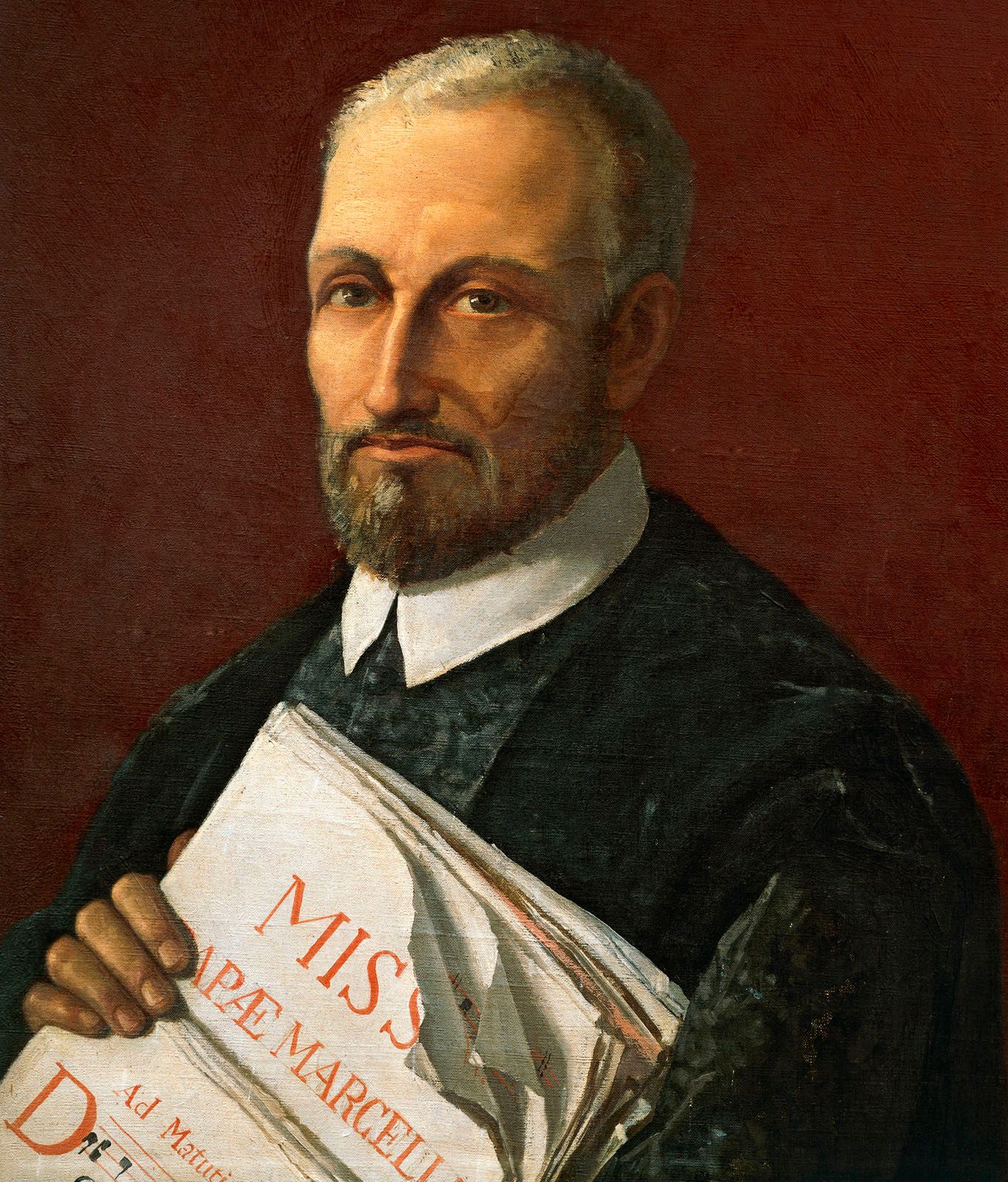
Giovanni Pierluigi da Palestrina
Italian composerWikipedia
48
MENTIONS
23
EPISODES
22
PODCASTS
Search complete. 48 mentions across 23 episodes found for "Giovanni Pierluigi da Palestrina".
Sep 15, 2026

Lew SmoleyHOST
It is very rare for any early symphony to attain the level of polyphonic mastery that Simpson achieves in the central part of his first symphony, whose purity of expression and quiet grandeur is unique in the world of contemporary music.
Lew SmoleyHOST
The only influence that the listener may readily recall is Palestrina, though the expansive design and harmonic simplicity is strongly typical of Simpson.
Lew SmoleyHOST
The slow movement, whose main idea is an inversion of the second theme, fugato at the first movement, then rises to a lyrical climax.
Lew SmoleyHOST
A mysterious transition at the entry of the horns introduces a gently The second section returns the tranquility and is denoted by woodwinds and horns.

NathanielGUEST
The Latin mass is incredible.
NathanielGUEST
But like you say about the Italians, I studied Palestrina when I was studying counterpoint.
NathanielGUEST
Every Jewish kid who wants to be a composer has to go through the Catholic Church.
NathanielGUEST
I wrote a Renaissance mass, Palestrina style.
NathanielGUEST
So this is nothing new to me.
NathanielGUEST
So there was a beauty that drew you to the church.
NathanielGUEST
It's not just the beauty.
NathanielGUEST
It's the Latin mass.

Chris MessersmithVOICE_ACTOR
Mm-hmm.
Duane NockVOICE_ACTOR
They're swinging Bach, and what's keener, they're doing the shag to Palestrina.
Chris MessersmithVOICE_ACTOR
[laughs]
Duane NockVOICE_ACTOR
As a connoisseur of music, of course I love the works of Rimsky-Korsakov, but today I note with a bitter shrug, they've made Scheherazade a jitterbug.

Phil BensonNARRATOR
The whole world of musical compositions was his to conquer, and he conquered it at the rate of about two great masters a month.
Phil BensonNARRATOR
From Handel to Richard Strauss, even from Palestrina to Debussy, the achievements of genius lay at his mercy.
Phil BensonNARRATOR
He criticised them with a freedom that was entirely unprejudiced by tradition.
Phil BensonNARRATOR
Beethoven was no more to him than Arthur Sullivan; indeed, was rather less.

speaker_0NARRATOR
Francis X. Haberle, Plainsong by the Rev.
speaker_0NARRATOR
T. Helmore, La vie de Pierluigi da Palestrina par Abbe Baini, Life of Johann Sebastian Bach by Splitta, halkins's history of music dr burney's history of music life of hendel by rochester life of hendel by marshall life of haydn by dr noll life of mozart by dr noll life of mozart by otojan mozart's letters Life of Beethoven by Dr. Noll.
speaker_0NARRATOR
Beethoven's Letters.
speaker_0NARRATOR
Seyfried's Anecdotes of Beethoven.
speaker_0NARRATOR
Hogarth's Memories of the Opera.
speaker_0NARRATOR
Havais's Music and Morals, Sir George Grove's Dictionary of Music and Musicians, Ehlert's Essays on Music, Rockstraw's History of Music, Fillmore's History of Music, The Imperial Biographical Dictionary, History of Modern Music by John Huller, Musical Studies by Francis Hufford, The Story of Music by J. Henderson.
speaker_0NARRATOR
Letters from Great Musicians giovanni pierluigi da palestrina born fifteen fourteen died fifteen ninety four very holy father study and care are never in accord especially is this so when the latter arises from poverty with the necessities of life to ask more is to fail in moderation and temperance one can easily deliver one's self from other cares and the man who is not content with this has only himself to blame but those alone who have proved it know how painful is this labor to maintain honestly themselves and those belonging to them and how this obligation incapacitates the mind for the study of science and the liberal arts i have always had sad experience of this now more than ever always do i render thanks to the divine goodness which has permitted that in spite of my greatest embarrassments i have never interrupted the study of music wherein i have found also a useful diversion In the career which I have run, and of which the end approaches, I have published a great number of my compositions.
speaker_0NARRATOR
But I have many others, the imprinting of which is retorted only by my poverty.

Stephen LaytonGUEST
But looking back, that's why it happened.
Stephen LaytonGUEST
That's why I went the extra 100 miles to get together people to sing, and then I put on the very eclectic program of Palestrina and Poulenc in the same breath.
Simon MooreHOST
[laughs]
Stephen LaytonGUEST
And put it on in King's Chapel, and then, you know, the, the rest is history.

Simon EversNARRATOR
He had a weak, good-looking little face, and a little black moustache turned up at the ends.
Simon EversNARRATOR
He was discoursing to his neighbour on Palestrina.
Simon EversNARRATOR
The Dean's proclamation had been elicited by some remark of Sir Archibald.
Simon EversNARRATOR
"I wonder how you've stuck it for so long," said the latter.

Barry RoseGUEST
When I was at St Paul's, when I first went to St Paul's and took over the choir, the tradition was that the choir would also sing the setting of the creed from the mass that we were singing.
Barry RoseGUEST
It could be Palestrina, it could be Victoria, it could be something more modern.
Barry RoseGUEST
But in the end, I said, no, you know, I'm going to stop that.
Barry RoseGUEST
And the congregation, this is the one thing where they should be able to affirm their faith, and they can't do it unless they say

John Van StanNARRATOR
Let us think of our own experiences in the realm of higher art music.
John Van StanNARRATOR
What did we understand of the text of a mass of Palestrina, of a cantata of Bach, of an oratorio of Handel, if we ourselves perhaps did not join in singing? Only for him who joins in singing do lyric poetry and vocal music exist.
John Van StanNARRATOR
The listener stands before it as before absolute music.
John Van StanNARRATOR
But now the opera begins, according to the clearest testimonies, with the demand of the listener to understand the word.

FoundringGUEST
And the church wanted to stick with the old tuning.
FoundringGUEST
And you had guys like Palestrina that were coming out and saying, well, actually, we can start mixing up a little bit and do these different types of harmonies.
FoundringGUEST
And you start to see what I would... not to use this disparaging term, but jazz-type chords and harmonies 500 years before jazz is even invented, but done way better and way more tastefully and way more...
FoundringGUEST
So long story short, they finally figured out that you can sacrifice the perfect octave ratio...
11 MINS LATER
FoundringGUEST
And now I realize that lyrics are, if not as important, but more important than the music itself because these sounds combined, the sounds of words matched with the etheric... otherworldly ephemerals that music sounds creates, it's a spell.
FoundringGUEST
It's a magic spell.
FoundringGUEST
And that's why music has been used in that capacity for so long and why it has been so jealously guarded and why perhaps the old church didn't really want people like Palestrina and Bach and stuff to explore this because it gave people man and access to a power that man wasn't really meant to have, or at least according to people that like to control things.
FoundringGUEST
So there's another
13 more episodes mention Giovanni Pierluigi da Palestrina.
Create an account to see the whole feed, search across every transcript, and follow the entities you care about.