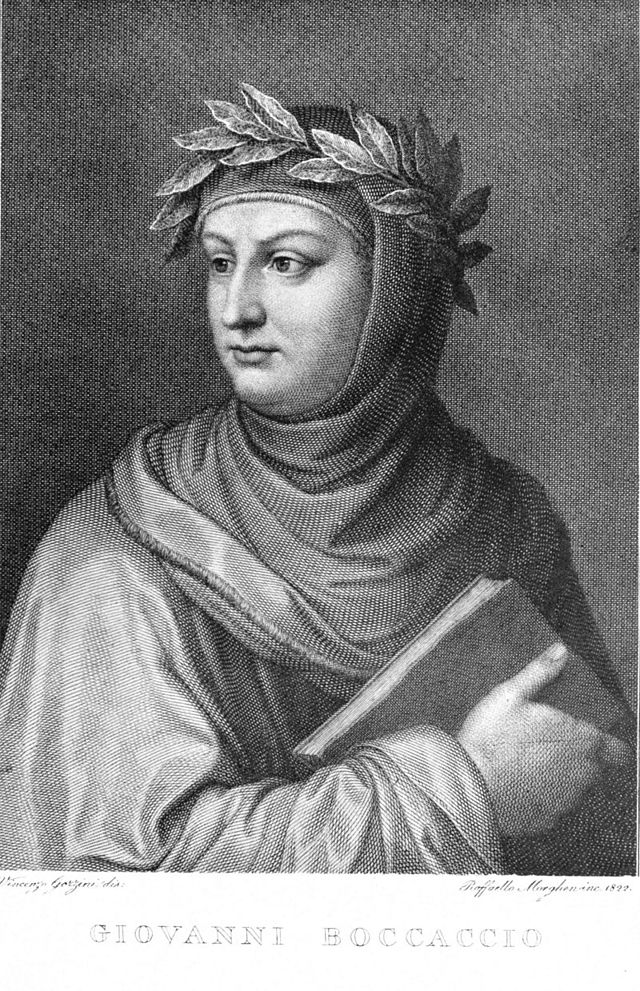
Giovanni Boccaccio
Italian writer and poetWikipedia
129
MENTIONS
29
EPISODES
28
PODCASTS
Search complete. 129 mentions across 29 episodes found for "Giovanni Boccaccio".
Oct 23, 2026

JonHOST
You know, and with Pasolini, you also have kind of all of his remakes and reimaginings of like classical stories.
JonHOST
Boccaccio and Canterbury Tales and his incredible movie about Jesus Christ.
JonHOST
And it's like, yeah, if you want a good movie, get a gay Italian communist to make them.
Gretchen Felker MartinGUEST
100%.

Angela McDowellHOST
Right.
Jerry CoatsHOST
So a frame tale, like if you've ever read Chaucer's Canterbury Tales or Boccaccio's Decameron, you know, the frame tale is these pilgrims are on a trip and then the tales inside the frame are the stories they tell.
Jerry CoatsHOST
So here we have a frame structure The song is the letter, the central idea.
Jerry CoatsHOST
And the the outside is her singing all the other song material and characterizing the relationship.

Tracy V. WilsonHOST
This fragment has provided the first evidence that this version of the story was read outside of the French royal court.
Tracy V. WilsonHOST
The story of Griselda, which is told in this poem, was first told in Giovanni Boccaccio's Decameron in 1353.
Holly FreyHOST
A collection of Latin fragments has been at the Penn Museum at the University of Pennsylvania since the museum acquired them from an antiquities dealer in Egypt in 1911.
Holly FreyHOST
Some of the largest pieces have been reassembled and translated, and it appears to be a page from a sort of pocket guide to Roman Empire laws that might have been used by tax officials or by landowners and their attorneys.

Gretel le MaîtreHOST
His account of the dominant husband was followed by the merchant who told the company that he had been married only two months before.
Gretel le MaîtreHOST
but had married a shrew for though the fiend to hear e coupled were she would him overmatch i dare will swear the origin of the story chaucer did not invent the story he puts into the mouth of the studious and contemplative clerk of oxford Chaucer's immediate source was the Latin prose translation made by the Italian poet Petrarch of an Italian poem found in Boccaccio's Decamerone.
Gretel le MaîtreHOST
The Decamerone tells of ten young Italians who left Florence during an epidemic of plague and spent ten days of their exile telling one another stories.
Gretel le MaîtreHOST
during their enforced retreat to the hills one hundred tales were told the last of which is the source of the clerk's tale boccaccio lived sometimes in naples and at others in florence and was visited by petrarch in the two became firm friends and doubtless petrarch heard the tale from boccaccio's lips a piece of mad folly albeit there came good thereof to him in the end It is known that Chaucer was in Italy on the king's business from December 1372 to May 1373, and it has been supposed that he heard the tale in turn from Petrarch, but there is no evidence that they ever met.
Gretel le MaîtreHOST
Indeed, in letters from Petrarch to Boccaccio, we learn of some who visited his home in Padua, but he makes no mention of Chaucer.
Gretel le MaîtreHOST
But whether these two met or not, Chaucer evidently had a copy in Latin of Petrarch's version of Boccaccio's poem and kept very closely to it in writing his verse translation.
Gretel le MaîtreHOST
But one point must be made clear, and that is there are additions, evidently Chaucer's, which are not found in Petrarch.
Gretel le MaîtreHOST
Chaucer adopted the seven-line stanza called Rhyme Royal.

Gloria MossGUEST
There are novels from the second century with all of these elements of potion, tomb, waking up after three days.
Gloria MossGUEST
Boccaccio in the 14th century in his Decameron has many scurrilous stories.
Gloria MossGUEST
No surprise that the Decameron by Boccaccio has been banned by the papacy.
Gloria MossGUEST
Same thing, potion, put in a tomb, waking up after three days.
Gloria MossGUEST
And there's even a play by Machiavelli, the man who wrote the print.

Lynn ThompsonNARRATOR
His own flock speedily espoused the doctrines of the Reformation; but when he proceeded to Mauléon and tried to preach there, the Basques refused to listen to him and hacked the pulpit to pieces, the bishop being precipitated upon the flagstones and so grievously injured that he died.
Lynn ThompsonNARRATOR
Beside the divines who sought an asylum at Nérac, there were various noted men of letters, foremost among whom we may class the queen's two secretaries, Clément Marot, the poet, and Peter Lemasson, the translator of Boccaccio's Decameron.
Lynn ThompsonNARRATOR
This translation was undertaken at the queen's request, as Lemasson states in his dedication to her, and it has always been considered one of the most able literary works of the period.
Lynn ThompsonNARRATOR
With Marot and Lemasson, but in the more humble capacity of valet, at the yearly wages of one hundred and ten livres, there came the gay Bonaventure des Périers, the author of Les Joies de Vie.
40 MINS LATER
Lynn ThompsonNARRATOR
I like it as a reader perhaps rather more than I esteem it as a critic, but even as a critic, and allowing fully for the personal equation, I think that it deserves a far higher place than is generally accorded to it.
Lynn ThompsonNARRATOR
Three mistakes, as it seems to me, pervade most of the estimates, critical or uncritical, of the Heptameron, the two first of old date, the third of recent origin.
Lynn ThompsonNARRATOR
The first is that it is a comparatively feeble imitation of a great original, and that anyone who knows Boccaccio need hardly trouble himself to know Margaret of Navarre.
Lynn ThompsonNARRATOR
The second is that it is a loose, if not obscene book, disgraceful for a lady to have written, or at least mothered, and not very creditable for anyone to read.

Lynn SalvaNARRATOR
Appendix A, Prologue, page 31.
Lynn SalvaNARRATOR
The dedication with which Anthony Limassol prefaces his translation of Boccaccio contains several curious passages.
Lynn SalvaNARRATOR
In it, Margaret is styled the most high and most illustrious Princess Margaret of France.
Lynn SalvaNARRATOR
only sister of the king, queen of Navarre, duchess of Alonso, and of Berry.
Lynn SalvaNARRATOR
The first edition of Limassol's translation 1545 was in folio, the subsequent ones of 1548, 1551, 1533 being in octavo.
Lynn SalvaNARRATOR
It should be remembered that Le Masson's was by no means the first French version of the Cameron.
Lynn SalvaNARRATOR
Laurent du Premier Fecte had already rendered Boccaccio's masterpiece into French in the reign of Charles VI.
Lynn SalvaNARRATOR
but unfortunately his translation although of pleasing naivete was not at all correct having been made from a latin version of the original

Pamela NagamiNARRATOR
His passionate love of the writings of the ancients and the perception and sympathy which enabled him rightly to interpret them woke his countrymen to an appreciation of the language and the spirit of the classics.
Pamela NagamiNARRATOR
Boccaccio, 1313-75.
Pamela NagamiNARRATOR
His friend, whose Italian stories the Decameron display his delight in the beauty of the world and of life, shared Petrarch's enthusiasm for ancient literature.
Pamela NagamiNARRATOR
They both strove to make themselves master of the beauty of form which they appreciated so keenly in the classical writings, and the results of their efforts roused the admiration and enthusiasm of their contemporaries.
Pamela NagamiNARRATOR
Petrarch had cherished as one of his dearest possessions a copy of Homer which he could not read.
Pamela NagamiNARRATOR
Before the middle of the 15th century, individual Greek teachers were invited to come over to Italy to teach their language, but it was the taking of Constantinople by the Turks, 1453, that gave this study the greatest impetus by driving out hundreds of learned Greeks whose only wealth consisted in their priceless manuscripts and their power to teach.
Pamela NagamiNARRATOR
One effect of this classical revival was the neglect of the Italian language, which had made such a glorious entrance into the world of literature in the writings of Dante, Petrarch, and Boccaccio.
Pamela NagamiNARRATOR
For nearly a century, scholars used only Greek or Latin, and it was not till the last part of the 15th century that the example and influence of Lorenzo de' Medici brought the vernacular into fashion once more.

speaker_0NARRATOR
The Black Death struck Florence in 1348 with catastrophic force.
speaker_0NARRATOR
Giovanni Boccaccio, who lived through it, described it in the opening of his Decameron.
speaker_0NARRATOR
The swellings, the black spots, the bodies piled in the streets, the collapse of every social bond.
speaker_0NARRATOR
Perhaps half the city's population died, and the plague kept coming back.

Bianca NobiloHOST
And there is this really strong class element that you mentioned between the wealthy who can escape to safer areas often.
Bianca NobiloHOST
And an example of that, have you read the Decameron, Tim, by Boccaccio?
Tim MarshallHOST
Reading up for this, yes, but I admit I wasn't aware of it.
Tim MarshallHOST
But another noble Italian person, not unlike yourself.
19 more episodes mention Giovanni Boccaccio.
Create an account to see the whole feed, search across every transcript, and follow the entities you care about.