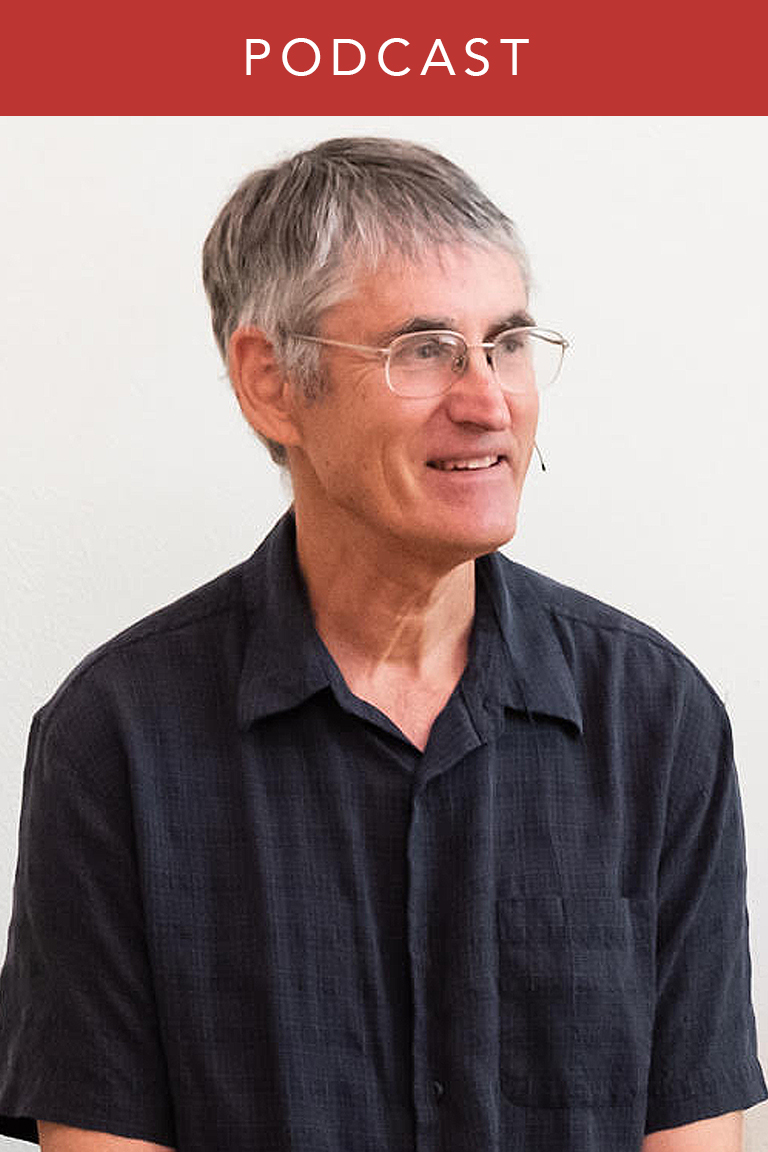
Gil Fronsdal
American teacher and writerWikipedia
10
MENTIONS
8
EPISODES
5
PODCASTS
Search complete. 10 mentions across 8 episodes found for "Gil Fronsdal".
Oct 1, 2026

Jill ShepherdHOST
And it's significant that p- that what I was pointing to just before, that this is what-- how we're spending our time and energy every day.
Jill ShepherdHOST
Because as Gil Fronsdal points out, in general, the things that we do repeatedly have much greater consequence than the things we do only once or a few times, and the effects may ripple further out into society and deeper into our hearts.
Jill ShepherdHOST
Because what we do repeatedly, it strengthens those pathways in our heart and mind.
Jill ShepherdHOST
So if we can really bring the teachings into every aspect of how we live, that turbocharges our practice.

RichieHOST
But the Buddha is offering some guidance, right? And this points, as all things on this path, points to a higher happiness.
RichieHOST
As Gil Fronsdal says in his book, Steps to Liberation, he says, intentions are the primary or underlying motivation for what we think, say, or do.
RichieHOST
It is not possible to end stress or suffering if our intentions cause suffering to others and ourselves.
RichieHOST
So it's safe to say our intentions matter quite a bit.

OliviaGUEST
So we're exploring the Dhammapada again, which again is just, um, this one in particular is translated by Gil Fronsdale.
OliviaGUEST
Um, and it's a book of teachings of the Buddha and verses.
OliviaGUEST
And so tonight we're doing chapter 12, which is entitled one self.

speaker_0NARRATOR
I want to start with a quote from Gil Fronsdale.
speaker_0NARRATOR
Where in my life do I postpone kindness until non-well-being goes away? What shifts when I practice well-being that includes non-well-being? A helpful way to practice this is to treat moments of non-well-being as worthy of care, rather than evidence of failure.
speaker_0NARRATOR
When irritation, sorrow, fatigue, fear, or disappointment arise, let them be included in the field of kindness.

Rick HansonHOST
Essentially, it's the idea that in our practice, which, you know, could have a beneficial forward quality, we are hindered by certain things.
Rick HansonHOST
Interestingly, I've learned from Gil Fronsdal that a way of translating the Pali word, P-A-L-I, in early Buddhism that's translated routinely as hindrances is as coverings.
Rick HansonHOST
Coverings.
Rick HansonHOST
Isn't that interesting? These are coverings over the beautiful true nature that is inherent in all of us but is covered over by various things.
Donald RothbergHOST
There's training in wisdom, there's training in meditation, and there's training in what we could call ethical practice.
Donald RothbergHOST
One of my colleagues, who's a teacher in England, Nathan Glyde, uh, likes to use the word, instead of ethical practice, training in care, being caring.
Donald RothbergHOST
Some, for some people, the t-term ethics means following rules, and it sounds like a little bit tight, right? So use the language that, that works for you.
Donald RothbergHOST
Uh, but we can, we can see that, you know, when we look at the teaching of the Noble Eightfold Path, there are, uh, actually two wisdom factors, wise, uh, understanding and wise intention, three meditation factors, y-you know, wise concentration, wise mindfulness, and also wise or skillful effort.
8 MINS LATER
Donald RothbergHOST
And wise speech is also quite wonderful, uh, in that when we take wise speech seriously and have it as a primary form of practice, we suddenly have many hours a day for spiritual practice.
Donald RothbergHOST
You know, I think I asked the question last time, how many people have complained, "Oh, it's really hard to find a half an hour for meditation"? Anyone ever complain like that? Yeah.
Donald RothbergHOST
And guess what? If you practice wise speech, or what one of my colleagues called right yabbering, [laughs] uh, if you practice wise speech, you may ...
Donald RothbergHOST
And that just includes, uh, speaking online and so forth, digital speech, so to speak, uh, we suddenly have multiple hours.
OliviaGUEST
So week two with the Dhammapada.
OliviaGUEST
We'll be exploring another set of verses, and the Dhammapada is saying, oh, I'm sorry, saying in words spoken by the Buddha, and we're working with a version that is translated by Gil Fronsdale.
OliviaGUEST
And this set of verses is entitled Thousands.
OliviaGUEST
I'm going to read it as a whole first, and then as we explore the words more deeply, I'd love it if folks, when I call out, um, would be comfortable reading a couple of the phrases throughout.
AndrewHOST
We're working with a particular translation.
AndrewHOST
I just wanted to share some of this since this is our first group.
AndrewHOST
This is by Gil Fronsdale, a teacher.
AndrewHOST
And the reason we wanted to go with this translation is he talks about it in the preface.
AndrewHOST
There's so many translations of this text.