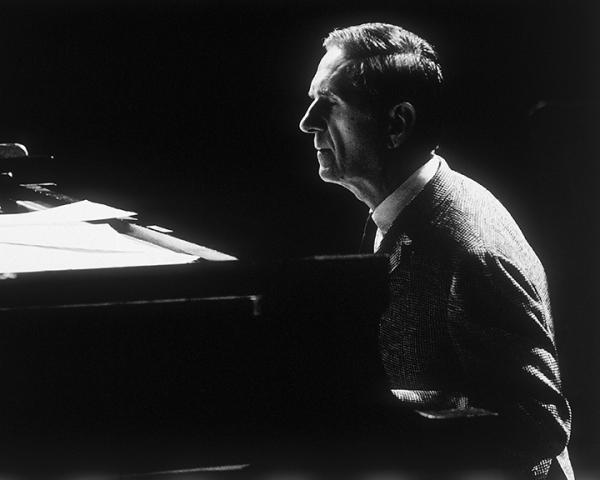
Gil Evans
Canadian jazz pianistWikipedia
10
MENTIONS
6
EPISODES
6
PODCASTS
Search complete. 10 mentions across 6 episodes found for "Gil Evans".
Oct 1, 2026

Abraham BurtonGUEST
...
Abraham BurtonGUEST
Gil Evans, it's really Gil Evans' old studio that he gave-
Jay SweetHOST
Mm
Abraham BurtonGUEST
... to, uh, Nasheet, uh, to, uh, Freddy Waits.

Volker GoetzeGUEST
I have been honored again at Chamber Music America support grant for a new trio with Chano Domingos, which is a very recognized or one of the renowned flamenco jazz pianists who brought jazz to the flamenco.
Volker GoetzeGUEST
and uh he used to live in in the states but moved back to barcelona so and um he was highly recommended for many people and i'm i it's it's he's he's the father of flamenco piano jazz kind of and and uh it's a huge honor to to record with him and i also invited mina sinelu a percussionist who It's originally from Paris but played with Miles Davis and Sting and Lou Reed and I don't know, Stevie Wonder, like Gil Evans' big band, you know, and he's coming along and it's a really pleasure because Chano is now a very experienced seniority artist, and he recently told me that he's really looking forward to this project, and for a long time he hasn't been excited about any project, so it really touches my heart that he's excited about this, and for me it's a huge honor, especially having started flamenco and trying to apply it on trumpet as much as I can, understanding that I will never become a true flamenco musician, but I can learn and grow as an improviser and trying to fit in And I'm curious to see what will happen, because we will have, you know, Mino, who's also played in Weather Report, like Fusion Jazz, with maybe some flamenco influences, maybe Martinique, because he's originally from Martinique, Paris, but he lives in New York.
Volker GoetzeGUEST
And then, you know, my little compositions, maybe write songs together.
Volker GoetzeGUEST
So it's really exciting and an honor to work with such prestigious and highly recognized jazz artists as Sano Dominguez and Maínez.

speaker_0HOST
1948 to 1950 was the Miles Davis's Nonet era, as he experimented with using typical non-jazz instruments like the French horn and tuba.
speaker_0HOST
At this point, Miles worked with greats like Gil Evans and Jerry Mulligan.
speaker_0HOST
He got himself off of the Demons for a little while.
speaker_0HOST
He decided to go with a vegetarian diet.
speaker_0HOST
Miles returned to Paris in 1957 to record and play, and then he came back to New York City, got the quintet back together, but also added Coltrane, who had dealt with his demons by then.
speaker_0HOST
Miles decided that he was sick of touring, wanted to settle down for a while as he had met another woman named Frances Taylor, who he married in 1959 and then divorced in 1968.
speaker_0HOST
Columbia Records recommended that he collaborate with Gil Evans and from 1957 to 1962, Miles and Gills made five albums together which showcased different styles like pieces with orchestral units and Miles playing different instruments such as the flugelhorn.
speaker_0HOST
This period also contained his 1959 classic Kind of Blue which is still considered to be one of the greatest albums ever recorded.

Sid GribetzHOST
What Miles Davis did in the second half of 1957 was also pretty cool and pretty influential.
Sid GribetzHOST
He did the first of his, what turned out to be several associations with Gil Evans, the great arranger doing orchestral recordings for Columbia Records.
Sid GribetzHOST
He got involved in various other projects.
Sid GribetzHOST
He then took a trip and stayed a couple months in France where he savored the music.

Bob WellerPANELIST
So how do you get from the Th- Thornhill band to the next-
Keith BishopPANELIST
Well, the, the connection was Gil Evans.
Bob WellerPANELIST
Yeah.
Bob WellerPANELIST
But I mean-
12 MINS LATER
Keith BishopPANELIST
It was, like, kind of a groundbreaking recording.
Keith BishopPANELIST
At the time, uh, Peter Rugolo was an A&R guy for Capitol Records, and he heard the band, I guess, play live and decided, "I would like them to make a record." They only played a few live gigs, and that recording came out, and it seemed like it c- really went over much bigger in California than anywhere else, and a lot of people were influenced by that writing.
Keith BishopPANELIST
And essentially what it was was a lot of the Gil Evans writing on there was reductions of what he'd done for the Claude Thornhill band.
Keith BishopPANELIST
He had French horn that he worked with in the Birth of the Cool band and a tuba.

John ClarkHOST
And, uh, it's been done many times by many jazz players and, and groups of jazz musicians and in suites and so forth, but no one really captured, uh, the spirit of, of the performance and of the opera the way Louis and Ella did.
John ClarkHOST
Uh, Miles Davis did a totally different version, of course, uh, for Columbia with Gil Evans' arrangements.
John ClarkHOST
But Louis really, especially in these cases, brings out, uh, the joy, but also the pain that was, uh, in this opera.
John ClarkHOST
So that's what we're gonna finish up the program with, There's a Boat That's Leavin', from 1957.