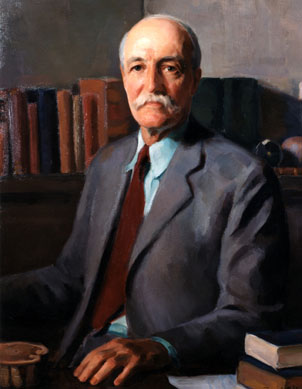
Gifford Pinchot
Forest scientist and former Governor of PennsylvaniaWikipedia
27
MENTIONS
20
EPISODES
17
PODCASTS
Search complete. 27 mentions across 20 episodes found for "Gifford Pinchot".
Nov 2, 2026

Mark DykeshornNARRATOR
a successful attempt to fix a permanent tidal plane for the chesapeake bay has recently been made by the u s coast and geodetic survey during the last fiscal year nearly forty stations were occupied at thirteen of which we are in possession of simultaneous tidal observations extending over one complete lunation the application of harmonic analysis to this unique series along our seaboard will open the way for correct predictions from the capes to harve de grace and will also result in the establishment for the whole bay of a plane of reference of unequalled permanence and undoubted accuracy the establishment of an invariable datum plane is one of the first requisites of inshore hydrography the accuracy with which reference levels should be determined depends of course on the nature of the work based upon it in foreign surveys vast sums have been expended in maintaining tide measuring instruments in the north sea along the coasts of france and in the mediterranean sea these have been connected wherever possible in efforts to compare the sea level at different ports around europe france and spain occupy favorable positions in work of this kind since by comparatively short lines without leaving their own territory they may connect the mean sea levels of the atlantic and the inland waters east of gibraltar how important the determination of heights is regarded abroad may be judged from the fact that up to eighteen ninety five the date of the last published report of the international geodetic association more than one hundred twenty two thousand kilometers of precise levelling had been done in continental europe and nearly ninety nine thousand permanent benchmarks had been established this work has had its greatest development in germany austria and france in the order named the average tide for the entire bay is about one foot possibly less for old point comfort we have two and one half feet for the mouth of the potomac one foot for washington three feet richmond three feet elk river at the head of the bay two feet and annapolis less than one foot the wind effect however is sometimes more than the total tide for example at baltimore the wind effect may amount to three feet while the tide proper uninfluenced by local disturbances is only one-third as much this diminution in the height of the tides as we come northward from the entrance and the subsequent increase as we continue on in the same direction is one of the peculiar features of the tidal phenomena of the bay the small range at annapolis is due partly to the change in width of the bay but principally to the fact that there is an interference at this point between the incoming and outgoing tidal waves when the crest of the southbound movement reaches the mouth of the severn river it meets the northbound wave from the capes and a partial neutralization of the vertical motion of the water takes place another interesting point in connection with the subject is that the rate of progress of the tidal wave from the mouth of the potomac to washington is somewhat less than that of an ordinary steamer so that a vessel requiring the greatest depth possible would be able to enjoy the condition of high water during its entire passage up the river the fact was first brought out by mr c a schott many years ago when the great eastern of transatlantic cable fame availed itself of this favourable circumstance and came to anchor within a few miles of the capital section two
David L. YorkNARRATOR
section three of the national geographic magazine volume ten october eighteen ninety nine this is a librivox recording all librivox recordings are in the public domain for more information or to volunteer please visit librivox dot org read by david l york kansas city mo august twenty first twenty twenty two the relation of forests and forest fires by gifford pinchot forester of the u s department of agriculture the study of forest fires as modifiers of the composition and the mode of life of the forest is as yet in its earliest stages remarkably little attention in view of the importance of the subject has hitherto been accorded to it a few observers who have lived much with the forest such as john muir of california have grouped fire with temperature and moisture as one of the great factors which govern the distribution and character of forest growth but so little has been said or written upon the subject that the opinion of each man seems to have been reached independently and upon the single basis of personal observation the documents upon the subject still reside with very few exceptions in the forest itself it is unfortunate that our acquaintance with what might also be called the creative action of forest fires should be so meager for only through a knowledge of this relation and through the insight which such knowledge brings can there be gained a clear and full conception of how and why fires do harm and how best they may be prevented or extinguished The records of past fires written in the forest now on the ground are often decipherable for more than a hundred years back, and in many cases for more than twice that length of time.
David L. YorkNARRATOR
Such records throw light on the relations of forest and fires as nothing else can, and are consequently the most valuable of all documents upon the somewhat intricate but most important question of the final effect of fire upon the forest.
David L. YorkNARRATOR
for we must clearly realize before the present subject can fall into its proper sequence that we have not stated everything when we say that a given forest is destroyed by fire the forests which the first white explorers saw as they landed on this continent and gradually overran were themselves the successors of others which through thousands of years were burned down at intervals that we can no longer trace there is but little of all the vast forest area of this country which does not bear either in actual scars or charcoal or in the manner and composition of its growth the marks of fire and indeed it is more than probable that further investigation will greatly narrow the limits of those portions which may now seem to have been exempt that fires do vast harm we know already although just what the destruction of its forests will cost the nation is unknown records compiled by the division of forestry indicate that the average direct recorded loss from this source is not less than twenty million dollars a year to this figure must be added the vast direct loss unrecorded together with a great but infinite damage from the effect of forest destruction on water supply and other losses of immense importance the deterioration of soil the destruction of the young growth and the loss of the increment which a healthy young forest would have been laying on year by year the latter may commonly amount in a pure forest to several hundred board feet per acre each year with further study a more exact statement of the grand total of the loss will be possible but even now it is safe to assume that for the nation as a whole the loss is represented yearly by a sum much in excess of fifty million dollars that figure sufficiently proves that the destructive action of fire on the forest in its relation to human needs is a subject of the first interest and importance but in the present paper this brief reference must suffice the regulative action of fire on the forest is here more directly in question fires determine the presence or absence of forests in a given region far more generally than is often supposed a very large part of the prairie regions of the united states is treeless probably because of fire such evidence as we have points strongly in this direction and in addition the behavior of the border forest lands along the eastern edge of the prairies powerfully confirms this view where such forest lands have been protected from fire as they have very largely through the process of settlement young trees have usually sprung up in great numbers under or between the scattered veterans which have survived the fires and a dense and vigorous young growth stands ready to replace by a heavy forest the open park-like condition which the fire had created and maintained the well-known oak openings furnish an excellent case in point in a similar way and for similar reasons trees are spreading from the borders of streams in the prairies to the grasslands near by such indications as these joined to the occasional discovery of evidence of former tree growth out on the prairie where trees no longer grow go far to prove that trees once grew and may grow again much beyond the limits they occupied when the white men first entered the country that fire was the restraining cause amidst of no doubt whatever and that it was the principal cause over vast areas is altogether probable one set of facts which may ultimately be used to establish this latter contention is found in the positions chiefly or exclusively occupied by trees in semi-arid regions which positions are either along water courses and so shielded from fire by moisture or on rough and stony ground and so protected by the absence of enough grass and other vegetable ground cover to carry a destructive flame the same course of reasoning applies to certain kinds of open glades or prairie well named fire glades by mr frederick v coville botanist of the u s department of agriculture in the black hills of south dakota for example these glades surrounded by forest bearing land are almost exclusively confined to ground rich enough to support a crop of grass sufficiently dense to burn fiercely while the timber is restricted to rough rocky or stony land almost always higher than the glades and comparatively safe from fire because of the scantiness of the minor vegetation it is able to support in semi-arid regions where fire glades of this kind occur there is an interesting alternation by years or series of years of the presence and absence of the moisture which makes forest reproduction possible in the same way the occurrence or absence of burning gives or denies an opportunity for young seedlings to reach a size at which they are reasonably safe from the attacks of ordinary surface fires it must be clearly borne in mind that it is only the average effect of the class of causes of which fire and rain are the chief with which we are concerned young trees sometimes succeed through combinations of temporary immunities in establishing themselves in the midst of fire glades of old dates and the rocky refuges where some seedlings usually escape the fire are not uncommonly burned over as the fire scarred trunks abundantly testify but these facts do not obscure the effective working of the averages although they do tend powerfully to lengthen the time required for the average to work itself out thus reproduction around the fire glades of the black hills is extremely slow perhaps the most remarkable of the regulative effects of forest fires relates to the composition of the forest the kinds of trees of which it is composed and the proportion of each this effect depends upon the action of fire in combination with the various qualities of resistance which trees possess these qualities are two chief kinds one adapted to secure the safety of the individual tree directly through its own powers of defense the other to assure the continuance of the species with little regard for the single tree an example of the first kind is the western larch whose enormously thick bark is almost fire-proof and is so good a non-conductor that it protects the living tissue beneath it even against fires hot enough to scorch the trunk fifty or seventy-five feet above the ground it is to this quality of the bark as well as to their marvelous fatality that the big trees of california owe their power to reach an age of three thousand or four thousand years the eastern pitch pine protects itself in the same way so do many other trees including the longleaf pine which adds to this quality of its bark another method of protection that places
49 MINS LATER
Betty BNARRATOR
For more information or to volunteer, please visit LibriVox.org. Read by Betty B.
Betty BNARRATOR
Geographic Literature.
Betty BNARRATOR
A Primer of Forestry, Part One, The Forest, Bulletin Number 24, Division of Forestry, U.S. Department of Agriculture, by Gifford Pinchot.
Betty BNARRATOR
Pages 88, panels 47, with 83 cuts in text.

DJ PetrovskiHOST
There are numerous indications that show that the Rothschilds were in part behind the assassination of Lincoln.
DJ PetrovskiHOST
Some of the men who worked for the Paisers of the 13th Top family were Andrew Carnegie, J.P. Morgan, the Vanderbilts, Gifford Pinchot, and John D. Rockefeller.
DJ PetrovskiHOST
These men were selected to run Paiser companies because they belonged to the Satanic elite.
DJ PetrovskiHOST
The Leroy Springs family got Paiser family companies in the early 1920s.

David MartinNARRATOR
And while they maunder along, they stifle the forces of life which are trying to break through.
David MartinNARRATOR
It was nothing but the insolence of the routinier that forced Gifford Pinchot out of the forest service.
David MartinNARRATOR
Pinchot, in respect to his subject, was a fine political inventor.
David MartinNARRATOR
But routine forced him out.

ChrisHOST
Politico reports that even with the relocation paused, the agency is moving forward with the plans to clear out its historic Washington, D.C. offices to make way for renovations and another USDA division.
ChrisHOST
This has sparked a frantic effort by agency retirees to save 121 years of irreplaceable artifacts, ranging from historical records to a mahogany desk once used by Forest Service founder Gifford Pinchot.
ChrisHOST
From BHA's perspective, the strength of our public lands depends on the professionals who manage them.
ChrisHOST
We believe the Forest Service must be fully staffed, properly positioned, and empowered to enforce the regulations that ensure our forests remain healthy and our backcountry experiences remain top tier.

ChrisHOST
Politico reports that even with the relocation paused, the agency is moving forward with the plans to clear out its historic Washington, D.C. offices to make way for renovations and another USDA division.
ChrisHOST
This has sparked a frantic effort by agency retirees to save 121 years of irreplaceable artifacts, ranging from historical records to a mahogany desk once used by Forest Service founder Gifford Pinchot.
ChrisHOST
From BHA's perspective, the strength of our public lands depends on the professionals who manage them.
ChrisHOST
We believe the Forest Service must be fully staffed, properly positioned, and empowered to enforce the regulations that ensure our forests remain healthy and our backcountry experiences remain top tier.

Anders ReynoldsHOST
That's the letter U, which are really the bones of what became the wilderness system.
Anders ReynoldsHOST
How did a recreation assignment with the Forest Service turn into a framework for keeping wild places forever roadless? And where did Gifford Pinchot fit in? Was he an ally? Was he a mentor? Or was he something more complicated to you? Oh, Gifford.
Bob MarshallVOICE_ACTOR
He was a friend.
Bob MarshallVOICE_ACTOR
He was a friend.

Dick SmithGUEST
We had a president named Teddy Roosevelt, who came to power in 1901, who had just a deep, deep commitment and love for both the outdoors and wild places and conservation.
Dick SmithGUEST
And he collaborated with an individual named Gifford Pinchot, who was another kind of wealthy Eastern individual, kind of the same social class as Teddy Roosevelt.
Dick SmithGUEST
But he was the first classically trained forester from the United States.
Dick SmithGUEST
Up until that time, there had not even been a curriculum in any college for forestry.
Dick SmithGUEST
And so that was kind of where things were initially.
Dick SmithGUEST
There still wasn't a whole lot of direction as to how the land should be managed.
Dick SmithGUEST
That fell largely to Gifford Pinchot, the first chief of the Forest Service, to come up with kind of what was the mission going to be And he came up with a famous term, at least for those of us in public land management.
Dick SmithGUEST
And his theme was the greatest good for the greatest number over the long term.

Tony SchoonenGUEST
So when they started, uh, when Roosevelt became president, things escalated dramatically, right? They, they formed the forest reserves- Which u- later became the Forest Service.
Tony SchoonenGUEST
Uh, Gifford Pinchot was a club member.
Tony SchoonenGUEST
He had...
Tony SchoonenGUEST
He was the first Forest Service chief.
9 MINS LATER
Mike OpitzGUEST
This is a herd that at one point numbered 40 million across North America.
Mike OpitzGUEST
He couldn't find a single one, and he watched the slaughter of all of the big game species across the West.
Mike OpitzGUEST
And it was, it was in the, about 1887, he finally came back from his Elkhorn Ranch to New York City, and he said, "I'm gonna gather 100 men, and we are gonna save the big game of North America." And, and guys like Gifford Pinchot and a, and an instrumental member of that was George Bird Grinnell, who at the time was the, the owner and editor of Forest and Stream magazine, and they used, they, they used that magazine to get the word out to the public.
Mike OpitzGUEST
And then they, then they decided to put together this collection called the National Collection of Heads and Horns.
10 more episodes mention Gifford Pinchot.
Create an account to see the whole feed, search across every transcript, and follow the entities you care about.