Gian Lorenzo Bernini
Italian sculptor and architectWikipedia
86
MENTIONS
32
EPISODES
27
PODCASTS
Search complete. 86 mentions across 32 episodes found for "Gian Lorenzo Bernini".
Sep 23, 2026

Julie Ann ThompsonNARRATOR
Triton.
Julie Ann ThompsonNARRATOR
The exquisite lines rise involuntarily to the lips as one comes suddenly upon Bernini's old fountain in the Piazza Tritone, which, standing in the center of one of the busiest and most prosaic thoroughfares of modern Rome, still keeps its own quality of beauty and seems to weave about itself the enchantment of the world of fable.
Julie Ann ThompsonNARRATOR
Roman art has created many Tritons, notably the joyous group surrounding Galatea in the Farnesia Palace, but there is about this water-worn old figure such distinction and such emphasis of life that he becomes the prototype for all his race.
Julie Ann ThompsonNARRATOR
He is Il Tritone.
Julie Ann ThompsonNARRATOR
Triton blows his conch shell with all his might as he kneels across the hinge of a wide-open scallop shell, which is supported on the upturned tails of three dolphins massed together in the middle of a large, low-lying basin.
Julie Ann ThompsonNARRATOR
The dolphins' tails are twisted and folded about large papal keys, a Bernini conceit which, suggesting St. Peter both as fisherman and pontiff, must have delighted the Pope.
Julie Ann ThompsonNARRATOR
The composition of dolphins, keys, and shell is extraordinarily rich and harmonious.
Julie Ann ThompsonNARRATOR
Triton, kneeling upon this noble support, is, from the waist upward, a severely simple figure, almost uncouth, and somewhat out of keeping with the rest of the design.

Linda TylerGUEST
But for him to sort of have a model, it was always going to be the great classical tradition.
Linda TylerGUEST
And he's still very influenced by the Michelangelo, all of the history, Bernini, all of the history of the figure, which is so, if you're going to be a figurative sculptor, is so hard to leave behind, so much easier to reference it and to to acknowledge your debt and to show how you're fitting into a tradition.
Linda TylerGUEST
I just saw a wonderful show, actually, at the Art Gallery of New South Wales, which was the history of the standing male figure.
Linda TylerGUEST
And it went from Hellenistic, you know, basically the classical period figure in action, through to Anthony Gormley, you know, the sectioned cubist figure.

James FoxHOST
Mm.
Alastair SookeHOST
-by Bernini, the Italian artist.
Alastair SookeHOST
Yet, just visible above her right shoulder, there's a, a single popped sofa button that's dangling by a thread, which suggests that something isn't right because this pretty nurse isn't in raptures.
Alastair SookeHOST
She's dead.
James FoxHOST
-it's almost like a fashion photograph.
Alastair SookeHOST
Yeah.
James FoxHOST
I know you mentioned Bernini, but it's almost like a beautiful young woman reclines on a sofa.
James FoxHOST
It's only when you look closely, it's only when you know the context, that you realize this is a, a Nazi who has taken her own life before the Americans take over.

Anthony CapozzoliHOST
Bernini was only 20 years old when he sculpted his Aeneas and Caius and Ascanius.
Anthony CapozzoliHOST
It was his very first major mythological commission for his premier patron, the mega-wealthy, mega-powerful Cardinal Scipione Borghese.
Anthony CapozzoliHOST
But to truly understand why this sculpture is so legendary, we have to look at the epic story it depicts, the artist's mind of a young Bernini, and the surprising political propaganda hidden beneath the surface that ties the Borghese to Venus, the fall of Troy, and the founding of Rome.
Anthony CapozzoliHOST
Troy is falling, the city is burning, enemy soldiers are pouring through the gates, and chaos reigns.
Anthony CapozzoliHOST
This is the iconic climax, straight out of Book 2 of Virgil's Aeneid.
Anthony CapozzoliHOST
Bernini freezes three specific figures in time, three generations of a single family fleeing the destruction.
Anthony CapozzoliHOST
Aeneas, the strong Trojan warrior, standing at the center, his muscles straining as he lifts his father.
Anthony CapozzoliHOST
Anchises, Aeneas' elderly, paralyzed father, perched high on his son's shoulders.

TomGUEST
So I asked him, any chance I could paint on your wall? So I showed him what I wanted to paint and he said, yeah, work away, no problem.
TomGUEST
It was a big painting of Michelangelo's Moses and an angel by Bernini.
TomGUEST
So yeah, I really enjoyed painting on the walls.
TomGUEST
That was fun.

Rick StevesHOST
The nearby Piazza Navona is a carnival 365 nights a year.
Rick StevesHOST
While this oblong square got its shape from a long-gone ancient stadium, today, the games are limited to browsing and flirting around its famous Bernini Fountain.
Rick StevesHOST
Just down the street is the floodlit Pantheon.
Rick StevesHOST
It looms high above our 21st century, as if aching to tell its story, 2,000 years of Roman history.

Tiffany ParksHOST
But anyway, I want to say it was sort of the Baroque period, but it doesn't at all fit into Baroque style.
Tiffany ParksHOST
If you look at that next to a Bernini statue, I mean, they couldn't be more different.
Tiffany ParksHOST
I mean, I love Bernini, so I'm not saying I prefer one over the other.
Tiffany ParksHOST
But it is nice when you come across an artist who could detach himself from the style of the day, as Caravaggio did.
Tiffany ParksHOST
And that's why we love Caravaggio, too.

Robert BarronGUEST
To some degree, it comes up out of Gothic, but it's a departure from it, certainly.
Robert BarronGUEST
And Rome, the Rome of, like, Bernini, is very much the Baroque period.
Robert BarronGUEST
And then you have, like, Rococo churches.
Robert BarronGUEST
Go to Bavaria, and you find a kind of flamboyant form of the Baroque that we call Rococo.

Jason BaxterGUEST
Lifted up on a billowing cloud, her body has lost all sense of time and space.
Jason BaxterGUEST
Bernini's sculpting is, if you've been to Rome, you know, Bernini's sculpting is, of course, always breathtakingly beautiful.
Jason BaxterGUEST
But on this occasion, the master really outdid himself.
Jason BaxterGUEST
Because Bernini did not just make a figural group, but he built a whole chapel, including a concealed window.
Jason BaxterGUEST
And so this is it from the outside, right? He had to puncture the wall to build this, to let in the natural light.
Jason BaxterGUEST
The light is filtered through a stained glass window before being reflected out and onto the radiating golden rods in imitation of the diffusion of heavenly glory dispersed within our world.
Jason BaxterGUEST
And so Bernini did the unthinkable.
Jason BaxterGUEST
He used gold and stone and glass to house light.

Jessica LiborHOST
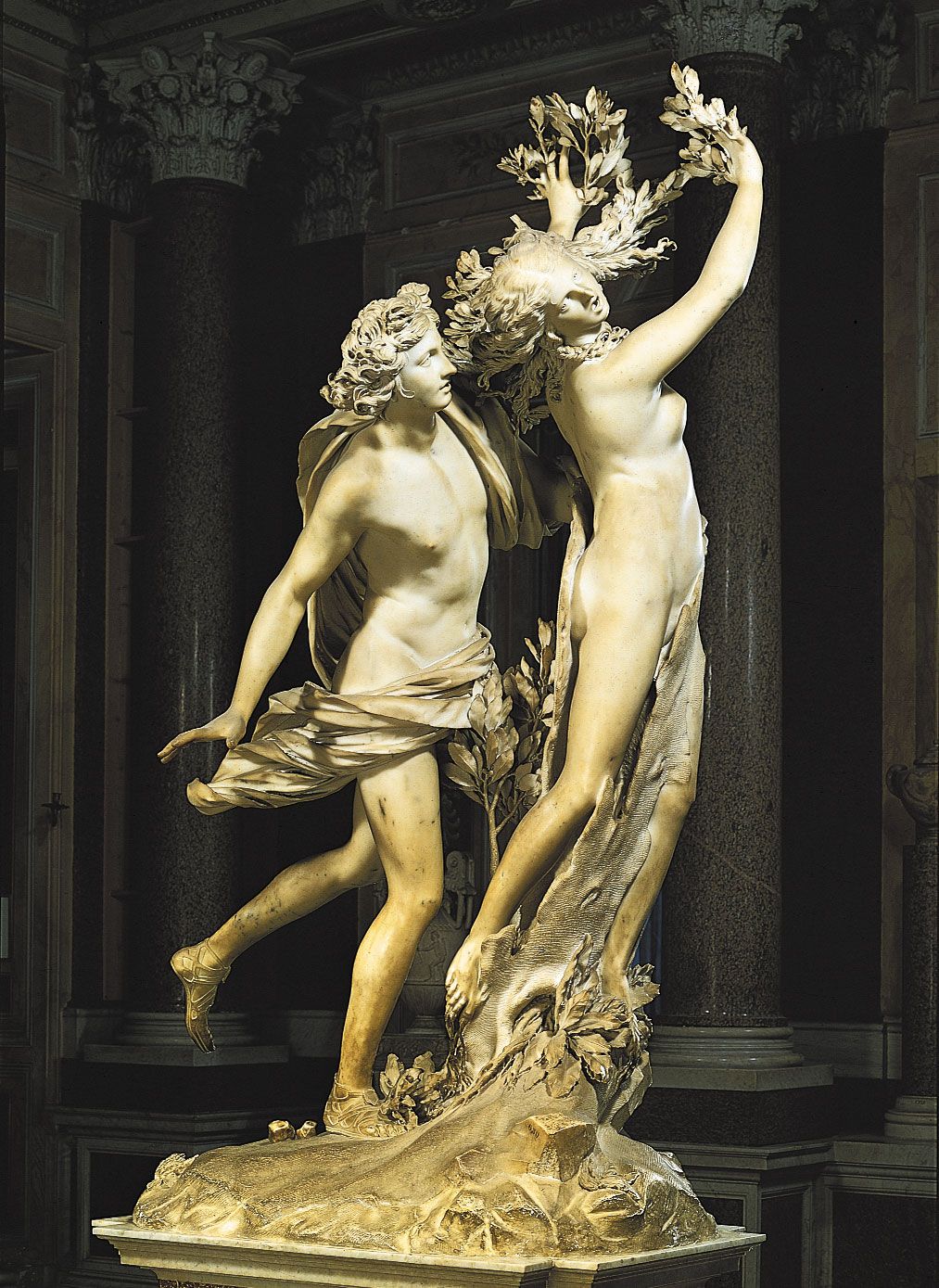
And so this summer on our honeymoon, we were in Rome in, um, August while visiting the Borghese Gallery, which highly recommend if you've never been there.
Jessica LiborHOST
Some of the most stunning work, the most historic work, like the work that's in your history books, um, tons of Berninis there.
Jessica LiborHOST
Like, it is absolutely stunning.
Jessica LiborHOST
I found myself fascinated by this portrait yet again.
22 more episodes mention Gian Lorenzo Bernini.
Create an account to see the whole feed, search across every transcript, and follow the entities you care about.