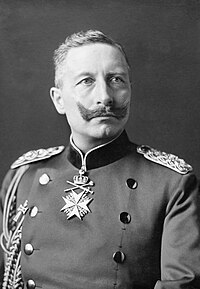
German Emperor
MonarchicalWikipedia
54
MENTIONS
6
EPISODES
6
PODCASTS
Search complete. 54 mentions across 6 episodes found for "German Emperor".
Oct 19, 2026

Steve DeaceHOST
The home of the arts center for a hub for arts and entertainment in all of the West.
Steve DeaceHOST
It was under an autocratic regime from the Kaisers in Bismarck.
Steve DeaceHOST
Forms of government don't make people better.
Steve DeaceHOST
Communism isn't a form of government.

Dominic LievenGUEST
And he, in, i- you know, in terms of values and, uh, political commitments, was absolutely committed to bringing a more humane, m-more liberal perhaps notion in the long run, more democratic China into the global order on the basis of the values that the Anglo-dominated, uh, global order embodied.
Dominic LievenGUEST
Um, and I said to him that it seemed to me that that was going to be a much greater and more difficult challenge than had been the challenge of bringing the Kaiser's Germany into the Anglo-dominated world order before 1914.
Dominic LievenGUEST
Germany, after all, is a European country, a Protestant-dominated country, a capitalist country.
Dominic LievenGUEST
Uh, certainly deeply influenced by liberal principles, and with a significant democratic element as well.
Dominic LievenGUEST
And don't set me off on that, 'cause I can talk for hours on that subject, and in a way which will numb you with boredom.
Dominic LievenGUEST
But anyway, i-it was.
Dominic LievenGUEST
China dominates, of course, the whole of East Asia, and therefore potentially has power on a scale which Germany can only dream of if Hitler or the Kaiser conquer Europe.
Dominic LievenGUEST
But China is obvious as- obviously as well far more alien in its deepest traditions, uh, a- as regards to the principles which underlie the A- Anglo-American order, than the Kaiser's Germany was.

Robert LyndeHOST
The Hohenzollerns of Prussia.
Robert LyndeHOST
And like I told you in that podcast, they are gonna b- eventually become the family that unites all of Germany, become the Kaisers.
Robert LyndeHOST
We're gonna see that later on.
Robert LyndeHOST
But for now, today, I wanna focus on two of Frederick I's descendants, and that would be King Frederick William I, his son, and his grandson, Frederick II, also known as Frederick the Great.

speaker_1NARRATOR
We are suffering just now from an outbreak of the imagination which exhibits itself in politics and the most unlikely places.
speaker_1NARRATOR
The German Emperor, for example, is neither a tyrant nor a lunatic, as used to be absurdly represented.
speaker_1NARRATOR
He is simply a minor poet, and he feels just as any minor poet would feel if he found himself on the throne of Barbarossa.
speaker_1NARRATOR
The revival of militarism and ecclesiasticism is an invasion of politics by the artistic sense.
7 MINS LATER
speaker_1NARRATOR
End of chapter 17 This is a LibriVox recording.
speaker_1NARRATOR
All LibriVox recordings are in the public domain.
speaker_1NARRATOR
For more information, or to volunteer, please visit LibriVox.org Varied Types by G. K. Chesterton Chapter 18 The German Emperor The list of the really serious, the really convinced, the really important and comprehensible people now alive includes, as most Englishmen would now be prepared to admit, the German Emperor.
speaker_1NARRATOR
He is a practical man and a poet.

John BatchelorHOST
This is the headquarters of the German high command.
John BatchelorHOST
It is also where the Kaiser, the King of Prussia, the Emperor of Germany, has a chateau in a town that is untouched by war but overrun with senior officers all weighed down with the anxiety of what will happen if Germany collapses, if we surrender, what is the future.
John BatchelorHOST
Nick, we go to Ludendorff again, the quartermaster general, meeting with Hindenburg, his boss, who is, to me, enigmatic and unreadable.
John BatchelorHOST
Ludendorff, after holding the army together with desperate chances and knitting together what he believes is a line to fall back on, he goes to Hindenburg and says, we must withdraw.
Nick LloydGUEST
So, of course, they can then use the army to either restore order back home or to conduct some kind of grand strategic retreat to the German borders.
Nick LloydGUEST
And then if the conditions are favorable, resume fighting.
John BatchelorHOST
The next day, there's lunch at the Kaiser's Chateau.
John BatchelorHOST
You emphasize that the lunch is otherworldly, disconnected.

JakeHOST
And, and also with that, I, I got a entrance in, in, in the monarchy and, and Peter Montz.
JakeHOST
got some interest with the last emperor in English and the Kaiser in Germany and what the leadership style with Kaiser William II as Kaiser of Germany and a lot of historians more focusing on Nazi Germany and the Holocaust but less of the unification of Germany under the Iron Chancellor Otto von Bismarck in 1871 and the new nation state of the German Empire And Peter Muntz, the last with Kaiser William I and Kaiser Wexig and Kaiser William II, the last monarch of, technically they've got more monarchies in Germany, but the last emperor of Germany and and what the people in the German empire, what, what is the sense of being German in the German empire compared to Nazi German, German regime and the period of, of the first repartee from November the 9th, 1918 to, to 1933.
JakeHOST
You've
Mathew TurnerGUEST
mentioned a really key point there, um, which is you clarified that he's the Kaiser Wilhelm II was technically the Kaiser of Prussia.
Mathew TurnerGUEST
Yeah.
Mathew TurnerGUEST
King of Prussia.
Mathew TurnerGUEST
So you have a third of Germans are Catholics still, and back then as well.
Mathew TurnerGUEST
Um, and you have, you have a king of Bavaria, you have a king of other various German states.