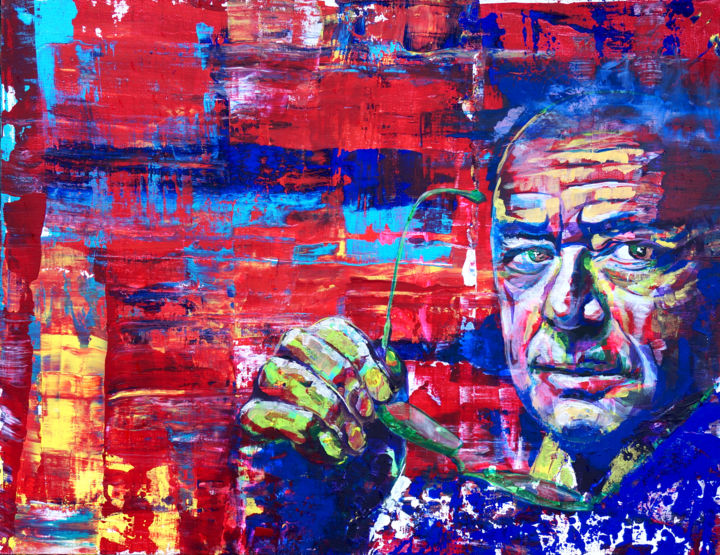
Gerhard Richter
German visual artistWikipedia
34
MENTIONS
21
EPISODES
20
PODCASTS
Search complete. 34 mentions across 21 episodes found for "Gerhard Richter".
Oct 30, 2026

L.G. WilliamsNARRATOR
It takes 100 artists from the canon of Western art and presents them as Black artists.
L.G. WilliamsNARRATOR
Salvador Dalí, Alberto Giacometti, Gerhard Richter, Cy Twombly.
speaker_1UNKNOWN
The result is immediate.
speaker_1UNKNOWN
Problem solved.

Ty Nathan ClarkHOST
No, you're going to get into the next space and you're going to still be going, oh, if I only had more room, oh, if I only had more height, if I only had more concrete, like that's just a nonstop.
Ty Nathan ClarkHOST
I mean, you could be Gerhard Richter in a 40,000 square foot space.
Ty Nathan ClarkHOST
And he's probably going, I wish I had 50,000 square feet.
Ty Nathan ClarkHOST
And that's just, so it's make where you are and make what you make.

Naomi ReaGUEST
I think if you're looking to sell expensive art, Paris is still the place that you'd go.
Naomi ReaGUEST
I think the reported sales figures from the first day included two paintings, also Hauser & Wirth, that sold for $10 million, both actually from 1965, one by Georg Baselitz and one by Gerhard Richter.
Naomi ReaGUEST
And I think Gagosian also sold a late de Kooning painting for around eight figures.
Naomi ReaGUEST
And I think overall in Paris, it felt like a lot more expensive work was, you know, trading hands.

Marion ManekerGUEST
And because Art Basel Paris has become a very sort of premier fair, and the biggest galleries have taken very expensive works, now that, you know, Hauser & Wurst does this thing where they hold something back and announce it on the day.
Marion ManekerGUEST
I think for them it was a big Gerhard Richter painting.
Marion ManekerGUEST
But there were several.
Marion ManekerGUEST
Gagosian sold a big de Kooning for $10 million.
Marion ManekerGUEST
There was a Richter sold for $10 million.
Marion ManekerGUEST
At Pace, they had a Modigliani nude.
Marion ManekerGUEST
Now, another work from that series, or two other works from that series, have sold for $140 and almost $80 million worldwide.

JamesHOST
Apparently he's got another movie which is supposedly very, very good as well.
SamHOST
The one about Richter.
SamHOST
Gerhard Richter.
JamesHOST
Yes, that makes sense.
JamesHOST
It's not that great.

Emily WilsonHOST
I wanted to talk to two of the people behind it, Camion Guillot, Chief Education and Public Engagement Officer, and Ted Mann, Project Assistant Curator, about how they changed the four floors of Doris and Don Fisher's art.
Emily WilsonHOST
They say they were trying to give visitors a way to connect to the collection, which includes work by Alexander Calder, Joan Mitchell, Saul LeWitt, and Gerhard Richter.
Emily WilsonHOST
At the opening, Robert Fisher, the Fisher's oldest son, talked about how Gamine executed her vision for the galleries to tell a story rather than display objects.
Emily WilsonHOST
He also said Ted curated the show with precision and poetry, not too shabby.
Emily WilsonHOST
Another way to humanize artists, Ted says, is not to divide them by nationality or style.
Emily WilsonHOST
For example, previously, the sixth floor was German art after 1916.
Ted MannGUEST
One of the things we've done is to move away from that, and we brought several of the German artists like Gerhard Richter and Sigmar Polke down to the fourth floor, and we're putting them in dialogue with contemporaries like Andy Warhol and Roy Lichtenstein, whose work they were looking at and responding to in very interesting and complex ways.
Ted MannGUEST
Along the same lines, we used to kind of separate out abstraction on the fourth floor from figurative art or pop and minimal art.

Stephen O'MalleyGUEST
He used to be an architect and he's just super curious.
Stephen O'MalleyGUEST
He introduced me to Leonardo da Vinci and The Who, for example, and also Gerhard Richter, and also hiking and architecture, obviously, and design and typography from his handwriting.
Stephen O'MalleyGUEST
I
Hampus LindwallHOST
don't

Ben SuttonGUEST
And the sales seem to be good.
Ben SuttonGUEST
I think Hausen and Wirth sold a Gerhard Richter piece Rococo table in the region for around $10 million US.
Ben SuttonGUEST
I've just had an email through from David Zwirner.
Ben SuttonGUEST
They sold four paintings by Robert Ryman for $4 million, $1.25 million, $850,000 and $650,000 each.

Chet ZarHOST
I was like super painter guy when I first started.
Chet ZarHOST
And I didn't really get abstract expressionism until – I watched this documentary on Gerhard Richter.
Anthony AusgangGUEST
Yeah.
Chet ZarHOST
And I was, and it was like, he was basically just going like, I, you know, these, these colors are beautiful.
Chet ZarHOST
And really I feel like I kind of grew as an artist as a result of that.
Chet ZarHOST
um so yeah it's like there's there's something for everybody and if it was all the same and it was all held to this one kind of standard beyond just making a great piece that works for its audience then everything would be boring and suck you know
Anthony AusgangGUEST
yeah totally you know one thing about gerhard richter and those guys is uh I would call them more figurative expressionists, actually, than abstract.
Chet ZarHOST
Oh, okay.

Sila BlumePANELIST
The, uh, the things that we can connect to Buñuel, um, these dissections, these, um, um, collage type of, uh, flows.
Sila BlumePANELIST
Uh, I'm, I'm just looking at a film just like I could look at, um, James Joyce's writing or a paint- a, a painting from Gerhard Richter as the artist putting certain things together that, as I, as I have said many times before, I could never grasp what Bergman really was doing, and much less the things that he did of which he was not aware of by the way he did them.
Sila BlumePANELIST
And the second thing is that I cannot, I cannot, um, separate, uh, the, these techniques to the point that I can compare them to what I could see today because they are coming from a different place.
Sila BlumePANELIST
Uh, you know, doing this with a camera with that angle, with that, uh, lens, uh, uh, that could be seen as the same, but the, the context and the intentionality in, in how, um, Bergman does it, at least in my eyes, the way I perceive the, the works of him that I have seen, um, the works of his that I have seen, I just see, uh, an artist doing things that on one side I have to simply accept and at the same time, what is happening with me? How is it affecting me when I, uh, I don't know if [laughs] I'm assuming that somebody has seen this, but this is the very first time that I see that when at the very beginning of the film, you see the film saying start nine, eight, seven.
11 more episodes mention Gerhard Richter.
Create an account to see the whole feed, search across every transcript, and follow the entities you care about.