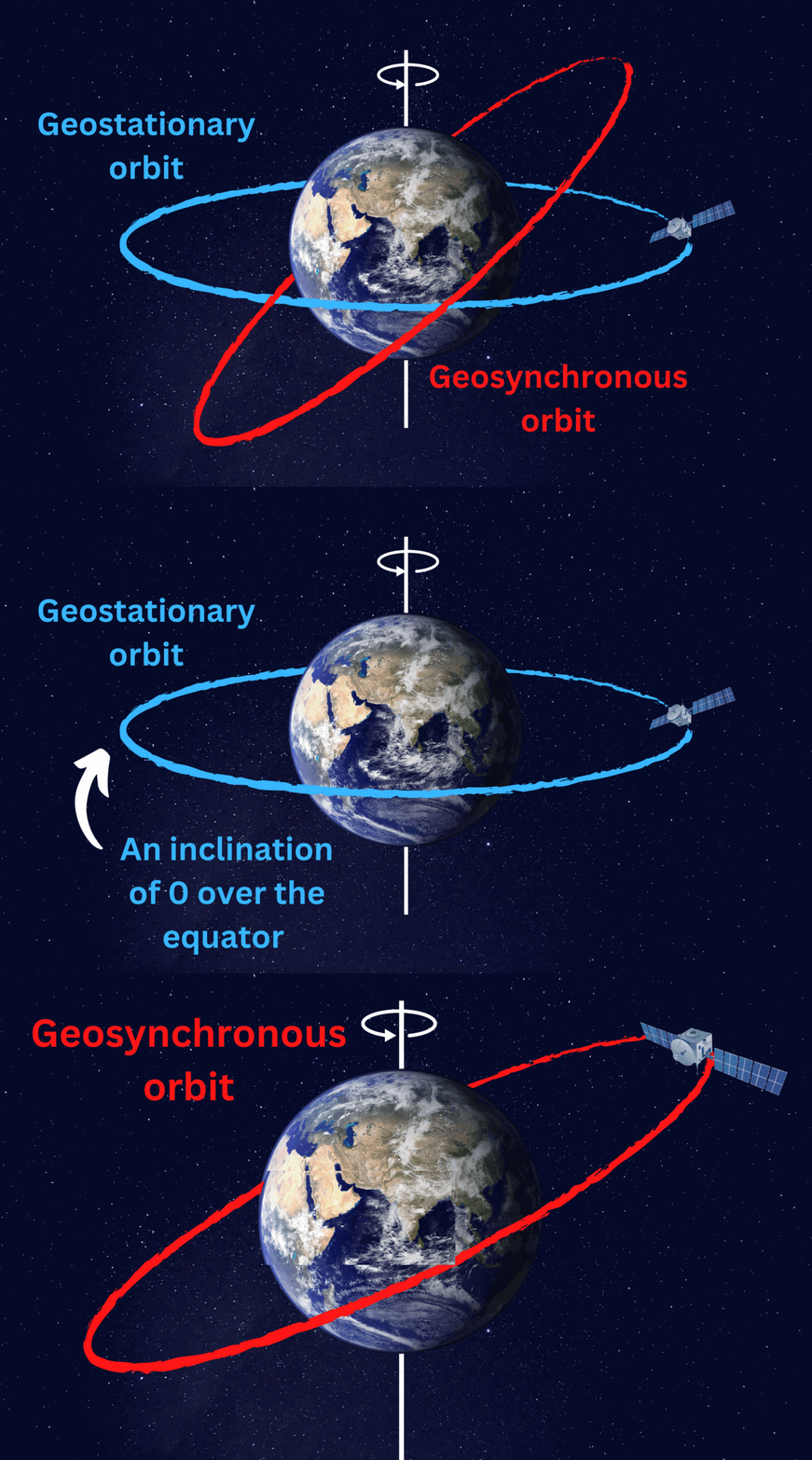
Geosynchronous orbit
Orbit typeWikipedia
6
MENTIONS
3
EPISODES
3
PODCASTS
Search complete. 6 mentions across 3 episodes found for "Geosynchronous orbit".
Sep 20, 2026

Tom PattonHOST
It's a lower signal limit, the one satellite operator SpaceX pushed for over objections from rival operator SES.
Tom PattonHOST
The update revises a data set of geostationary satellite links, or GSO links, used to check whether new broadband satellites in lower orbits interfere with them.
Tom PattonHOST
Those lower orbit systems are called non-geostationary, or NGSO.
Tom PattonHOST
The change stems from an April 30th order that replaced power limits dating back to the 1990s.
Tom PattonHOST
Under the new framework, NGSO operators have two options: strike a coordination agreement with GSO networks, or prove they won't cause unacceptable interference using that shared data set of links.
Tom PattonHOST
The affected bands run from 10.7 to 12.7 gigahertz, 17.3 to 18.6 gigahertz, and 19.7 to 20.2 gigahertz.
Tom PattonHOST
The bureau built an initial set of 328 reference links back in April.
Tom PattonHOST
The most contested issue, the signal threshold for links without adaptive coding.

Isabel HiltonGUEST
I think I first came across it a number of years back because at an organisation I used to run called China Dialogue, we were looking at climate change.
Isabel HiltonGUEST
We were looking at, you know, what are the energies of the future? What are the technologies of the future? And it would come up from time to time, but it would sound so, you know, crackers that it just sort of sat there but more recently I did notice for example that it's in the current Chinese five-year plan and that's a mark of seriousness and you begin to encounter people who are taking it very seriously indeed so essentially what this is is the notion that you can harvest solar power in effectively in geosynchronous orbit so very very high orbit and
Ellen HallidayHOST
Geosynchronous means rotating kind of at the same pace as the Earth.
Isabel HiltonGUEST
That's right.
Isabel HiltonGUEST
As opposed to there are various layers of spaces, you know, low Earth orbit, where most of our satellite communications are, for example, it's getting very crowded.

Isabel HiltonGUEST
I think I first came across it a number of years back because at an organisation I used to run called China Dialogue, we were looking at climate change.
Isabel HiltonGUEST
We were looking at, you know, what are the energies of the future? What are the technologies of the future? And it would come up from time to time, but it would sound so, you know, crackers that it just sort of sat there but more recently I did notice for example that it's in the current Chinese five-year plan and that's a mark of seriousness and you begin to encounter people who are taking it very seriously indeed so essentially what this is is the notion that you can harvest solar power in effectively in geosynchronous orbit so very very high orbit and
Ellen HallidayHOST
Geosynchronous means rotating kind of at the same pace as the Earth.
Isabel HiltonGUEST
That's right.
Isabel HiltonGUEST
As opposed to there are various layers of spaces, you know, low Earth orbit, where most of our satellite communications are, for example, it's getting very crowded.