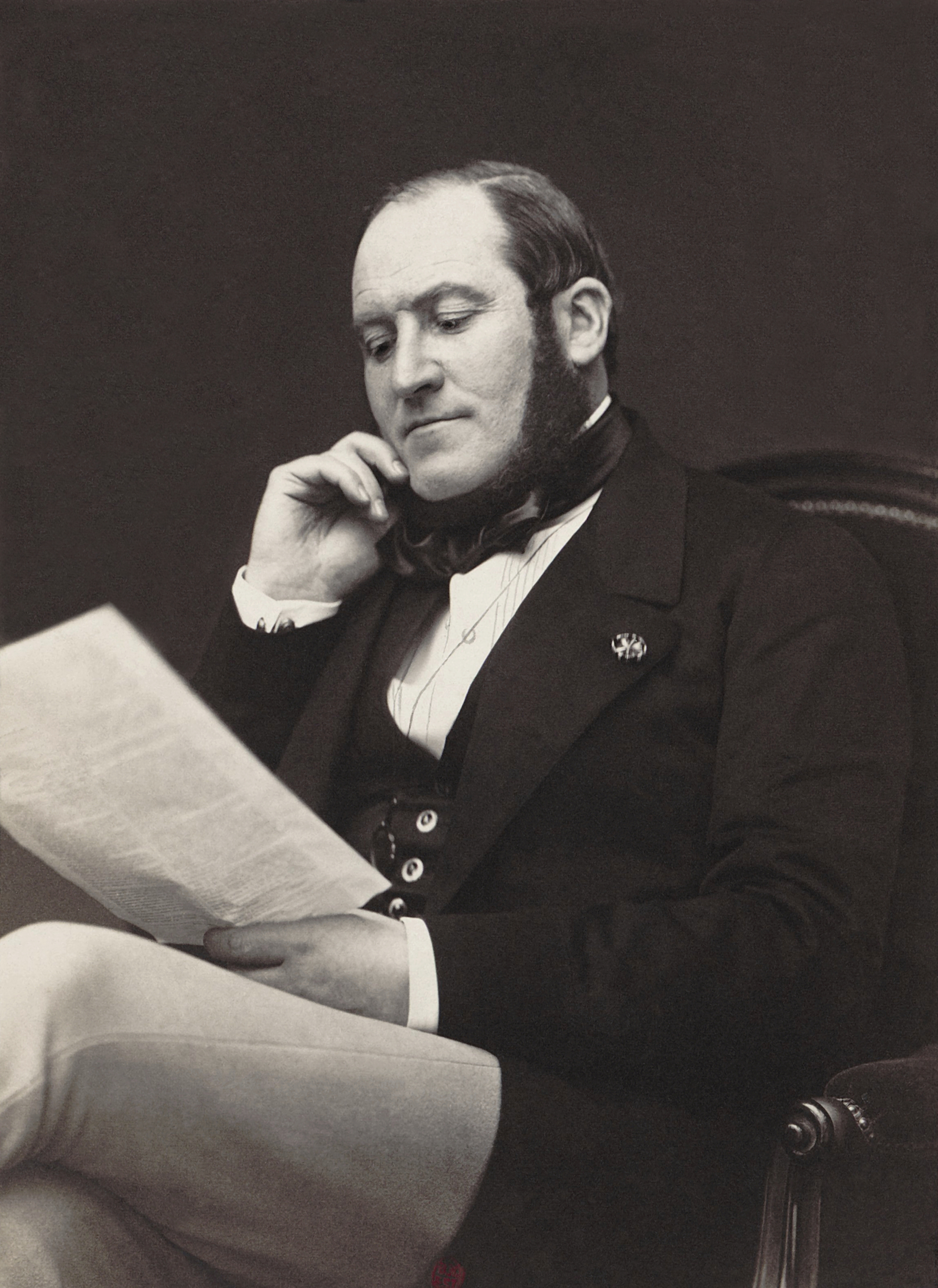
Georges-Eugène Haussmann
Former Deputy of the French National AssemblyWikipedia
12
MENTIONS
9
EPISODES
9
PODCASTS
Search complete. 12 mentions across 9 episodes found for "Georges-Eugène Haussmann".
Oct 13, 2026

PaulHOST
The other saw a shopper.
PaulHOST
Then came Baron Haussmann.
PaulHOST
He tore up the narrow, winding soul of Paris to replace it with wide, military-grade boulevards.
PaulHOST
By the time the dust settled, the flaneur's natural habitat was gone.

speaker_2NARRATOR
With his new imperial powers, Napoleon III was soon in a position to launch the transformative changes in France that he planned.
speaker_2NARRATOR
One of the most enduring legacies of the Second Empire was the transformation of Paris under the direction of Baron Georges Haussmann, whom he appointed as city prefect in June 1853.
speaker_2NARRATOR
Over the next 17 years, Haussmann implemented the emperor's plans to demolish much of the medieval city, replacing the narrow streets with large parks, expansive squares, and a ring of wide boulevards named after the marshals of La Grande Armée in Napoleon I's time.
speaker_2NARRATOR
A few months after his appointment, Haussmann announced plans to build a grand thoroughfare named the Avenue Napoleon III, now the Avenue de l'Opera, which led to a magnificent new opera house constructed by the architect Charles Garnier between 1861 and 1875.

William McLeanHOST
Pierre L'Enfant.
William McLeanHOST
And that happened prior, about 60 years before Haussmann's intervention in Paris.
William McLeanHOST
Yes.
William McLeanHOST
The reasons were quite different.
William McLeanHOST
By Broadway.
William McLeanHOST
And then Paris, 60 years after L'Enfant's Washington.
William McLeanHOST
Haussmann, in a sense, did to Paris what L'Enfant had attempted to do in Washington.
William McLeanHOST
But let's move away from those two examples.

RavenHOST
He just took it from the prison viewing to an actual building dedicated for that.
RavenHOST
So then, as Paris changed, as all cities do forever and ever, there's a fellow named Baron Haussmann, which sounds German to me, not French.
RavenHOST
But he had this older morgue building replaced with a large, better-known morgue behind Notre Dame, and this is actually the morgue that we're gonna be discussing.
RavenHOST
This is called Musée Carnavalet, and it dates the replacement building to 1868, so from about 1904-ish to 1868.

Larry BernsteinHOST
Napoleon III, he appoints
Shlomo AngelGUEST
the Baron Haussmann to widen this road.
Shlomo AngelGUEST
We're going to create a boulevard here.
Shlomo AngelGUEST
But the Baron Haussmann knows that it's going to be very difficult to get through these neighborhoods.
Shlomo AngelGUEST
So what he does is he offers very generous compensation.
Shlomo AngelGUEST
He says, I'm going to give you more than what your land is worth.
Shlomo AngelGUEST
He's going to compensate them according to the new value.
Shlomo AngelGUEST
Moreover...

John MerrimanHOST
The boulevard, the barricades are across the same streets where they were in many cases in 1792 and in 1789.
John MerrimanHOST
And the problem, in 1968 it was very hard to build a barricade across the Boulevard Saint-Michel, which was built by Haussmann at this time.
John MerrimanHOST
So, the troops come pouring in.
John MerrimanHOST
This is down the Rue de Rivoli, which was completed in the 1850s and 60s, and the damage is staggering.

Georgia HardstarkHOST
There are now just two correct answers separating him from the million-pound jackpot.
Georgia HardstarkHOST
He's asked, quote, "Baron Haussmann is best known for his planning of which city?"
Karen KilgariffHOST
Oh, I know this one.
Georgia HardstarkHOST
No.

R. Tripp EvansGUEST
Yeah, I mean, there's a direct link because Arthur Gilman, who was one of the major planners of Back Bay, had studied in France.
R. Tripp EvansGUEST
He knew Baron Haussmann's rebuilding of Paris, which was happening simultaneously to the creation of Back Bay.
R. Tripp EvansGUEST
So in the 1850s, Paris is being completely redesigned in the same way that Boston is being redesigned.
R. Tripp EvansGUEST
And what results, yes, is something that looks very French.