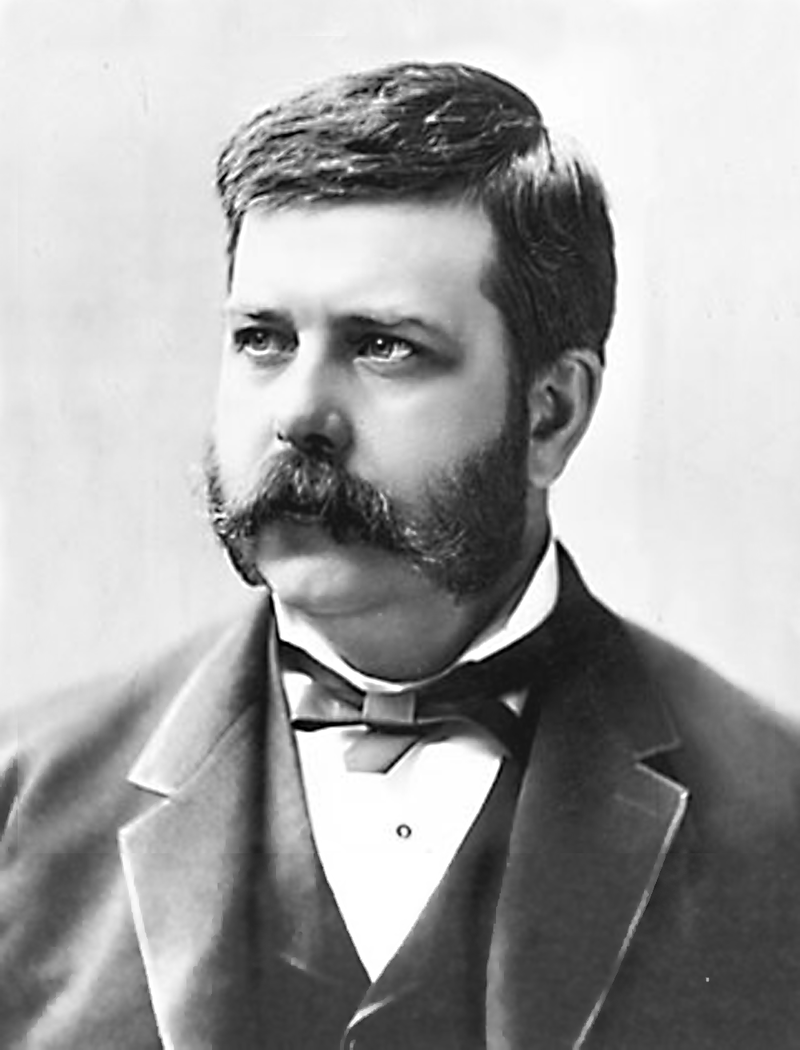
George Westinghouse
American inventor and engineerWikipedia
35
MENTIONS
23
EPISODES
22
PODCASTS
Search complete. 35 mentions across 23 episodes found for "George Westinghouse".
Oct 2, 2026

speaker_2HOST
Very true.
speaker_3HOST
And his novel, The Last Days of Night, is a historical fiction piece set during the bitter real-life rivalry between George Westinghouse and Thomas Edison over the electrification of America.
speaker_2HOST
Okay, let's just pause on that for a second.
speaker_3HOST
Sure.

Robin D. LawsHOST
[laughs]
Kenneth HiteHOST
And so you have a number of our, our great industrial, uh, founders, not George Westinghouse.
Kenneth HiteHOST
He was Team Tesla, so he doesn't get to go to heaven on the machine.
Kenneth HiteHOST
But word gets around, and, uh, Westinghouse says, "Hey, Tesla, how come Edison can send people to heaven with a machine and you can't send people to heaven with a machine?" And Tesla says, "Well, I can send them all kind of places with a machine, not just heaven.

Kelly WeinersmithHOST
Mm-hmm.
Moiya McTierGUEST
I had no idea who George Westinghouse was before I started researching this, so that was a, a fun extra character that I got to spend time with.
Kelly WeinersmithHOST
Excellent.
Kelly WeinersmithHOST
So are you starting on a new book?

TomHOST
This is an episode, the kind of an episode that we like to do where we take a movie, which could be a documentary, a popular film, Hollywood film, whatever, and run it through an organizational lens.
TomHOST
This time we have decided to choose a rather lesser known film called The Current War, which which was a 2017 film that basically tells the story, a somewhat historical fictional story about the War of the Currents that was fought between Thomas Edison and George Westinghouse back in the late 19th century.
TomHOST
So the movie and the real story behind it is that Edison and Westinghouse found themselves as competitors and opponents on the institution of electricity or the availability of electricity countrywide.
TomHOST
Edison was favoring the direct current model.
TomHOST
George Westinghouse was favoring the alternating current model.
TomHOST
And in the course of the episode, the real life episode and the movie itself, it sort of chronicles how those two perspectives turned into a fierce and rather nasty competition between the two individuals and then ultimately led to Westinghouse winning out.
TomHOST
alternating current becoming the de facto standard.

Russ AllenHOST
In 1884, he immigrated to the U.S. and worked for Thomas Edison for a period of time, but left to eventually compete with him and have his invention of alternating current, or AC-based power generation and distribution systems accepted over Edison's direct current, or DC-based power generation and distribution systems.
Russ AllenHOST
After prevailing in this acrimonious tussle, Tesla sold his AC-related patents to George Westinghouse, who was awarded the contract to build generators and transmission equipment for the Niagara Falls Power Company.
Russ AllenHOST
Prior to immigrating to the U.S., Tesla worked for the Continental Edison Company in Paris.
Russ AllenHOST
In 1883, Tesla was working on assignment in Strasbourg when, on his own time and expense, he constructed his first induction motor.
speaker_0HOST
We also read two papers from Administrative Science Quarterly, Michael Tushman and Philip Anderson's Technological Discontinuities and Organizational Environments from nineteen eighty-six, and Benjamin Cole and David Chandler's A Model of Competitive Impression Management: Edison versus Westinghouse in the War of the Currents from twenty nineteen.
speaker_0HOST
The War of the Currents was a real competition between two important industrial figures, Thomas Edison and George Westinghouse, over which type of power would become the dominant standard for distributing electricity across the United States.
speaker_0HOST
Edison was the initial combatant and championed direct current, or DC, in which electricity would flow in one direction as batteries do.
speaker_0HOST
Westinghouse favored alternating current, or AC, in which the electricity reversed its flow in regular periods.

CorrineHOST
Edison built his system on direct current.
CorrineHOST
His competitor, George Westinghouse, was developing AC, which could transmit electricity economically over much greater distances than Edison's low voltage DC.
CorrineHOST
Edison's system required generating capacity relatively close to customers.
CorrineHOST
AC could be stepped up for transmission and stepped down near where it was used.
CorrineHOST
licensing, testing mandates, and the regulatory machinery surrounding them impose cost.
CorrineHOST
Established AI companies can absorb many of those costs.
CorrineHOST
Smaller competitors may not be able to.
CorrineHOST
More consequential is the problem of the competitor who doesn't yet exist.

CorrineHOST
Law enforcement searches will require a case number in order to conduct a search by the end of the year, although the system can be bypassed in an emergency, Flock said.
CorrineHOST
Haley launched an investigation into Flock last month and led a Wednesday hearing into the company and three competitors that provide similar surveillance systems.
CorrineHOST
We have an entire constitutional system to protect individual liberty, Haley said in an interview.
CorrineHOST
Without some limits imposed by the companies or by the government, he said, we're going to have a huge problem with the invasion of basic rights and liberties.
24 MINS LATER
CorrineHOST
licensing, testing mandates, and the regulatory machinery surrounding them impose cost.
CorrineHOST
Established AI companies can absorb many of those costs.
CorrineHOST
Smaller competitors may not be able to.
CorrineHOST
More consequential is the problem of the competitor who doesn't yet exist.

John HopkinsHOST
But over in Europe, a rival system, alternating current, or AC, is being developed, and it proves to be very efficient for long-distance transmission.
John HopkinsHOST
A man named George Westinghouse imports AC to America and hires Edison's former employee, Nikola Tesla, to help make improvements.
John HopkinsHOST
By 1888, AC is posing a serious threat to Edison's business, but he does not take it sitting down.
John HopkinsHOST
He identifies all the weaknesses he can with the rival system, claiming it is of inferior design and infringes various of his patents.
John HopkinsHOST
This is a genuine concern for Edison, who knows that electricity needs to win the trust of wary consumers.
John HopkinsHOST
He feeds a press frenzy on the back of several fatalities caused by contact with high-voltage AC power lines Telegraph and telephone repairmen find themselves at particular risk as pole-mounted AC lines often cross with theirs.
John HopkinsHOST
Edison secretly colludes with other players in the electrical market to chip away at Westinghouse's reputation.
John HopkinsHOST
There are a series of unseemly public experiments, for instance, where an array of animals, including dogs, calves, and horses, are electrocuted using AC current, ostensibly to show the dangers.

Sebastian MajorHOST
Carlson argues that Tesla, quote, "...resorted to illusions to convince ordinary people of the value of his creations." Tesla came to believe that along with identifying the ideal for an invention, he also had to create the right illusion about the exciting and revolutionary changes his invention would bring about for society.
Sebastian MajorHOST
Tesla sought to capture the imagination of the public as well as entrepreneurs who would purchase and develop his inventions.
Sebastian MajorHOST
In the end, Carlson believes that Tesla became too focused on the creation of this public illusion, and this kept him from creating working machines later in his career.
Sebastian MajorHOST
In other words, Tesla became overwhelmed by his own myth, which Carlson thinks may have contributed to the decline in his mental health around the turn of the century.
13 more episodes mention George Westinghouse.
Create an account to see the whole feed, search across every transcript, and follow the entities you care about.