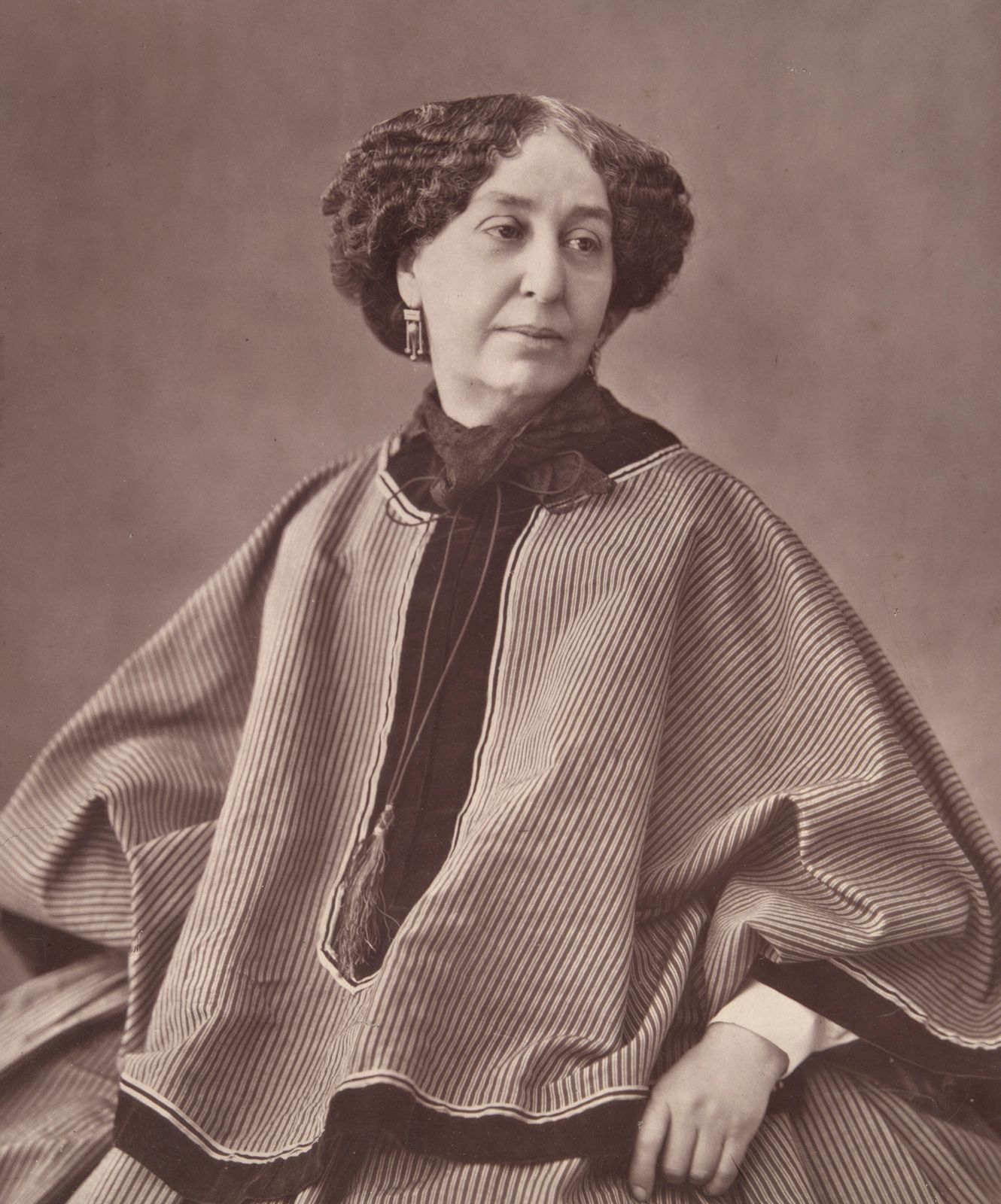
George Sand
French novelistWikipedia
68
MENTIONS
27
EPISODES
26
PODCASTS
Search complete. 68 mentions across 27 episodes found for "George Sand".
Nov 4, 2026

Phyllis HollisGUEST
Impromptu.
Phyllis HollisGUEST
And it's about George Sand, Delacroix, Chopin, that whole group.
Phyllis HollisGUEST
Two-week trip to an aristocrat's house someplace in France.
Phyllis HollisGUEST
And to watch that film, And then to walk down the street and see where they lived during that period of time.

speaker_0HOST
As such, to truly understand what he's talking about, you also need some knowledge about these people, because Nietzsche doesn't give you the knowledge himself, he assumes that the reader is familiar.
speaker_0HOST
He talks about, for example, Thomas Carlyle, Ernest Renan, George Sand, Sainte-Beuve, Emerson, Charles Darwin.
speaker_0HOST
And many of these names might not sound familiar, but back in Nietzsche's day, they were among the most popular writers of the time.
speaker_0HOST
So people in Nietzsche's time would have been familiar with these names, but us in the 21st century, not necessarily so.

Olivia GiovettiHOST
And I think this is a lot of what is happening beginning around this time in the Romantic era, especially coming from women themselves.
Olivia GiovettiHOST
You look at someone like George Sand's writings, which are so erotic at times and express a level of agency and sexuality in women that you get in something like Dangerous Liaisons, but that's also such a It doesn't end well, right? So now we're in this kind of shifting era.
Olivia GiovettiHOST
And I actually I needed to find out more about this.
Olivia GiovettiHOST
So I wound up reading an essay by Maya Corey on the erotic effectivity in Renaissance religious art.

speaker_4NARRATOR
for my part, should approve of their action in slamming the door in the face of invading facts that threaten to leave the way open for scandal-hunters and herophobists to enter with them, and to deal with the honored reputation of Charlotte Bronte in the same way that, more to the discredit of english letters than to that of two french writers of genius recent critics have dealt with the love-letters of madame de stal and this point of view however is a mistaken one in the present case because to commence with charlotte bront's romantic love for m heger affords no game to the scandal-hunter but on the contrary it is serviceable to the just appreciation of her character as well as of her genius, that is, her true sentiment for her professor, that explains her attitude of mind when writing Villette, should be rightly understood.
speaker_4NARRATOR
Then also, whilst Madame de Stael's infatuation for Benjamin Constant neither adds to nor diminishes her claims as the authoress of Corrine and d'Alemont to the rank of a fine writer and a great critic, and while Georges Sand's tormenting and tormented love for the ill-fated, irresistible, unstable child of his century, Demuset, is a poignant revelation of the passing weakness, through immense tenderness of a splendidly strong and independent spirit, that one is almost ashamed to be made the spectator of, Charlotte Bronte's various martyrdom undergone secretly and silently and rewarded openly, fills one with an extraordinary sentiment of respect for her, and justifies Mr. Clement Shorter's own fine and generous utterances upon the impression that the letters that betray the anguish she endured and overcome alone produces upon him.
speaker_4NARRATOR
Charlotte Bronte, said Mr. Clement Shorter, by the report of an interviewer who recorded his opinions in the times thirtieth july immediately after the publication of these letters is one of the noblest figures in life as well as in literature and these letters place her on a higher pedestal than ever let me quote from the same report in the times the further statement of his opinions given by this well-known critic as to the sentiments revealed in these letters mr shorter affirmed the interviewer welcomed the publication of the letters in the times as giving the last and final word on an old and needless controversy personally he said i have always held the view that those letters were actuated only by the immense enthusiasm of a woman desiring comradeship and sympathy with a man of the character of professor There was no sort of great sorrow on her part, because Professor Hager was a married man, and it is plain in her letters that she merely desired comradeship with a great man.
speaker_4NARRATOR
When Charlotte Bronte made her name famous with her best-known novel, she experienced much the same adulation from admirers of both sexes as she had already poured upon her teacher.

Barbara TuckerHOST
After two books of fiction for George Eliot, though, the secret was out.
Barbara TuckerHOST
Another female writer of the time, a French one named George Sand, had taken the man's name.
Barbara TuckerHOST
She pushed the gender boundaries a lot more than Marianne Evans did, though.
Barbara TuckerHOST
George Sand was protesting.
Barbara TuckerHOST
George Eliot wanted to sell her writing.
Barbara TuckerHOST
However, she had other publicity problems.

Brian LehrerHOST
Helena Bonham Carter and Tim Burton raised their two children while living in two houses next door to each other in London, I read.
Brian LehrerHOST
Also the novelist George Sand and Frederic Chopin, just to name a few.
Brian LehrerHOST
So do you live separate from your partner? How does it work for you? The phones are open for your stories, your calls, your texts, 212-433.
Brian LehrerHOST
WNYC 433-9692.

speaker_0NARRATOR
Only the form in which it is expressed sometimes fails to answer the purpose.
speaker_0NARRATOR
that present-day marriage is not suited to its purpose is no longer denied by any thinking person so it is not surprising that even such persons favor a free choice of love and a free dissolution of the marriage relation who are not inclined to draw the resulting conclusions that point to a change of the entire social system Do you believe that freedom and sexual intercourse is justifiable among members of the privileged classes only? In a controversy in which she opposes the emancipation of women, as set forth by the writer, Fanny Lewald Matilda Reichard Stromberg says the following, If you demand complete equality for women in social and political life, George Sand must also be justified in her struggles for emancipation, the strove for nothing else but to possess what has long since been man's undisputed possession.
speaker_0NARRATOR
for no good reason is to be found why only woman's head and not also her heart shall participate in this equality while she shall not give and take as freely as man on the contrary if nature gives woman the right and thereby also the duty for we shall not bury a talent bestowed upon us to exert her brain to the utmost in competition with the intellectual titans of the opposite sex I must also give her the light to preserve her equilibrium, just as they do, by quickening the circulation of her heart in whatever manner she may see fit.
speaker_0NARRATOR
We all read without being shocked in the least how, for instance, Goethe, to choose the greatest as an example, again and again wasted the warmth of his heart and the enthusiasm of his great soul upon some other woman.
speaker_0NARRATOR
Intelligent people consider this perfectly natural, and only narrow-minded moralists condemn it.
speaker_0NARRATOR
Why then deride the great souls among women? Let us assume that the entire female sex consisted of great souls like George Sand.
speaker_0NARRATOR
Let us assume that every woman were a Lucrezia Florini, whose children are all children of love, but who brings up these children with true motherly love and devotion, as well as in a rational and intelligent manner.
speaker_0NARRATOR
How would the world fare? There is no doubt that the world could continue to exist and develop as today, and might even fare exceptionally well.

Jacke WilsonHOST
She was previously here in episode 776 to talk about Mary Shelley and Bath, a book published by Manderley Press, for which Fiona wrote the introduction.
Jacke WilsonHOST
And she was here in episode 813, where we focused on her book, Becoming George, The Invention of George Sand.
Jacke WilsonHOST
She returns today for a discussion of Elizabeth Barrett Browning, whom Fiona wrote about in her biography, Two-Way Mirror, The Life of Elizabeth Barrett Browning.
Jacke WilsonHOST
Fiona Sampson, welcome back to the History of Literature.
33 MINS LATER
Jacke WilsonHOST
Okay, we're back.
Jacke WilsonHOST
So Fiona, let's circle back to the life a little bit because it's so fascinating.
Jacke WilsonHOST
And we also, I want to ask you about this relationship with Robert Browning, what it did for Elizabeth, because, and maybe we can compare that with Mary Shelley and Percy Shelley and George Sand and Frederick Chopin.
Jacke WilsonHOST
We're not biting off a little more than we can chew there.

Elif ShafakGUEST
So the moment words like the enemy of the people or these people are enemies, et cetera, those words make me very, very worried because I've heard that kind of rhetoric elsewhere.
Elif ShafakGUEST
And one more thing, if I may add, As I was writing in one brief moment, All Eternity, I also focused on the friendship of Flaubert, Gustave Flaubert and Georges Sand, which to me was very interesting because she is very progressive at the time.
Elif ShafakGUEST
She's very scandalous.
Elif ShafakGUEST
Freedom is very important for her in her private life as well.

Tom ConwayVOICE_ACTOR
These little problems help me to escape the common places of existence.
Tom ConwayVOICE_ACTOR
Yes, after all, l'homme sait rien, l'oeuvre sait tout, as Flaubert once wrote to George Sand.
Joseph BellNARRATOR
Fascinating story, Dr. Watson.
Joseph BellNARRATOR
What a thrilling time you must have had during the days you lived with Sherlock
17 more episodes mention George Sand.
Create an account to see the whole feed, search across every transcript, and follow the entities you care about.