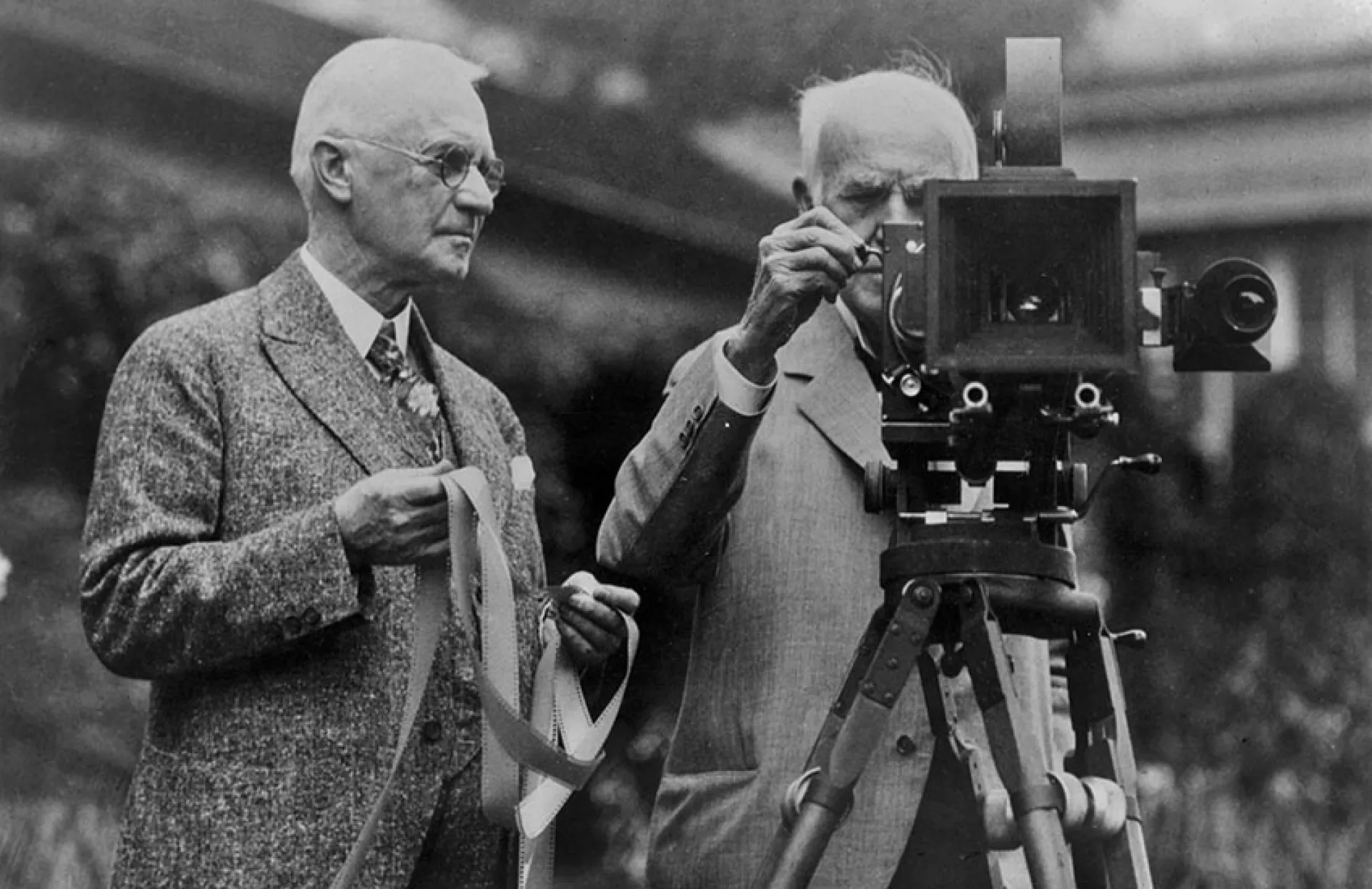
George Eastman
American innovator and entrepreneurWikipedia
17
MENTIONS
8
EPISODES
8
PODCASTS
Search complete. 17 mentions across 8 episodes found for "George Eastman".
Oct 5, 2026

Matty CHOST
And it's strange how it happens in one place or another.
Matty CHOST
You know, I was just in Rochester, New York, and, like, that's where Kodak is because that's where George Eastman was from.
Mike ConnellGUEST
Yeah.
Matty CHOST
And so these sort of weird cultural things pop up in small places we don't really think of, and then they really shape America.

Kevin EalainGUEST
But yeah, 1881, Peter Houston invented the first roll film.
Kevin EalainGUEST
And he licensed his patents to George Eastman of Eastman Kodak.
Kevin EalainGUEST
And the rest is history from there.
Kevin EalainGUEST
Kodak, of course, being kind of the titan of the film and photography world.

speaker_3NARRATOR
In just a couple of decades, photography had gone from being an experimental laboratory process to becoming a profession that employed thousands of people.
speaker_3NARRATOR
George Eastman appeared in 1888 with the Kodak camera, small, portable, and affordable enough for people to buy it for themselves.
speaker_3NARRATOR
and delivered the first models with the film already loaded, telling people to take their photographs and send the cameras back to their company, where they would reveal the film, make the copies, and return everything.
speaker_3NARRATOR
Photography went from being a work of specialists to becoming something that ordinary people could do.

Jared PolinHOST
He and his twin brother, Francis Edgar Stanley, jointly owned the Stanley Dry Plate Company, and...
Jared PolinHOST
Eastman Kodak purchased the company business in January of 1904.
Jared PolinHOST
What exactly were they making? The Stanleys were making pre-coated, factory-produced gelatin-dry glass plates for photographers.
Jared PolinHOST
Before dry plates became practical, photographers commonly used the wet collodion process.
Jared PolinHOST
I want to know how much these things were.
Jared PolinHOST
Oh, my God.
Jared PolinHOST
So there is a link out to an Eastman Professional Photographic Apparatus and Materials Manual from October 1917.
Jared PolinHOST
It's a catalog.

speaker_3NARRATOR
In barely a couple of decades, photography had gone from an experimental laboratory process to a profession employing thousands of people.
speaker_3NARRATOR
George Eastman appeared in 1888 with the Kodak camera, small, portable and affordable enough for people to buy one for themselves.
speaker_3NARRATOR
And he delivered the early models with film already loaded, telling people to take their photographs and send the cameras back to his company, where they would develop the film, make the prints and return everything to them.
speaker_3NARRATOR
Photography went from being the work of specialists to something ordinary people could do.

Susan VollenweiderHOST
They'd been around for about 30 years.
Susan VollenweiderHOST
We're still a few years out from George Eastman's box camera with a roll of film.
Susan VollenweiderHOST
But she had to pick the most complicated method of photography.
Susan VollenweiderHOST
And she's not just taking the photographs, but of course, she's developing them too.

Tristan EttlemanHOST
Yes, there's a very small
Anthony SlideGUEST
portion of it survives that George Eastman has, but the film itself is not.
Tristan EttlemanHOST
And
Anthony SlideGUEST
it would be fascinating to see it, actually.

Stephen DaltonHOST
This is all you can currently offer.
Stephen DaltonHOST
Then, in 1888, George Eastman's company introduces the Kodak camera.
Stephen DaltonHOST
The famous marketing promise is essentially that the customer presses the button and Kodak handles the complicated processing.
Stephen DaltonHOST
This is a huge change.