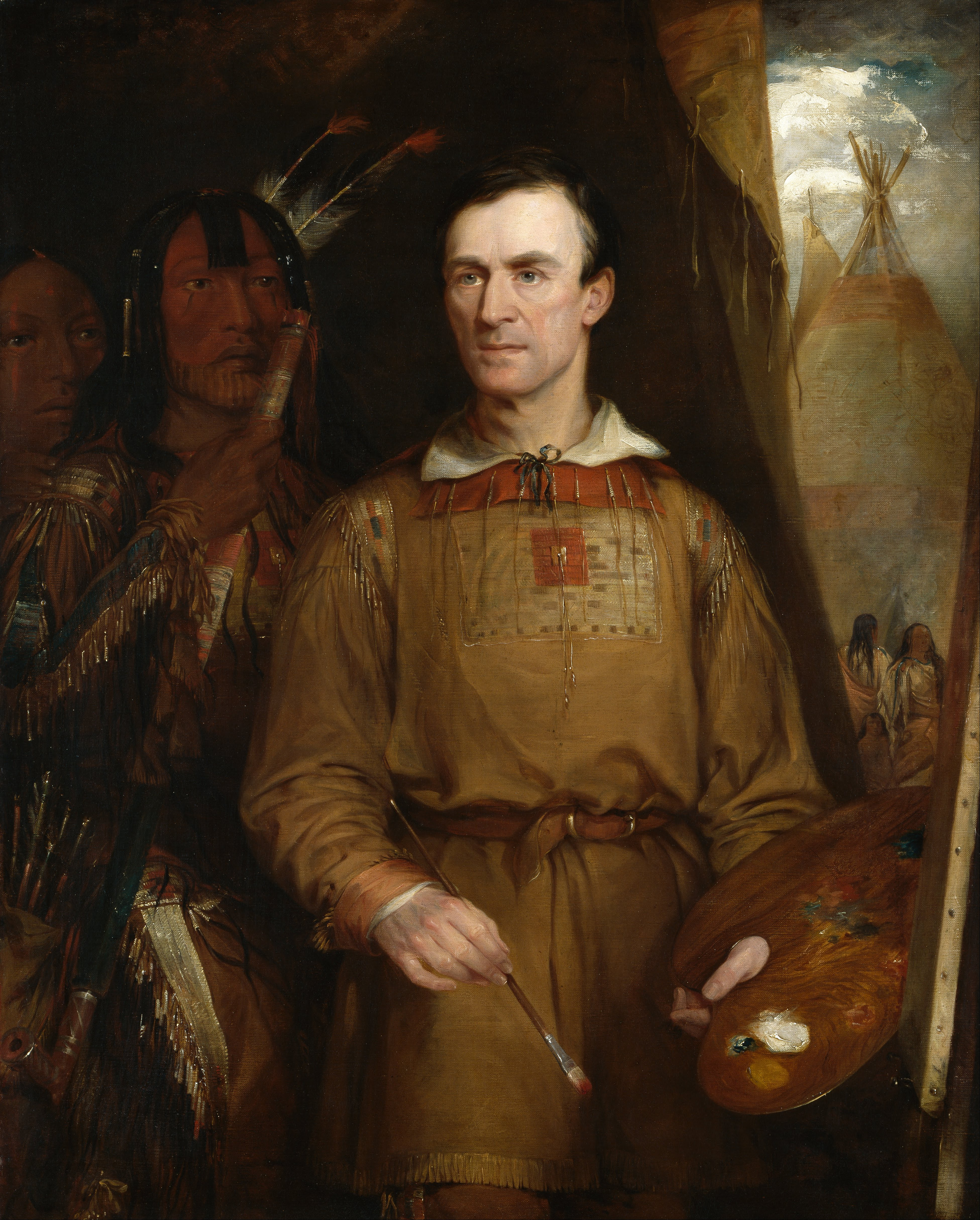
George Catlin
American lawyer and painterWikipedia
25
MENTIONS
11
EPISODES
11
PODCASTS
Search complete. 25 mentions across 11 episodes found for "George Catlin".
Oct 13, 2026

speaker_4SOUNDBITE_SPEAKER
And you see this in other ways with other forms of popular culture.
speaker_4SOUNDBITE_SPEAKER
Painters like George Catlin reinforced this noble savage fantasy by stripping indigenous life of context.
speaker_4SOUNDBITE_SPEAKER
So in his paintings he would remove trade goods, he would ignore any metal tools that were in the scenes, and he would paint clothing as traditional even when it wasn't.
speaker_4SOUNDBITE_SPEAKER
So if someone's sitting in front of you and they're wearing as it were modern clothing or western style clothing, you don't paint that, you paint some imagined, what you imagine as traditional clothing.

Larry Len PetersonGUEST
Well, Russell was born in St. Louis, which was the gateway to the West.
Larry Len PetersonGUEST
It's where Lewis and Clark started, Bodmer, Catlin, and numerous other folks that wanted to discover the Missouri River territory all the way up through Montana.
Larry Len PetersonGUEST
Russell was not from a poor family.
Larry Len PetersonGUEST
He was from a very wealthy family, and he grew up in Oak Hills, kind of a southern suburb of St. Louis on a plantation-style mansion.
Larry Len PetersonGUEST
One of the relatives even married a Native American and lived with her, was involved with the Sand Creek Massacre in Colorado on the Native American side.
Larry Len PetersonGUEST
So Russell got ingrained in him early on a disdain for the U.S. military and a love for Native Americans.
Larry Len PetersonGUEST
And I think one other point probably growing up is he would go to the St. Louis library and he could look at images by Catlin and Mix and Bodmer and other artists, King, and enjoyed and often later on was inspired by those images, some he almost directly copied as he got older.
Michael KlaassenHOST
Sarah, you probably have some knowledge about this next question, because the museum probably has some of these materials.

Phil SchempfNARRATOR
All LibriVox recordings are in the public domain.
Phil SchempfNARRATOR
For more information, or to volunteer, please visit LibriVox.org Recording by Phil Schempf The History of Minnesota and Tales of the Frontier, Part 1 By Charles E. Flandreau Section 6 George Catlin Featherstone Haw Schoolcraft and the Source of the Mississippi Elevations in Minnesota Nicolet George Catlin In 1835, George Catlin, an artist of merit, visited Minnesota and made many sketches and portraits of Indians.
Phil SchempfNARRATOR
His published statements after his departure about his adventures elicited much adverse criticism from the old settlers.
Phil SchempfNARRATOR
Featherstone Hawk.
1 HR 15 MINS LATER
Sharon ChimeradanNARRATOR
A joint resolution was passed ordering a slab of red pipestone from the famous quarry to be sent to the Washington Monument Association, which was done, and now represents Minnesota in that lofty monument at the National Capitol.
Sharon ChimeradanNARRATOR
This was done at the suggestion of Henry H. Sibley, who furnished the stone.
Sharon ChimeradanNARRATOR
It will be remembered that I have referred to the visit of George Catlin, the artist, to Minnesota in 1835, and that his report was unreliable.
Sharon ChimeradanNARRATOR
Among other things, he said that he was the first white man who had visited this quarry and induced geologists to name the pipestone Catlinite.

Jeff FennupGUEST
... interesting kind of tie-in to be like, how did that genetic variation get to that tribe? So yeah.
Tim ConstantineHOST
Well, that's, and that's what George Catlin was recording.
Tim ConstantineHOST
Fascinating figure from history that I lo- I, I love this guy.
Tim ConstantineHOST
I love looking into this guy.
Tim ConstantineHOST
They talk about there being a god and a devil, and they say the name is Samael on these tablets.
Tim ConstantineHOST
And that's very old stuff.
Tim ConstantineHOST
So, and then you get into George Catlin, and he talks about the Mandans, and he talks about how they're an amalgam of, of white and Native.
Jeff FennupGUEST
Mm-hmm.

ToddHOST
how long ago was that
Joe GiagoGUEST
uh probably late 1700s 1800s is when they would you know that kind of competition and then even like uh george catlin uh the artists who who you know came across minnesota in that area there there's there's uh where warriors would do flight shooting contests to see which arrow would go further.
Joe GiagoGUEST
He depicts that in some of his artwork.
Joe GiagoGUEST
Wow.

Kirsten EvendenGUEST
He spent time studying Raphael.
Kirsten EvendenGUEST
He spent time in Naples and in Northern Europe, upwards in, in Switzerland, and, and then eventually met George Catlin, or ran into the work of George Catlin, the American artist, um, of the early 19th century, when he was spending time in London.
Kirsten EvendenGUEST
And that really was a significant moment for him because George Catlin lectured in London and talked about working amongst First Peoples in the American West, depicting them.
Kirsten EvendenGUEST
And, um, we have to remember they were people of their time.
Kirsten EvendenGUEST
At that time, people thought the First Nations people were, quote unquote, "dying out," um, which of course was not the case.
Kirsten EvendenGUEST
But, um, George Catlin encouraged the likes of Kane to depict them, learn about them, study them, because they were supposedly a dying race.
Kirsten EvendenGUEST
[theme music] And so that really inspired Paul Kane, and it was upon his return back to Canada and Toronto that he then began to make plans to actually travel west.
Kirsten EvendenGUEST
He also spent time in and around Manitoulin Island with the Ojibwe.

Tim ConstantineHOST
But they were also...
Tim ConstantineHOST
George Catlin said that no native ever did him wrong or no native ever took his stuff or backstabbed him in any other way, any kinda way.
Tim ConstantineHOST
He was saying, like, they're honorable people.
Tim ConstantineHOST
So I don't think they were just gonna let you come in and steal their land, though, understandably.
Tim ConstantineHOST
J- Jeff Phillips been on the show.
Tim ConstantineHOST
He mentioned the Mandans, you know? And, and we got to talking about that and, and it g- and how they had s- They were speaking, like, Welsh, and they had Hebrew-like practices.
Tim ConstantineHOST
Practice is not from America, right? George Catlin also mentioned that the Mandans were, when he came across them, he, he s- put it like this.
Tim ConstantineHOST
He said, "They're an amalgam of natives and whites." So...

Anna SmistGUEST
Her black hair is separated by a middle part and fastened at the nape of her neck in a hairpiece just visible by the slight hunch in her shoulders.
Anna SmistGUEST
Clearly impressed by the way she outfitted herself for the portrait, the painter, George Catlin, worked painstakingly to capture every detail.
Anna SmistGUEST
To remember this work, Catlin titled it simply, Wife of Keokuk.
Anna SmistGUEST
Although everything she is wearing communicates her status, access to luxury European trade items, and her wealth evidenced by the time-consuming pieces of sock material culture like beadwork, silversmithing, and ribbon work, Catlin reduces her value to being the wife of a notable sock leader in the 19th century, someone worth remembering by her connection to the man who likely put her up for the portrait.
1 more episode mentions George Catlin.
Create an account to see the whole feed, search across every transcript, and follow the entities you care about.