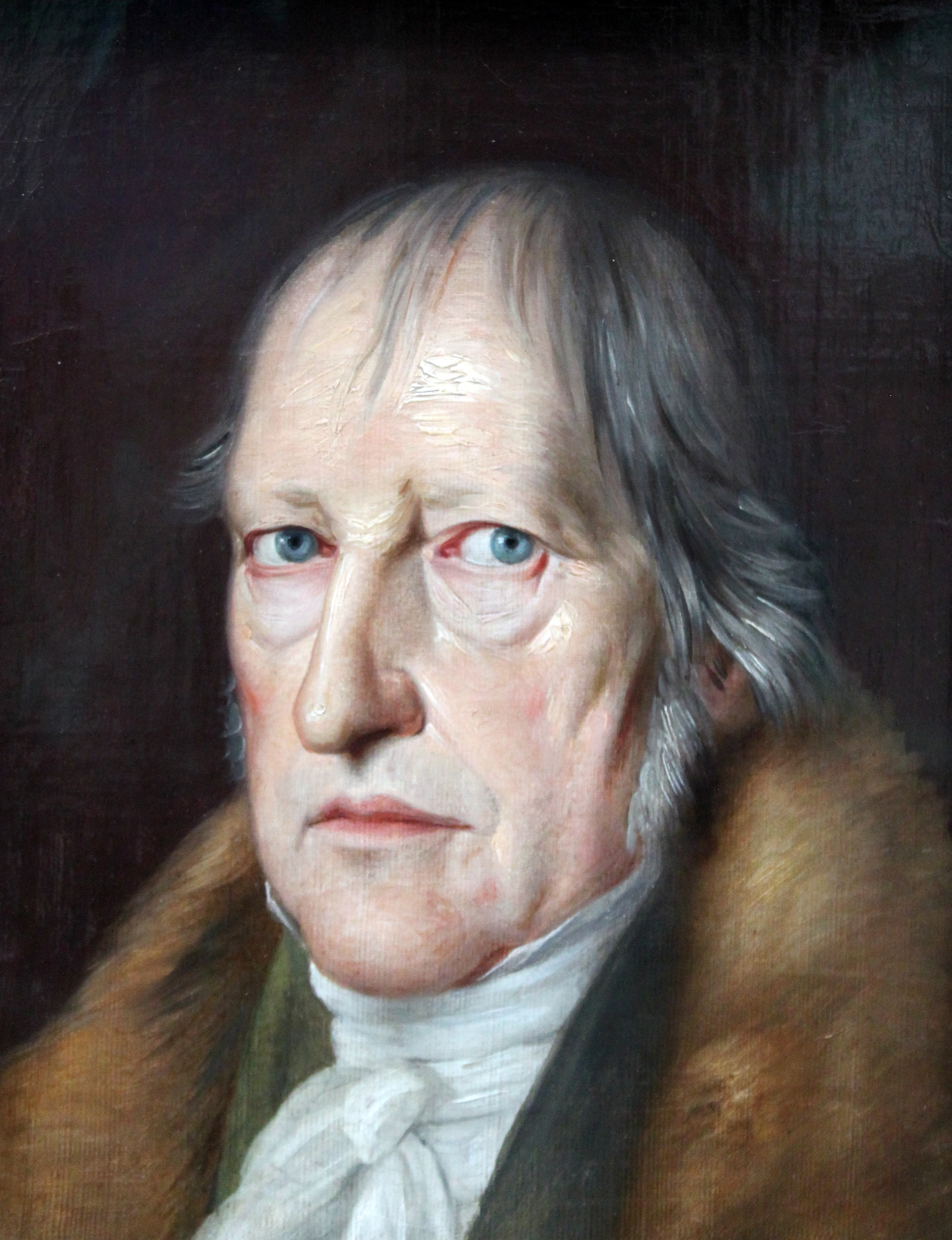
Georg Wilhelm Friedrich Hegel

Georg Wilhelm Friedrich Hegel

German philosopherWikipedia

Search complete. 2386 mentions across 458 episodes found for "Georg Wilhelm Friedrich Hegel".

Sep 11, 2026

Zach DasherHOST
45:23
I, I mean, 'cause, like, that is a g- um ...
Zach DasherHOST
45:26
He didn't bring up this philosopher, but there's a philosopher whose name was Friedrich Hegel, and this particular philosopher, um, again, it's, it's funny that s- the same course, uh, came up with what ...
Zach DasherHOST
45:38
He did mention the term dialectical in the, in the lecture.
Zach DasherHOST
45:41
So, um, i- he really was instrumental in forming what's called this dialectical model.
Zach DasherHOST
46:22
And but when you have a, a synthesis that forms, it creates a new thesis that has an antithesis, and then that forms a higher synthesis, and then this just goes on forever.
Zach DasherHOST
46:33
And Hegel was very influential in Western thought, and so he, he would argue that this is how God comes into being through the struggle.
Zach DasherHOST
46:42
Well, it's interestingly enough, you know what, you know what, uh, another philosopher came a- along the scene later, his name was Karl Marx, and Karl Marx studied Friedrich Hegel.
Zach DasherHOST
46:53
And so Marxism is essentially Hegel turned into a, a, a materialism.
Roger BerkowitzHOST
25:13
She writes in this period in her Denk Tagebuch, she's writing a lot about what she calls reconciliation.
Roger BerkowitzHOST
25:22
She cites the great thinker of reconciliation, Hegel, and his maxim, a ripped stocking is better than a darned stocking.
Roger BerkowitzHOST
25:34
Why is a ripped stocking, one that has a rip in it, better than one that's been fixed or, you know, darned, sewn? And she says, being ripped first makes noticeable the original unity.
Roger BerkowitzHOST
25:52
The stocking thus appears as a living unity in the ripped stocking, precisely what it proves its uselessness for life.
Roger BerkowitzHOST
26:23
You need sin.
Roger BerkowitzHOST
26:25
You need horror to make possible the thought of a unity, of a whole, in a world that is broken.
Roger BerkowitzHOST
26:36
And so Hegel says, you know, we prefer the ripped than the darned.
Roger BerkowitzHOST
26:42
And Arendt says, not so fast, right? She says, Hegel's a little too satisfied with the present.
H. Sterling BurnettPANELIST
74:26
I forget.
H. Sterling BurnettPANELIST
74:27
Hegel goes back to Hegel that you're all part of a social organism.
H. Sterling BurnettPANELIST
74:32
Uh, and it goes back to, in France, it goes back to, um, I forget the philosopher, but basically they both shared the idea that there is this entity called society that we are members of.
H. Sterling BurnettPANELIST
74:48
We contribute to it.
Landon D. C. ElkindNARRATOR
19:02
Parmenides himself is the source of a peculiarly interesting strain of mysticism which pervades Plato's thought, the mysticism which may be called logical because it is embodied in theories of logic.
Landon D. C. ElkindNARRATOR
19:16
This form of mysticism, which appears, so far as the West is concerned, to have originated with Parmenides, dominates the reasonings of all the great mystical metaphysicians from his day to that of Hegel and his modern disciples.
Landon D. C. ElkindNARRATOR
19:31
Reality, he says, is uncreated, indestructible, unchanging, indivisible.
Landon D. C. ElkindNARRATOR
19:37
It is immovable in the bonds of mighty chains without beginning and without end, since coming into being and passing away have been driven afar and true belief has cast them away.
Landon D. C. ElkindNARRATOR
19:50
The fundamental principle of his inquiry is stated in a sentence which would not be out of place in Hegel.
Landon D. C. ElkindNARRATOR
19:57
Thou canst not know what is not, that is impossible, nor utter it, for it is the same thing that can be thought and that can be.
Landon D. C. ElkindNARRATOR
20:06
And again, it needs must be that what can be thought and spoken of is, for it is possible for it to be, and it is not possible for what is nothing to be.
Landon D. C. ElkindNARRATOR
24:51
This is an outcome of the denial of division.
Jörg PohlGUEST
8:00
He studied in Heidelberg where he met Ernst Bloch and the two formed a lifelong relationship.
Jörg PohlGUEST
8:08
And despite Lukács' later criticism of Bloch's views on expressionism and surrealism, they stayed like... friends you know and in in 1916 he he wrote the the famous uh the theory of the novel which is regarded as a central piece of of the literature critique and he became a communist after world war one and world war one and then he joined the communist party of hungary and he started to systematically study Hegel and Marx and Kant.
Jörg PohlGUEST
8:47
And then he tried to synthesize those thoughts.
Jörg PohlGUEST
8:53
In 1923, this is quite important.
Jörg PohlGUEST
11:37
Those things taking into focus, not really class struggle, but the everyday life and being alienated.
Jörg PohlGUEST
11:54
of the so the the wrong the wrong consciousness or us or something because this it leads to a general reversal that capitalism creates in in in the subjects as a false consciousness within you know like like like adorno summed it up like we like the the whole is the false like a um like taking hegel's um the true is the whole and turning it twice around so so i'm this is something that that ideology is is not really about about one one leader many manipulating like uh but but because it's it is like an like an a personal structure So another point of you is the exploration of, Doug, you already mentioned it, of the philosophical category of totality.
Jörg PohlGUEST
13:09
So Hegel, he said, the true is the whole.
Jörg PohlGUEST
13:14
from an idealistic stance applied from a dialectical materialist perspective.
Phil BensonNARRATOR
9:35
Wayfarer, tell the Spartans that we died doing their bidding.
Phil BensonNARRATOR
9:41
At all times and among all peoples, when a man turns in the midst of need and stress to calm reflection and utters it, there is, as Hegel finely says, an approach to poetry.
Phil BensonNARRATOR
9:54
And Hebraism, by as its work canonizing and consecrating that mood which looks from the transient to the permanent relations of things, has made that approach to poetry more accessible and more frequented.
Phil BensonNARRATOR
10:09
Sometimes the vision of things in their eternal relations has overpowered the vision of their transient ones.

30 MINS LATER

Phil BensonNARRATOR
40:24
All the business of life comes into the story quite naturally.
Phil BensonNARRATOR
40:29
We discuss the whole economy of the little country town, we get to know how it lives, we see its orchards, gardens, vineyards, and reckon their yield.
Phil BensonNARRATOR
40:39
Here was once more a true epos where, to recall Hegel's phrase once more, everything that a nation is indeed finds utterance.
Phil BensonNARRATOR
40:50
Goethe's wonderful epic feeling for the springs of story had its counterpart, as we know, in a not less wonderful lyric feeling for the springs of song, and here he was only the most perfect of a throng of singers whose collective song is not to be matched by the Volkslied of any other people.
Amelia ChesleyNARRATOR
16:13
The book of nature, the book of organic life, and that of human development can already be read without resorting to the power of a creator.
Amelia ChesleyNARRATOR
16:22
a mystical vital force, an immortal soul, Hegel's trilogy, or the endowment of abstract symbols with real life.
Amelia ChesleyNARRATOR
16:30
Mechanical phenomena in their ever-increasing complexity suffice for the explanation of nature and the whole of organic and social life.
Amelia ChesleyNARRATOR
16:39
There is much, very much in the world that is still unknown to us, much that is dark and incomprehensible, and of such unexplained gaps new ones will always be disclosed as soon as the old ones have been filled up but we do not know of and do not see the possibility of discovering any domain in which the phenomena observed in the fall of a stone, or in the impact of two billiard balls, or in a chemical reaction, that is, mechanical phenomena, should prove inadequate to the necessary explanations.

16 MINS LATER

Amelia ChesleyNARRATOR
33:12
In the same way, a solid foundation for the history of the development of man's customs, manners, beliefs, and institutions was laid down.
Amelia ChesleyNARRATOR
33:20
a history the want of which was strongly felt by the 18th century philosophers and by Auguste Comte.
Amelia ChesleyNARRATOR
33:28
At the present time, this history can be written without resorting to either the formula of Hegelian metaphysics or to innate ideas and inspiration from without.
Amelia ChesleyNARRATOR
33:39
Without any of those dead formula, behind which, concealed by words as by clouds, was always hidden the same ancient ignorance and the
John Thomas KuzmarskiNARRATOR
91:09
In 1834 he resigned his commission and went to Moscow, where he spent six years studying philosophy.
John Thomas KuzmarskiNARRATOR
91:16
Like all philosophical students of that period, he became a Hegelian, and in 1840 he went to Berlin to continue his studies, in the hope of ultimately becoming a professor.
John Thomas KuzmarskiNARRATOR
91:27
But after this time his opinions underwent a rapid change.
John Thomas KuzmarskiNARRATOR
91:31
He found it impossible to accept the Hegelian maxim that whatever is, is rational, and in 1842 he migrated to Dresden, where he became associated with Arnold Ruge, the publisher of Deutsch-Jap Bucher.
John Thomas KuzmarskiNARRATOR
91:46
By this time he had become a revolutionary, and in the following year he incurred the hostility of the Saxon government.
John Thomas KuzmarskiNARRATOR
91:54
This led him to go to Switzerland, where he became in contact with a group of German communists.
speaker_12NARRATOR
120:21
Here, emanation gives way to evolution and intuition to the construction of ideas.
speaker_12NARRATOR
120:28
Hegel especially brought this leading fundamental thought to a remarkable expression.
speaker_12NARRATOR
120:35
In Hegel's teaching, the process of thought is driven further and further by means of self-engendered antithesis.
speaker_12NARRATOR
120:43
Through thesis, antithesis, and synthesis, the thought process evolves in ever richer content.
speaker_12NARRATOR
120:52
It ascends from general outlines to concrete forms.
Landon D.C. ElkindNARRATOR
200:22
Footnote.
Landon D.C. ElkindNARRATOR
200:23
The confusion of these two meanings of is is essential to the Hegelian concept of identity indifference.
Landon D.C. ElkindNARRATOR
200:31
End of footnote.
Landon D.C. ElkindNARRATOR
200:33
If you were to try to substitute for the author of Waverly in that proposition any name whatever, say C, so that the proposition becomes Scott is C, then if C is a name for anybody who is not Scott, that proposition would become false, while if, on the other hand, C is a name for Scott, then the proposition will become simply a tautology.

448 more episodes mention Georg Wilhelm Friedrich Hegel.

Create an account to see the whole feed, search across every transcript, and follow the entities you care about.

We value your privacy

We use cookies to understand how you use our platform and to improve your experience. Click “Accept All” to consent, or “Decline non-essential” to opt out of non-essential cookies. Read our Privacy Policy.