Genetic code
57
MENTIONS
7
EPISODES
5
PODCASTS
Search complete. 57 mentions across 7 episodes found for "Genetic code".
Sep 23, 2026

Cory SmithHOST
Today's guest is Dr. Akos Njerges, a genome engineer and independent research group leader at Harvard Medical School.
Cory SmithHOST
His lab works at the intersection of synthetic genomics, directed evolution, protein evolution, and genetic code rewriting.
Cory SmithHOST
Akos and his collaborators have engineered bacteria with altered genetic codes that resist viral infection, restrict the exchange of genetic information, and incorporate new chemistries beyond biology's standard amino acid alphabet.
Cory SmithHOST
His recent work uses multiomics and laboratory evolution to diagnose and repair the unexpected defects that emerge when scientists attempt to redesign genomes at enormous scale.
Cory SmithHOST
Today, we explore what happens when we move beyond editing individual genes and begin rewriting the operating system of life.
Akos NyergesGUEST
I was specifically excited about the opportunity that once we get to this stage that we will be able to write genomes and we will be able to synthesize practically however we want to, then we will be able to engineer the biological hardware.
Akos NyergesGUEST
including achieving functions that are not currently, either do not exist in nature or functions we just really want to see under laboratory conditions and test practically side tracks in life.
Akos NyergesGUEST
And one area there is genetic code engineering and I became really excited I became really fascinated by the opportunity to block viral infections and horizontal gene transfer, which was one of the major drivers of microbial evolution.

Taylor HenryHOST
I'm joined today with Dr. Richard Ulrey, a chiropractic physician and longtime student of genetics, minerals, and human health.
Taylor HenryHOST
He is the author of The Minerals and the Genetic Code, one of AcresUSA books.
Taylor HenryHOST
He's the author of a lot of other books that we'll get into as well, and he will be Speaking at the ECO-A conference this year, he has a full day workshop and he will have a general session throughout the conference.
Taylor HenryHOST
So, Dr. Ulrey, welcome back to Acres USA.
Richard OlreeGUEST
I'm going to write it.
Richard OlreeGUEST
Then I started getting onto planes and running down to Missouri where Chuck lived.
Richard OlreeGUEST
And after that, we produced the book Minerals for the Genetic Code.
Richard OlreeGUEST
But you did ask about my background.
Cory SmithHOST
Today's guest is Dr. Akos Njerges, a genome engineer and independent research group leader at Harvard Medical School.
Cory SmithHOST
His lab works at the intersection of synthetic genomics, directed evolution, protein evolution, and genetic code rewriting.
Cory SmithHOST
Akos and his collaborators have engineered bacteria with altered genetic codes that resist viral infection, restrict the exchange of genetic information, and incorporate new chemistries beyond biology's standard amino acid alphabet.
Cory SmithHOST
His recent work uses multiomics and laboratory evolution to diagnose and repair the unexpected defects that emerge when scientists attempt to redesign genomes at enormous scale.
Cory SmithHOST
Today, we explore what happens when we move beyond editing individual genes and begin rewriting the operating system of life.
Akos NyergesGUEST
Exactly.
Akos NyergesGUEST
I was specifically excited about the opportunity that once we get to this stage that we will be able to write genomes and we will be able to synthesize practically whatever we want to, then we will be able to engineer the biological hardware.
Akos NyergesGUEST
including achieving functions that are not currently do either do not exist in nature or functions we just really want to see under laboratory conditions and test practically side tracks in life and one of one area there is genetic code engineering and i became really excited I became really fascinated by the opportunity to block viral infections and horizontal gene transfer, which was one of the major drivers of microbial evolution.

Pat MiletichGUEST
Well, what it means is that we cannot grow food that have the nutrients in it that we need unless we understand what nutrients.
Pat MiletichGUEST
From my perspective from many years ago, reading books like Dead Doctors Don't Lie, Minerals for the Genetic Code, things like that that are really important for people to read.
Pat MiletichGUEST
I, from my perspective and through research, realized that the human body needs 60 plus minerals alone, two thirds of our Well, when we go to regenerative ag people and I ask the regenerative agriculture people, how many minerals do you need to have in soil? And they say 17.
Pat MiletichGUEST
They say 17.

KellyHOST
And uracil is used as a base instead of thiamine.
KellyHOST
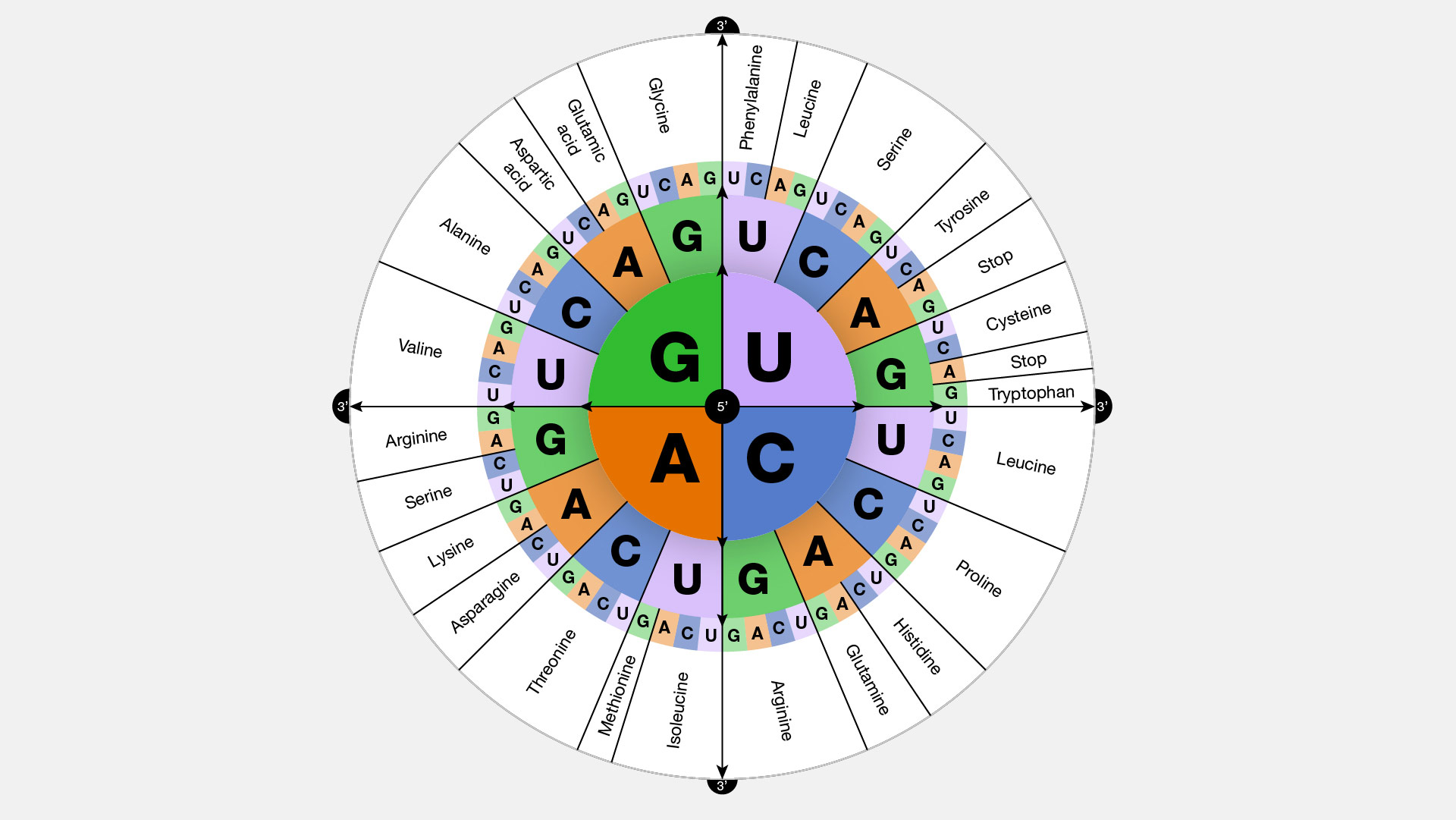
The language of protein exists in the genetic code in a set of three letters.
KellyHOST
Three nucleotide bases, or a triplet, is considered together as a code for a single amino acid.
KellyHOST
The combination of these triplets results in the primary structure or the order of amino acids in any given protein, the first step in protein expression is transcription.
KellyHOST
Translation itself occurs at the ribosome.
KellyHOST
Those triplets, or groups of three-letter bases, are called codons, three-base sequences.
KellyHOST
They can be mapped out for every organism using a master plan called the genetic code.
KellyHOST
Figure 6.13 in your text outlines the genetic code, and while you don't need to memorize it, you should know how to read it.
KellyHOST
Remember that genes are transcribed into RNA and translated into protein.
KellyHOST
We left off with an introduction to the genetic code.
KellyHOST
I have a little more on that to discuss with you.
KellyHOST
You should notice when looking at figure 6.13 from the textbook that many of the amino acids use more than one codon sequence.

Mark SaltzmanHOST
I know if I have A, G, C, G, A, I know what messenger RNA to make from that because I have to satisfy these base pairing rules.
Mark SaltzmanHOST
It's more complicated in making protein from an RNA strand and that complication is called the genetic code.
Mark SaltzmanHOST
You know that, you probably know that messenger RNA is read in three base units called codons.
Mark SaltzmanHOST
This particular piece of messenger RNA is drawn in this cartoon in three base pair units.
Mark SaltzmanHOST
That's not enough to specify over twenty amino acids.
Mark SaltzmanHOST
If I have three, I have sixteen times four or sixty-four possible choices, way more than enough.
Mark SaltzmanHOST
That creates a problem in the genetic code in that there's 64 possible sequences but there's only 20 some amino acids.
Mark SaltzmanHOST
Each amino acid can be specified by more than one codon.