General relativity
106
MENTIONS
7
EPISODES
7
PODCASTS
Search complete. 106 mentions across 7 episodes found for "General relativity".
Sep 21, 2026

Lindsay GrahamHOST
When the results of Arthur's expedition is made public at the end of nineteen-nineteen, Einstein will be catapulted to overwhelming fame.
Lindsay GrahamHOST
But many in the scientific community will continue to be skeptical of the physicist's so-called theory of general relativity.
Lindsay GrahamHOST
They'll question the validity of Arthur's conclusions and the rigor of his experiment, claiming that he didn't measure the positions of enough stars, and it will take several more years before another expedition will lay these doubts to rest with their own experiment on September twenty-first, nineteen twenty-two.
Lindsay GrahamHOST
Hello, History Daily listeners.
Lindsay GrahamHOST
On this podcast, every day, we tell the true stories of the people and events that shaped our world.
Lindsay GrahamHOST
Today is September twenty-first, nineteen twenty-two.
Lindsay GrahamHOST
Astronomers prove Einstein's theory of general relativity.
Lindsay GrahamHOST
It's late 1907 inside an office in Bern, Switzerland, nearly fifteen years before Arthur Eddington's experiment in Principe.

Kelly BecherNARRATOR
the concept true does not tally with the assertions of pure geometry because by the word true we are eventually in the habit of designating always the correspondence with a real object geometry however is not concerned with the relation of the ideas involved in it to objects of experience but only with the logical connection of these ideas among themselves it is not difficult to understand why in spite of this we feel constrained to call the propositions of geometry true geometrical ideas correspond to more or less exact objects in nature and these last are undoubtedly the exclusive cause of the genesis of those ideas geometry ought to refrain from such a course in order to give its structure the largest possible logical unity the practice for example of seeing in a distance two marked points on a practically rigid body is something which is lodged deeply in our habit of thought we are accustomed further to regard three points as being situated on a straight line if their apparent positions can be made to coincide for observation with one eye under suitable choice of our place of observation if in pursuance of our habit of thought we now supplement the propositions of euclidean geometry by the single proposition that two points on a practically rigid body always correspond to the same distance line interval independently of any changes in position to which we may subject the body the propositions of euclidean geometry then resolve themselves into propositions on the possible relative position of practically rigid bodies begin footnote it follows that a natural object is associated also with a straight line three points a b and c on a rigid body thus lie in a straight line when the points a and c being given b is chosen such that the sum of the distances ab and bc is as short as possible this incomplete suggestion will suffice for the present purpose geometry which has been supplemented in this way is then to be treated as a branch of physics we can now legitimately ask as to the truth of geometrical propositions interpreted in this way since we are justified in asking whether these propositions are satisfied for those real things we have associated with the geometrical ideas in less exact terms we can express this by saying that by the truth of a geometrical proposition in this sense we understand its validity for a construction with ruler and compasses of course the conviction of the truth of geometrical propositions in this sense is founded exclusively on rather incomplete experience For the present, we shall assume the truth of the geometrical propositions.
Kelly BecherNARRATOR
Then, at a later stage, in the general theory of relativity, we shall see that this truth is limited, and we shall consider the extent of its limitation.
Kelly BecherNARRATOR
On the basis of the physical interpretation of distance which has been indicated, we are also in a position to establish the distance between two points on a rigid body by means of measurements.
Kelly BecherNARRATOR
For this purpose we require a distance, rod S, which is to be used once and for all and which we employ as a standard measure.
Kelly BecherNARRATOR
Furthermore, the magnitudes of the coordinates are not actually determined by the constructions with rigid rods, but by indirect means.
Kelly BecherNARRATOR
If the result of physics and astronomy are to maintain their clearness, the physical meaning of specifications of position must always be sought in accordance with the above considerations.
Kelly BecherNARRATOR
A refinement and modification of these views does not become necessary until we come to deal with the general theory of relativity, treated in the second part of this book.
Kelly BecherNARRATOR
We thus obtain the following result.

speaker_2NARRATOR
The universe runs on two sets of rules.
speaker_2NARRATOR
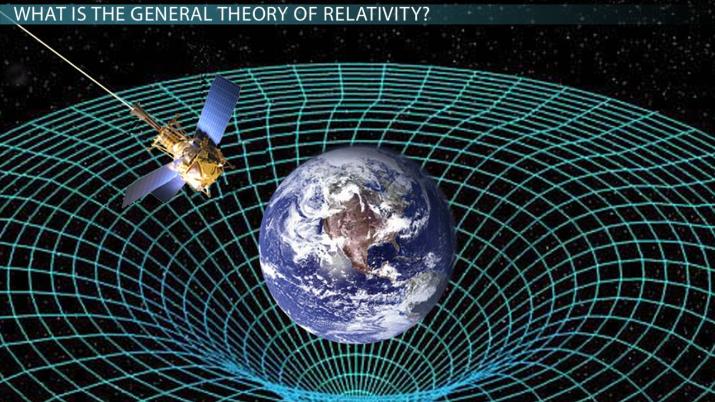
Big things follow Einstein's general relativity.
speaker_2NARRATOR
Gravity bends spacetime.
speaker_2NARRATOR
Clocks run slower near massive objects.

Kelly BecherNARRATOR
the concept true does not tally with the assertions of pure geometry because by the word true we are eventually in the habit of designating always the correspondence with a real object geometry however is not concerned with the relation of the ideas involved in it to objects of experience but only with the logical connection of these ideas among themselves it is not difficult to understand why in spite of this we feel constrained to call the propositions of geometry true geometrical ideas correspond to more or less exact objects in nature and these last are undoubtedly the exclusive cause of the genesis of those ideas geometry ought to refrain from such a course in order to give its structure the largest possible logical unity the practice for example of seeing in a distance two marked points on a practically rigid body is something which is lodged deeply in our habit of thought we are accustomed further to regard three points as being situated on a straight line if their apparent positions can be made to coincide for observation with one eye under suitable choice of our place of observation if in pursuance of our habit of thought we now supplement the propositions of euclidean geometry by the single proposition that two points on a practically rigid body always correspond to the same distance line interval independently of any changes in position to which we may subject the body the propositions of euclidean geometry then resolve themselves into propositions on the possible relative position of practically rigid bodies footnote it follows that a natural object is associated also with a straight line three points a b and c on a rigid body thus lie in a straight line when the points a and c being given b is chosen such that the sum of the distances ab and bc is as short as possible this incomplete suggestion will suffice for the present purpose geometry which has been supplemented in this way is then to be treated as a branch of physics we can now legitimately ask as to the truth of geometrical propositions interpreted in this way since we are justified in asking whether these propositions are satisfied for those real things we have associated with the geometrical ideas in less exact terms we can express this by saying that by the truth of a geometrical proposition in this sense we understand its validity for a construction with ruler and compasses of course the conviction of the truth of geometrical propositions in this sense is founded exclusively on rather incomplete experience For the present, we shall assume the truth of the geometrical propositions.
Kelly BecherNARRATOR
Then, at a later stage, in the general theory of relativity, we shall see that this truth is limited, and we shall consider the extent of its limitation.
Kelly BecherNARRATOR
End of section 1 Section 2 The System of Coordinates On the basis of the physical interpretation of distance which has been indicated, we are also in a position to establish the distance between two points on a rigid body by means of measurements.
Kelly BecherNARRATOR
For this purpose we require a distance, rod S, which is to be used once and for all and which we employ as a standard measure.
Kelly BecherNARRATOR
Furthermore, the magnitudes of the coordinates are not actually determined by the constructions with rigid rods, but by indirect means.
Kelly BecherNARRATOR
If the result of physics and astronomy are to maintain their clearness, the physical meaning of specifications of position must always be sought in accordance with the above considerations.
Kelly BecherNARRATOR
A refinement and modification of these views does not become necessary until we come to deal with the general theory of relativity, treated in the second part of this book.
Kelly BecherNARRATOR
We thus obtain the following result.

David KippingHOST
He predicted that there should exist a certain mass which is so great that the escape velocity equals the speed of light.
David KippingHOST
Mitchell called these dark stars, but nobody really took them very seriously until GR came along.
David KippingHOST
That's Einstein's theory of general relativity.
David KippingHOST
While serving for Germany during the First World War, Karl Schwarzschild found a solution to GR, something that Einstein did not expect to be achieved so easily.
David KippingHOST
But his solution researched the possibility of these dark stars, something considered implausible by Einstein and many others.
David KippingHOST
By 1971, the astronomical discovery of Cygnus X-1 provided the first evidence that this wasn't a trick of the math, but a real phenomenon.

ShaneHOST
One of the other solutions that people put forward is this idea of firewalls, where you say, okay, one of the assumptions that goes into the paradox is that general relativity, gravity makes sense at the horizon.
ShaneHOST
Nothing crazy happens.
ShaneHOST
I can trust, you know, GR, what Einstein said.
ShaneHOST
So if I throw away that assumption and just say, look, something actually does happen at the horizon, I have, I don't know, a fluid or something exciting, some theory of quantum gravity on the horizon and some theory of microstates on the horizon, which burns up the information as it enters the black hole.
ShaneHOST
There are people who sort of, they replace GR at the horizon with something else.
ShaneHOST
What's wrong with that approach?
Bill UnruhGUEST
Well, the trouble is that the horizon is a perfectly regular place.
5 MINS LATER
ShaneHOST
Originally,