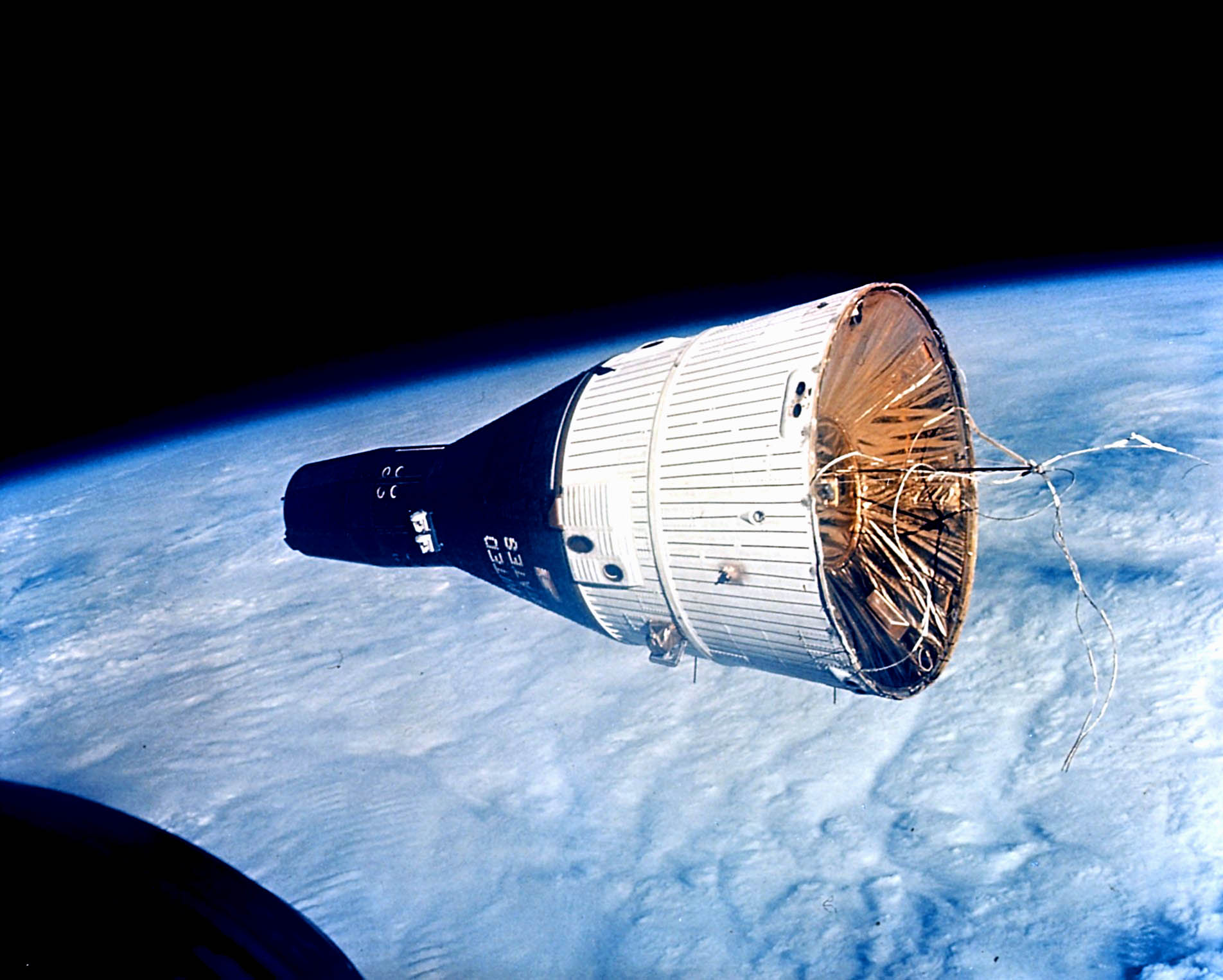
Gemini 7
Space flightWikipedia
17
MENTIONS
6
EPISODES
6
PODCASTS
Search complete. 17 mentions across 6 episodes found for "Gemini 7".
Sep 11, 2026

speaker_0SOUNDBITE_SPEAKER
Uh, Gemini 7 here.
speaker_0SOUNDBITE_SPEAKER
You Houston on your 8?
speaker_1SOUNDBITE_SPEAKER
Loud and clear.

speaker_0NARRATOR
Following on from Grissom, he was the pilot of the Gemini 4, and accordingly on the 3rd of June 1965, he became the first American to make a spacewalk.
speaker_0NARRATOR
He was also the backup command pilot for Gemini 7, and because of the usual pre-rotation process, he was due to pilot the Gemini 10, which would have made him the first of his group to fly twice.
speaker_0NARRATOR
Instead, he was promoted in 1966 to be the command module pilot for AS204.
speaker_0NARRATOR
The final member of the crew was pilot Roger B. Chaffee, a rookie.

Mark GagnonHOST
These objects didn't just show up once.
Mark GagnonHOST
They appeared during Mercury, Gemini, and Apollo missions.
Mark GagnonHOST
Individually, every incident could be dismissed as a technical anomaly, a weird light aberration, debris drifting outside the spacecraft, or a crew member misunderstanding what they're seeing.
Mark GagnonHOST
But taken together, is it possible they form a pattern stretching across the entire history of human spaceflight, a pattern of sightings, uncertainty, and even control? Because the question is no longer whether astronauts are seeing strange things in space, the question is what NASA believed those objects were.
Mark GagnonHOST
And NASA never really has to lie about a coverup or do anything because NASA never conducted an investigation that would produce anything to cover up.
Mark GagnonHOST
But that doesn't change the fact that the astronauts saw something that they thought was weird.
Mark GagnonHOST
Now, one of the earliest sightings was around December 4th, 1965, when Frank Borman and Jim Lovell launched on Gemini 7.
Mark GagnonHOST
The mission was brutal.

Kaveh HodaGUEST
[laughs]
QuinnHOST
"Leaves a bad taste in your mouth and coating on the roof of your mouth," Jim Lovell complained to Mission Control during Gemini VII.
QuinnHOST
And again, on other missions, astronauts just chose to, like, not eat these things.
QuinnHOST
On Mercury 9, which lasted 33 hours, astronaut Gordon Cooper ate only 700 of his 2400 calories.
Other ChrisHOST
Yeah.
Other ChrisHOST
I mean, that way it'll at least surprise them, you know? [laughs]
QuinnHOST
Ge- Gemini VII-
Kaveh HodaGUEST
But then you prepare the meal

James McDivittSOUNDBITE_SPEAKER
They checked the NORAD records to see what they had up on radar, and there wasn't anything within, uh, very close range of us.
Simon WhistlerHOST
Gemini VII and the bogey.
Simon WhistlerHOST
A similar experience took place during the Gemini VII mission in December 1965, known as the Bogey Encounter.
Simon WhistlerHOST
Astronauts Frank Borman and Jim Lovell were aboard the spacecraft, and it was Borman who spotted an unidentified object just an hour and 43 minutes into the mission.
Simon WhistlerHOST
Here's the conversation between him and CAPCOM.
James McDivittSOUNDBITE_SPEAKER
Uh, Gemini VII here.
James McDivittSOUNDBITE_SPEAKER
Houston on your eight.
Simon WhistlerHOST
Loud and clear.

WyattHOST
In the next few episodes, you will see how this knowledge got put to use effectively.
WyattHOST
That December, the Gemini 7 mission was launched, which completed over 200 orbits over the course of nearly 14 days.
WyattHOST
It set another long-duration spaceflight endurance record, helping scientists ensure that humans could survive a lengthy trip in such an environment.
WyattHOST
While up there, Gemini 6A was launched.
WyattHOST
The circumstances demanded an abrupt change of plans.
WyattHOST
NASA quickly changed Gemini 6A's course and had them stay about a foot apart for roughly five hours.
WyattHOST
Though Gemini 6A and Gemini 7 lacked the docking mechanisms to physically attach, they verified orbital mechanics calculations and paved the way for future lunar module docking procedures.
WyattHOST
In March of 1966, Gemini 8 was launched with Armstrong and Scott with the objective of docking with an unmanned vehicle.