Gaussian function
31
MENTIONS
10
EPISODES
10
PODCASTS
Search complete. 31 mentions across 10 episodes found for "Gaussian function".
Sep 8, 2026

speaker_0NARRATOR
He also addresses practical concerns, like false positives and fitting strategies.
speaker_0NARRATOR
Traditional fitting methods are slow and depend on Gaussian assumptions.
speaker_0NARRATOR
By mapping hits directly to parameters, Whiteson says the new approach can be far faster, more flexible, and better suited to both discovery and precision measurement.
speaker_0NARRATOR
It's a genuinely different way of looking at the problem.

Nani de la PeñaGUEST
I got my colleagues and students involved.
Nani de la PeñaGUEST
And we began to do something that's called Gaussian splats.
Nani de la PeñaGUEST
Sometimes people have heard of Gaussian mathematics and people understand Gauss in terms of, you know, lens settings, et cetera, for film.
Nani de la PeñaGUEST
But what this was a relatively recent breakthrough to use the Gaussian mathematics to allow us to use video and photographs to capture a scene and then translate it into fully dimensional content.
Mark BrodyHOST
Rory, what does using that kind of technology do for this story? And maybe how does it show itself to viewers in a way that sort of a straight documentary just on film or video does not?
Rory MitchellGUEST
Well, this is really a it's a unique spatial archive.
Rory MitchellGUEST
Well, when you put a VR headset on, we talk about these as experiences because you really have to experience this in order to start to understand VR.
Rory MitchellGUEST
what it feels like because when you put a VR headset on and you can then take a, when you take a step, the entire world moves with you.

Matt WorkmanGUEST
If you want to abstract even one step up and be like, I just want to film people in it and direct, this is a great...
Matt WorkmanGUEST
I don't know if Gaussian splats the word anymore.
Matt WorkmanGUEST
Who knows? Being able to actually go in
Faraz ShababiHOST
there and direct it is great.
Faraz ShababiHOST
And then the different angles, stopping the time, all of this stuff is done because they used Atlas to...
Faraz ShababiHOST
To regenerate all of the different frames and angles.
Faraz ShababiHOST
One thing, it's not creating Gaussians, right? I think it's creating
Faraz ShababiHOST
points.

Hassaan SaleemHOST
What's IID?
Christian FerkoGUEST
The short answer to your question is Gaussianity.
Hassaan SaleemHOST
Sorry, can you clarify IID?
Christian FerkoGUEST
Oh, sorry.
Christian FerkoGUEST
Good.
Christian FerkoGUEST
So there's, there's a few ways.
Christian FerkoGUEST
Uh, typically, you, you ty- you stare at the theorem that tells you that at large N, this th- thing becomes Gaussian, which was known, um, years ago, even in, in Neel's PhD thesis, and you violate one of those assumptions that guarantees g- guarantees Gaussianity.
Christian FerkoGUEST
So there's essentially three ways that you can do this.

Tim WarrenGUEST
If that one does not hold, my next mark is going to be on the daily chart.
Tim WarrenGUEST
Huge order block down here around 916, around that daily Gaussian band.
Tim WarrenGUEST
I'm not convinced we get all the way down there, but that is the next big, big order block.
Tim WarrenGUEST
So do you see a flash crash on link in a bear trend? I would be scooping up a lot of link around that nine 15 mark.
10 MINS LATER
Tim WarrenGUEST
It's a breaker block, which means it was an order block.
Tim WarrenGUEST
I think you're looking back.
Tim WarrenGUEST
between $2,100 to $2,000 back towards that 200-day moving average slash daily Gaussian band for your bigger pullback.
Tim WarrenGUEST
If we slash through this level, then you're looking for an oversold daily buy signal.

Steven StrogatzGUEST
But when you have repeating stuff in time, pi comes in there too.
Steven StrogatzGUEST
Now, why does the pi come into the Gaussian distribution? you know, the normal distribution for like, if I want to calculate the area under the Gaussian, to normalize it to have area one, I'm going to have some square roots of two pi in the formula.
Steven StrogatzGUEST
Well, that's because to calculate that area, you use the symmetry properties of the Gaussian.
Steven StrogatzGUEST
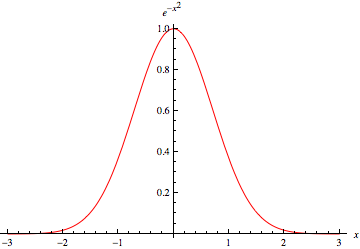
So the Gaussian is this bell, and it's very hard to calculate the area under the bell.
Steven StrogatzGUEST
But if you rotate the bell in two dimensions to make something that really looks like a bell, a two-dimensional surface of a bell, then the math becomes much more beautiful because instead of just having bilateral symmetry of the bell curve, you have rotational symmetry of a bell surface.
Steven StrogatzGUEST
And you can do that integral in polar coordinates.
Steven StrogatzGUEST
Why is that happening? It's sort of because, it's interesting to think about.
Steven StrogatzGUEST
I mean, the two pi is very much related to a trick about two dimensions.

Rob PhillipsGUEST
I can write down a law called Fick's law, which tells me how to relate flux to the gradient in the concentration.
Rob PhillipsGUEST
I will get a partial differential equation called the diffusion equation, and when I solve it, I will get a Gaussian.
Rob PhillipsGUEST
And so that's a deterministic, like there is no lack of determinism there.
Rob PhillipsGUEST
You tell me an initial condition, I will tell you what happens all the way to infinity.
Rob PhillipsGUEST
Now, what's amazing is if I average over those molecules that are hopping around, like let's say that I do it a thousand times, and you can do this in your class, and probably you do.
Rob PhillipsGUEST
You know, like you flip coins, you get a bunch of random walkers.
Rob PhillipsGUEST
You add up and average all their trajectories, and guess what? It's a Gaussian.
Rob PhillipsGUEST
So I'm not super excited about the dichotomy between these things, and let me give you a second example, which is mRNA and its production.

UrbanHOST
LEWM, which is the abbreviation, does not rely on any training heuristics such as stop gradient, exponential moving averages, or pre-trained representations.
UrbanHOST
To prevent trivial collapse, the SigReg reguliz- regularization term enforces Gaussian distributed latent embeddings promoting feature diversity.
UrbanHOST
For tractability, latent embeddings are projected onto multiple random directions, and a normality test is applied to each one-dimensional projection.
UrbanHOST
Aggregating these statistics encourages the full embedding distribution to match an isotropic Gaussian.
UrbanHOST
So I know that's very high-level language.
UrbanHOST
You don't have to fully understand it all.
5 MINS LATER
UrbanHOST
It pulls data, takes these measurements, very precise measurements using, you know, wireless body area networks, sensor networks, Internet of things.
UrbanHOST
Uh, think back to that figure fourteen that I showed you at the beginning of the, the presentation.

Brendan O'DonoghueGUEST
And the way they are trained is you take the ground truth data that you want to model and you add some noise to it.
Brendan O'DonoghueGUEST
And in the continuous domain, that's typically Gaussian, but it doesn't have to be.
Brendan O'DonoghueGUEST
And then you train the model to the neural network to remove that noise.
Brendan O'DonoghueGUEST
And then there's various ways you can do that.
Brendan O'DonoghueGUEST
And then you train it on a bunch of different noise amounts and a bunch of different data.
Brendan O'DonoghueGUEST
And then when it comes to inference time and you want a sample from the data distribution that you care about, you just give the model pure noise.
Brendan O'DonoghueGUEST
So pure Gaussian in the case of Gaussian diffusion.
Brendan O'DonoghueGUEST
And then you iteratively apply the neural network and kind of move along this kind of ODE flow of this kind of probability density towards maximizing the data distribution that you care about.