Gaokao
34
MENTIONS
9
EPISODES
7
PODCASTS
Search complete. 34 mentions across 9 episodes found for "Gaokao".
Nov 7, 2026

Cyrus JanssenGUEST
And it's exactly.
Cyrus JanssenGUEST
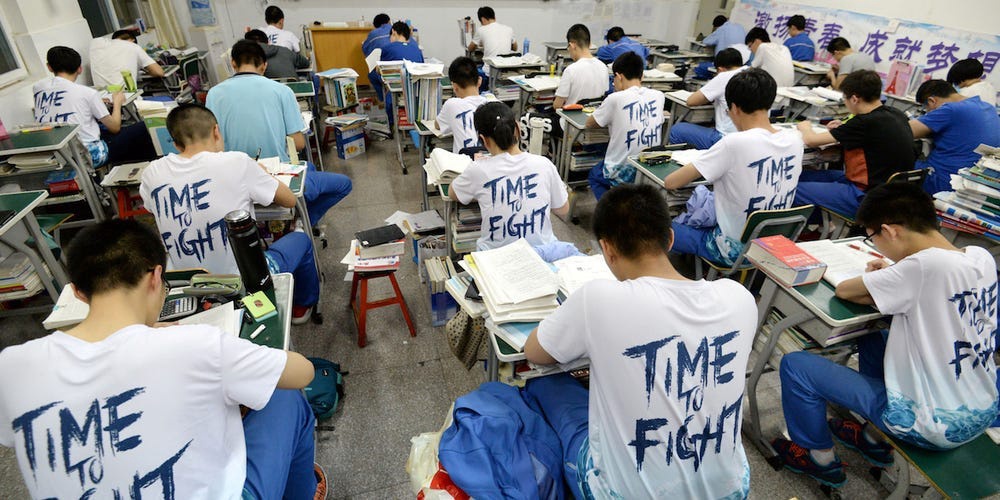
So the Gaokao, just so people don't know, the Gaokao is equivalent.
Cyrus JanssenGUEST
It's your college entrance test.
Cyrus JanssenGUEST
It is like the biggest test you ever take in China.
Cyrus JanssenGUEST
And it's like a two or three day examination, depending on where you are in the country.
Cyrus JanssenGUEST
But yeah, people study their whole lives, you know, to take that test.
Cyrus JanssenGUEST
And so, you know, if you pass the Gaokao and you're going to get into big school, like massive deal.
DylanHOST
Yeah, that's so wild because I mean, the idea I think about in food sometimes like it's like in the US, sometimes there's just like really crappy food, right? Like we allow certain things in our food production line that China would have never allowed.

Larry LifsonGUEST
We have more teams here, so we do that.
Larry LifsonGUEST
And then with the activities, for example, in China, they have very important tests, the Zhengkao to get into high school and the Gaokao to get into college.
Larry LifsonGUEST
And you have to spend hours and hours studying and preparing for this.
Larry LifsonGUEST
There's not a lot of time for extracurriculars because you need to do well because that's going to determine your future.

FeifeiHOST
We call it 中考.
FeifeiHOST
So will this new school system take the pressure off the students and perhaps their parents too? But will the schools themselves be ready for such a new change? And today I'm sitting down with Yushan and Yusheng for this very important, I think it's sort of the second most important exam throughout our educational experiences after Gaokao.
FeifeiHOST
And I guess all of us have taken part in the Zhongkao exam, right?
YushanHOST
Yeah.
YushanHOST
And then after nine years of compulsory education, students typically take the exam after around 15 years old.
YushanHOST
And their results play a very central role in determining whether they enter an ordinary academic high school or a vocational secondary school.
YushanHOST
So for many families, this means the pressure of competing for educational opportunities begins well before the university entrance examination, which is the Gaokao.
FeifeiHOST
Yeah, and also I think it's the first time as a 15-year-old, as a teenager, you are facing sort of a life choice.

Larry BernsteinHOST
If you missed our previous podcast, it was how high stakes college exams can change your life.
Larry BernsteinHOST
Our speaker was Stanford economics professor Hongbin Li, who discussed his new book, The Highest Exam, How Gaokao Shapes China.
Larry BernsteinHOST
He expressed why this high stakes exam is critical.
Larry BernsteinHOST
for the Chinese in our college admission process, as well as getting a job.
FeifeiHOST
We call it 中考 .
FeifeiHOST
So will this new school system take the pressure off the students and perhaps their parents too? But will the schools themselves be ready for such a new change? And today I'm sitting down with Yushan and Yusheng for this I think it's sort of the second most important exam throughout our educational experiences after Gaokao.
FeifeiHOST
And I guess all of us have taken part in the Zhongkao exam, right? So let's first explain what exactly is Zhongkao.
YushanHOST
Yeah, so for generations of Chinese students, the Zhongka or senior high school entrance examination, it has been a major also turning point because it's kind of decided which kind of high school you're going to get in.
YushanHOST
And then after nine years of compulsory education, students typically take the exam after around 15 years old.
YushanHOST
And their results play a very central role in determining whether they enter an ordinary academic high school or a vocational secondary school.
YushanHOST
So for many families, this means the pressure of competing for educational opportunities begins well before the university entrance examination, which is the Gaokao.
FeifeiHOST
Yeah.

Mr BallenHOST
They were both tall and thin, they wore glasses, they were both kind of quiet and nerdy, and they both loved video games.
Mr BallenHOST
But Henry and Pan, of late, had not had a chance to spend much time together because they were both very busy studying for something called the Gaokao, which is China's national college entrance exam.
Mr BallenHOST
This test is sort of like the SAT in America, except realistically it's way more high stakes because it's literally the only thing that some colleges in China take into account for admissions.
Mr BallenHOST
And so if Henry and Pan wanted to get into good colleges, they needed to ace this test.
21 MINS LATER
Mr BallenHOST
Like no one could recall who Pan Bowen was except for Henry and Lee.
Mr BallenHOST
Henry would eventually visit a psychiatrist because this was obviously an enormous trauma for him.
Mr BallenHOST
And the psychiatrist would tell him that the stress of studying for that Gaokao exam had caused him to hallucinate a multi-year-long friendship with a fictional person, Pan Bowen.
Mr BallenHOST
Now, Henry did not believe this.
Larry BernsteinHOST
And today's episode is How High-Stakes Chinese College Exams Can Change Your Life.
Larry BernsteinHOST
Our speaker is Stanford economics professor Hongbin Li, who will discuss his new book, The Highest Exam: How Gaokao Shapes China.
Larry BernsteinHOST
I want to find out why a high-stakes exam is critical for the Chinese in their college admission, as well as getting a job.
Larry BernsteinHOST
And I want to learn why this exam is believed to be the one thing in Chinese society that cannot be corrupted.
Larry BernsteinHOST
Hongbin, can you please begin with six minutes of opening remarks?
Hongbin LiGUEST
The book I wrote with my coauthor, Ruixue Jia, is on China's Gaokao, the highest exam.
Hongbin LiGUEST
So this is the college entrance exam every kid needs to take to go to college in China.
Hongbin LiGUEST
Scheduled in early June, between two to four days.

Hugo Kristiāns BaltaGUEST
For example, uh, maths especially.
Hugo Kristiāns BaltaGUEST
Or expanding that even a bit further where you could, uh, create a same, uh, exam system as is the Gaokao in China or the, what's N- what's in America? The what, what-
Nikodem SkrobiszHOST
SAT.
Hugo Kristiāns BaltaGUEST
SAT.

Gerard A. PostiglioneGUEST
The second one is the one you just mentioned, and that one is, is equity, and part of the book goes into the, um, the history of the examination system that lasted through most of China's dynasties.
Gerard A. PostiglioneGUEST
China's been a meritocracy, and so the question you're asking is, is it still a meritocracy? And, you know, after the revolution in 1949, the advantages, uh, uh, those, uh, being clearly students from families of workers, of farmers, and of the military, and that changed when Deng Xiaoping took power in the late '70s, uh, and there was more of an emphasis on the academic side rather than the political side of education, and therefore, you begin to see the, the re-implementation of the Gaokao exam, of the National College and University Entrance Exam.
Gerard A. PostiglioneGUEST
And when that started to happen, it clearly was, in many ways, a meritocracy because 80%, well, even more than 80% of the population was rural.
Gerard A. PostiglioneGUEST
So in terms of your opportunities, most students, uh, were, you know, in, in rural either village or township or, or counties' primary, secondary schools, and there was a certain amount of, of equity.
Gerard A. PostiglioneGUEST
But as urbanization occurred, as the GDP growth was averaging close to 10% a year, you began to get the emergence of a middle class, and the students who attend post-secondary education, their chances are still, I would say most c- cases hinge fully on the Gaokao scores.
Gerard A. PostiglioneGUEST
There's some experimentation, particularly close by Hong Kong, the Southern University of Science and Technology when it was first established by Zhu Yuanxin, who was the president of the, uh, China University of Science and Technology formerly, and he came over to establish a new university.
Gerard A. PostiglioneGUEST
He said, "No Gaokao scores.
Gerard A. PostiglioneGUEST
We're gonna identify people who are creative and innovative," and so on.