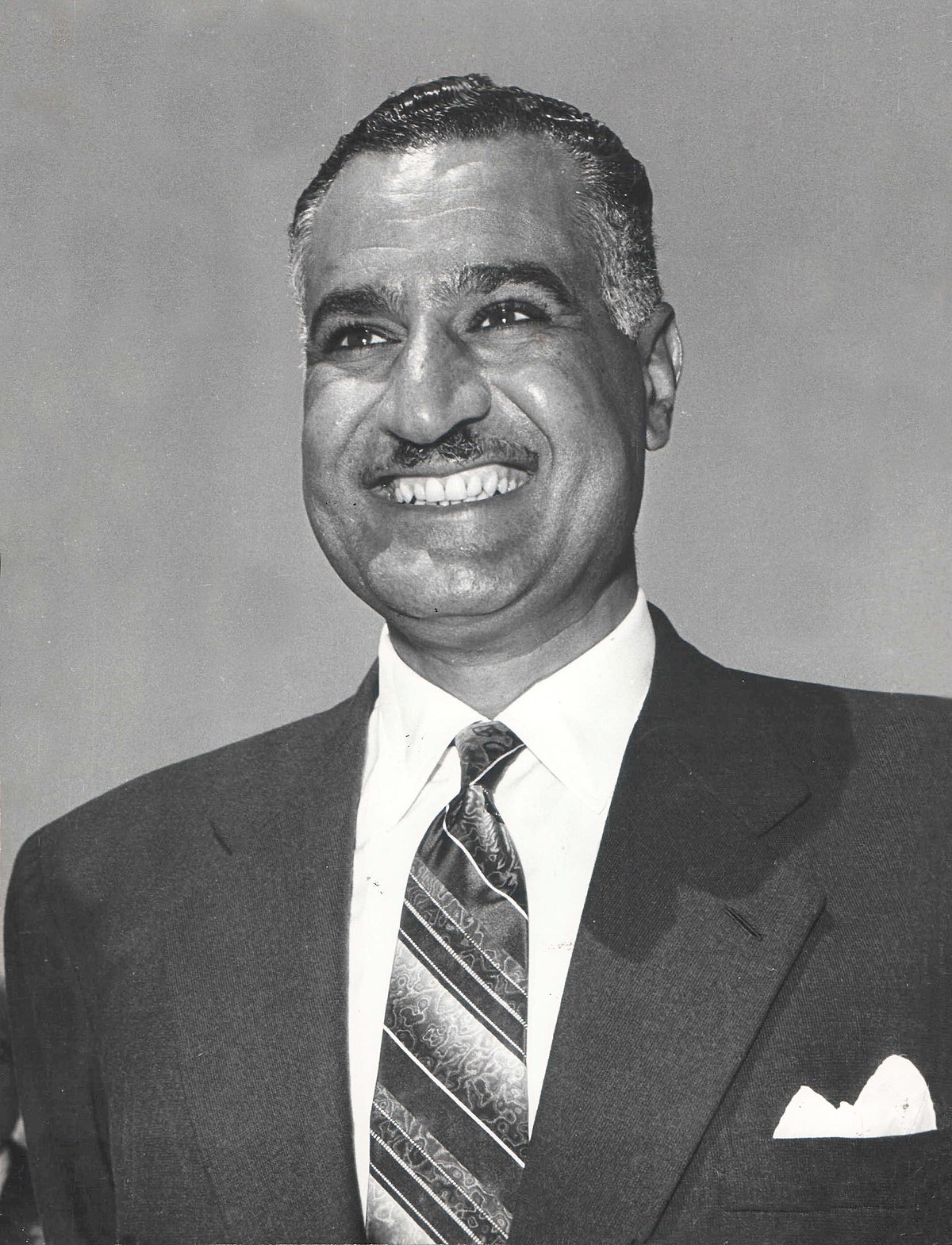
Gamal Abdel Nasser
Military officer and former President of the United Arab RepublicWikipedia
245
MENTIONS
88
EPISODES
75
PODCASTS
Search complete. 245 mentions across 88 episodes found for "Gamal Abdel Nasser".
Sep 13, 2026

Thomas777GUEST
We were talking about how they're vague which Johann von Leers, as well as Otto Reimer and Hans Rudel, was a major contributor to, both in terms of his work product and capital investment.
Thomas777GUEST
And when Argentina was no longer a friendly environment for that sort of partisan activity, Johann de Perón being forced out of office, von Leers made his way to the court of Nasser And Egypt and Syria, in particular, were very much the loci of that kind of partisan activity.
Thomas777GUEST
And that's significant because that plays into not just the military culture of the region on the Arab side, many of whom were trained by former National Socialists and Wehrmacht veterans.
Thomas777GUEST
But also, it impacted the culture of resistance in profound ways.
1 HR 9 MINS LATER
Thomas777GUEST
There's people with a superficial understanding of National Socialism, and there's some Palestinian liberationists who mean well.
Thomas777GUEST
but they're somewhat conceptually impoverished in their understanding of the historical record.
Thomas777GUEST
They cast the Mufti as almost like a Palestinian Nasser.
Thomas777GUEST
That's not really accurate.

ThomasGUEST
We were talking about how Der Weg, which Johann von Leers, as well as Otto Rehmer and Hans Rudel, was a major contributor to both in terms of his work product and capital investment.
ThomasGUEST
And when Argentina was no longer a friendly environment for that sort of partisan activity, going to Peron being forced out of office, Von Leers made his way to the court of Nasser and Egypt and Syria in particular, were very much the loci of that kind of partisan activity.
ThomasGUEST
And that's significant because that plays into not just the military culture of the region on the Arab side, many of whom were trained by former national socialists and Wehrmacht veterans, but also it impacted the culture of resistance in profound ways.
ThomasGUEST
And that's something that's overlooked.
1 HR 14 MINS LATER
ThomasGUEST
There's people with a superficial understanding of National Socialism, and there's some Palestinian liberationists who mean well.
ThomasGUEST
but they're somewhat conceptually impoverished in their understanding of the historical record.
ThomasGUEST
They cast the Mufti as almost like a Palestinian Nasser.
ThomasGUEST
That's not really accurate.

Isaac ZileSOUNDBITE_SPEAKER
This is an important detail since being in an active state of belligerency allows the parties involved to withhold certain peacetime rights from one another if they so choose.
Isaac ZileSOUNDBITE_SPEAKER
Egyptian President Gamal Abdel Nasser had no qualms about doing exactly that and arguing that he was legally entitled to his actions despite the fact that the Israelis disagreed with his assessment, as we'll dive deeper into shortly.
Isaac ZileSOUNDBITE_SPEAKER
Moreover, the Israeli-Syrian border was by far the most tumultuous front in the lead-up to the 1967 Six-Day War.
Isaac ZileSOUNDBITE_SPEAKER
According to a posthumously released 1976 interview with the infamous Israeli general and former defense minister Moshe Dayan, roughly 80% of the clashes along the Syrian border on the eve of the Six-Day War were sparked by Israeli aggression.
26 MINS LATER
Isaac ZileSOUNDBITE_SPEAKER
She was terrified at the prospect of being the first Israeli Prime Minister to willingly withdraw from land and this motivated her behavior when dealing diplomatically or militarily with the Arabs.
Isaac ZileSOUNDBITE_SPEAKER
As she put it herself in her memoir while reminiscing on this period, intransigent was to become my middle name.
Isaac ZileSOUNDBITE_SPEAKER
As peace negotiations between Israel and its neighbors crumbled due to the failure to agree on an interpretation of Resolution 242, and as Israel's intransigence persisted, Gamal Abdel Nasser came to the realization that what was taken by force can only be recovered by force.
Isaac ZileSOUNDBITE_SPEAKER
He knew that the Israelis weren't interested in genuine peace talks and were just trying to stall as long as they could in order to fill the territories with settlers in the attempt to make facts on the ground and cozy into the territorial status quo.

speaker_0HOST
And from 1955 to 19, uh, 65, that 10-year period, he wrote the most, two dam- most damaging books on taking the Quran and applying it to the 20th century.
speaker_0HOST
He was then executed by Gamal Nasser in 1960, uh, 1965, but his students was Ayman Zawahiri.
speaker_0HOST
Ayman Zawahiri.
speaker_0HOST
Remember, Sayyid Qutb had memorized the Quran by the time he was 10 years old.

Malcolm NanceHOST
Even Egypt tried to invade this place in the 60s and got their asses kicked.
Malcolm NanceHOST
Gamal Abdel Nasser had horrible trouble with the Yemenis, mainly the Houthis in the north.
Malcolm NanceHOST
If they take Aden, this game is over.
Malcolm NanceHOST
And I mentioned this the other day because that's the capital.

Hossam El-HamalawyGUEST
This is all of it.
Hossam El-HamalawyGUEST
It included three successive regimes, Nasser, Sadat, and Mubarak.
Hossam El-HamalawyGUEST
Sisi lumped them all together in one lot as the First Republic, and actually I'm arguing that he's right, even when on the surface they had different inclinations, different stated goals, different international alliances.
Hossam El-HamalawyGUEST
But when it comes to the core of how the state machine was organized, actually they didn't differ that much, and there was some logic in organizing the security apparatus which completely changed after 2013.
Hossam El-HamalawyGUEST
[upbeat music]
Dana Al KurdHOST
Let's get into that in particular.
Dana Al KurdHOST
It's, it's the fact that Abdel Nasser and onward, they pitted different parts of the security apparatus against each other.
Dana Al KurdHOST
Correct me if I'm wrong.

Hossam el-HamalawyGUEST
This is all of it.
Hossam el-HamalawyGUEST
It included three successive regimes, Nasser, Sadat, and Mubarak.
Hossam el-HamalawyGUEST
Sisi lumped them all together in one lot as the First Republic, and actually I'm arguing that he's right, even when on the surface they had different inclinations, different stated goals, different international alliances.
Hossam el-HamalawyGUEST
But when it comes to the core of how the state machine was organized, actually they didn't differ that much, and there was some logic in organizing the security apparatus, which completely changed after 2013.
Hossam el-HamalawyGUEST
[upbeat music]
Dana El KurdHOST
Let's get into that in particular.
Dana El KurdHOST
It's, it's the fact that Abdel Nasser and onward, they pitted different parts of the security apparatus against each other.
Dana El KurdHOST
Correct me if I'm wrong, I, I'm not a scholar of Egypt, but, um-

Hal KempferHOST
And there were also foreign forces, regular and conventional forces were involved.
Hal KempferHOST
The Egyptian president, Gamal Abdel Nasser, supported the Republican side with as many as 70,000 Egyptian troops and weapons.
Hal KempferHOST
I will tell you that their intervention did not go well.
Hal KempferHOST
They got up in that mountainous area where the Houthis are ensconced now, and they had a very, very difficult time.

Dan SnowNARRATOR
On the 29th of October, Israeli paratroopers and ground forces attacked the Sinai Peninsula, while British and French troops launched Operation Musketeer two days later, attacking Egypt by air and sea.
Dan SnowNARRATOR
Egyptian President Nasser responded by sinking 40 ships in the canal, closing it to all traffic.
Dan SnowNARRATOR
The 70,000 Egyptian forces were quickly overwhelmed, but world opinion labelled the invasion an act of aggression.
Dan SnowNARRATOR
The invading forces had made the fatal error of not securing American support for the offensive.

David ZereCORRESPONDENT
...
David ZereCORRESPONDENT
Brotherhood of Muslims in the early 1900s, you know, being left out of the constitution in Iran, and then going against the secular governments across pan-Arab countries like, uh, Nasser in Egypt and other, and you know, A- Anwar Sadat was assassinated with the Middle East Accords and others.
David ZereCORRESPONDENT
So, uh, yeah, definitely, uh, very significant.
David ZereCORRESPONDENT
Um, you know-
78 more episodes mention Gamal Abdel Nasser.
Create an account to see the whole feed, search across every transcript, and follow the entities you care about.