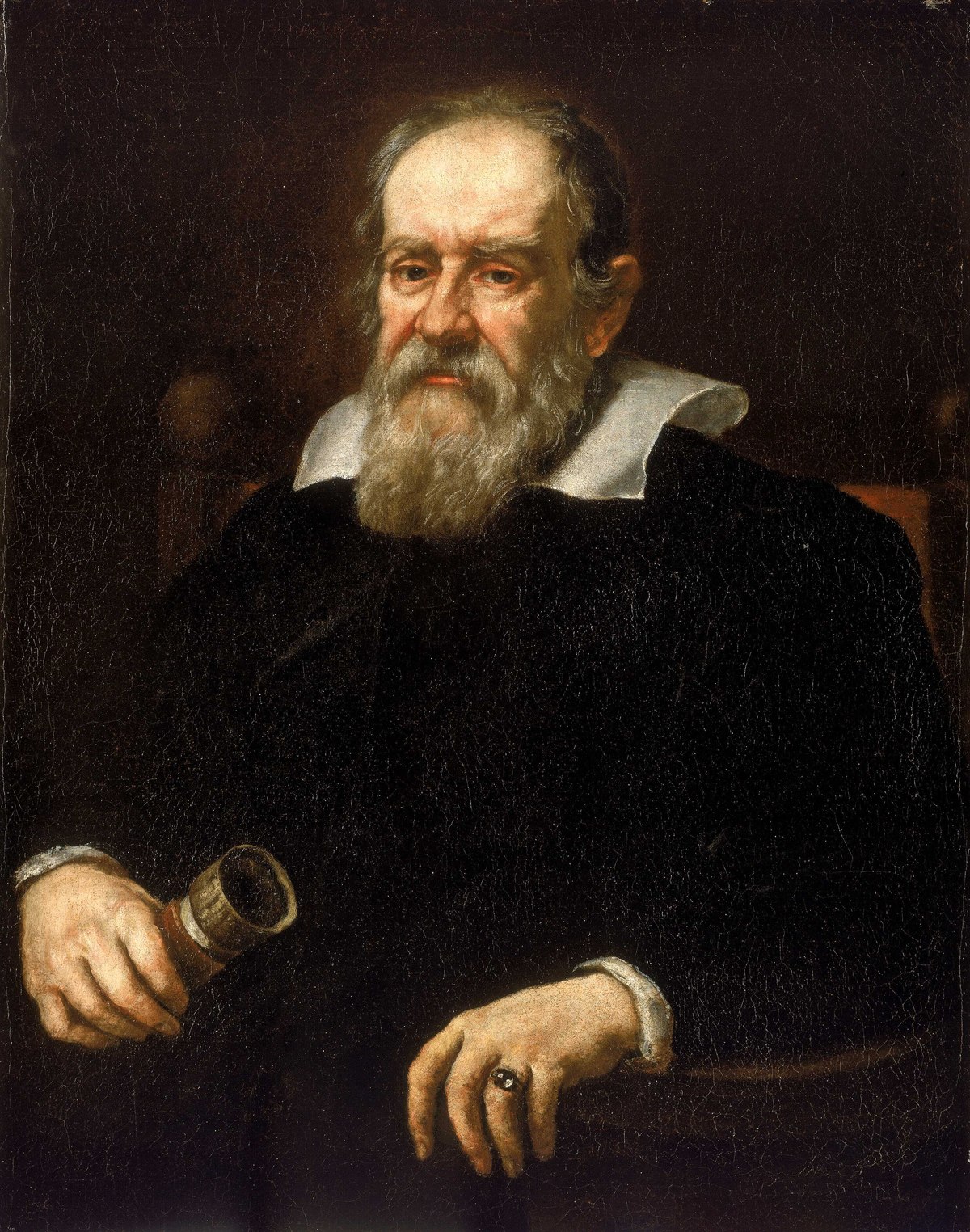
Galileo Galilei
PolymathWikipedia
1.4k
MENTIONS
380
EPISODES
285
PODCASTS
Search complete. 1392 mentions across 380 episodes found for "Galileo Galilei".
Sep 17, 2026

Micah DankGUEST
This is a screenshot of what I found.
Micah DankGUEST
In 1610, Italian astronomer Galileo Galilei was the first to gaze at Saturn through a telescope.
Micah DankGUEST
To his surprise, he saw a pair of objects on either side of the planet.
Micah DankGUEST
So Saturn was discovered in 1610, right? Well, I just showed you guys ancient Saturnalia festival information that they just lie about, so you can't trust search engines when you look up stuff because they lie to you.

David BaronGUEST
But then when, you know, this was a time when science had so undermined traditional religion.
David BaronGUEST
I mean, that's the history of science, right? Whether it's Galileo or Copernicus or Newton or Darwin, it's challenging the teachings of traditional religion.
David BaronGUEST
And Darwin had come along not that long before this.
David BaronGUEST
And so a lot of people really felt alienated, I would say.

Margherita VitaliHOST
Uncomfortable, of course, but as I told you, it works much better than those of the competition.
Margherita VitaliHOST
Many scientists before him, including Galileo himself, had pointed their lenses towards infinity, trying to bring what is incredibly great to us human beings.
Margherita VitaliHOST
Anthony does the exact opposite.
Margherita VitaliHOST
He, with his lenses, because he will build hundreds in his life, He prefers, instead, to look at what is invisible to the naked eye, to reveal the incredibly small to people.

speaker_3NARRATOR
The beginnings of the scientific movement were confined to a minority among the intellectual elite.
speaker_3NARRATOR
In a generation which saw the Thirty Years' War and remembered Alva in the Netherlands, the worst that happened to men of science was that Galileo suffered an honorable detention and a mild reproof before dying peacefully in his bed.
speaker_3NARRATOR
The way in which the persecution of Galileo has been remembered is a tribute to the quiet commencement of the most intimate change in outlook which the human race had yet encountered.
speaker_3NARRATOR
Since a babe was born in a manger, it may be doubted whether so great a thing has happened with so little stir.
speaker_3NARRATOR
The thesis which these lectures will illustrate is that this quiet growth of science has practically recolored our mentality so that modes of thought which in former times were exceptional are now broadly spread through the educated world.
10 MINS LATER
speaker_3NARRATOR
There had been some progress in medicine and some progress in astronomy.
speaker_3NARRATOR
But the total advance was very little compared to the marvellous success of the 17th century.
speaker_3NARRATOR
For example, compare the progress of scientific knowledge from the year 1560, just before the births of Galileo and of Kepler, up to the year 1700, when Newton was in the height of his fame, with the progress in the ancient period, already mentioned exactly ten times as long.

Shaun McAfeeGUEST
He was the counter-reformation.
Shaun McAfeeGUEST
Why did it take, by the way, after having all these accomplishments under his belt, after having no equal and a life of complete piety, why did it take three centuries to have him canonized? Enter in Galileo.
Shaun McAfeeGUEST
One of two things happened.
Shaun McAfeeGUEST
One version of the story of how Robert interacted with Galileo that history was told, and another that wasn't really known until the 19th century where we have contemporary documentation.
Conor GallagherHOST
Before we start today's episode, I want to tell you about a sponsor that I have handpicked for this show.
Conor GallagherHOST
Ashley and I have a large family.
41 MINS LATER
Shaun McAfeeGUEST
So things like the art of dying well, the point is, is he was a spiritual master of his own.
Shaun McAfeeGUEST
Before that, he had the mind's ascent to God, which is kind of an intellectual, scientific look at the way that the mind uses.

Steven SeitelNARRATOR
But it must be recognized that if in many respects Bacon is in advance of contemporaries who cannot be dissociated from the Renaissance, in other respects, such as belief in astrology and dreams, he stands on the same ground, and in one essential point, which might almost be taken as the test of mental progress at this period, Bruno and Campanella have outstripped him.
Steven SeitelNARRATOR
For him, Copernicus, Kepler, and Galileo worked in vain.
Steven SeitelNARRATOR
He obstinately adhered to the old geocentric system.
Steven SeitelNARRATOR
It must also be remembered that the principle which he laid down in his ambitious program for the reform of science, that experiment is the key for discovering the secrets of nature, was not a new revelation.
1 HR 13 MINS LATER
Steven SeitelNARRATOR
These conversations, though they show no dramatic power and are simply a vehicle for the author's satirical criticisms on life, are written with a light touch and are full of surprises and unexpected turns.
Steven SeitelNARRATOR
The very choice of the interlocutors shows a curious fancy which we do not associate with the geometrical intellect.
Steven SeitelNARRATOR
Descartes is confronted with the third false Demetrius, and we wonder what the gourmet Apicius will find to say to Galileo.
Steven SeitelNARRATOR
2.

Edmund BloxhamNARRATOR
Three, four, open the door." The boy caught Greg's sleeve.
Edmund BloxhamNARRATOR
"You might as well blame Galileo or Copernicus because they studied the universe.
Edmund BloxhamNARRATOR
Or go back to the beginning, blame the unknown who did our first scientific pioneering." Copernicus and Galileo? What was the kid trying to say? And why would a twelve-year-old speak so glibly, so unknowingly of the giants? That proved his alienness.
Edmund BloxhamNARRATOR
When Greg was twelve, the only thing he had thought about seriously was football or baseball or summer vacation, or how he was going to get out of the piano lessons his mother imposed on him.
Edmund BloxhamNARRATOR
The boy pulled him to a stop.

RichieHOST
Interesting.
RichieHOST
We have one more original musical to talk to you about coming to Broadway, which is at the Sam S. Schubert Theater, and that is Galileo, with the first preview of November 10th, opening night December 6th, with a synopsis that reads, When maverick scientist Galileo Galilei makes celestial observations that challenge humanity's understanding of the universe, he's summoned to Rome to defend his discoveries before the most powerful religious institution in the world, one that's facing a rebellion of its own.
RichieHOST
Wow.
RichieHOST
Wow.
Landon D.C. ElkindNARRATOR
But the new realism, which owes its inception to Harvard, is very largely impregnated with its spirit.
Landon D.C. ElkindNARRATOR
It represents, I believe, the same kind of advance as was introduced into physics by Galileo.
Landon D.C. ElkindNARRATOR
The substitution of piecemeal, detailed, and verifiable results for large, untested generalities, recommended only by a certain appeal to imagination.
Landon D.C. ElkindNARRATOR
But before we can understand the changes advocated by this new philosophy, we must briefly examine and criticize the other two types with which it has to contend.
1 HR 5 MINS LATER
Landon D.C. ElkindNARRATOR
But it is not this that I mean to praise in saying that all philosophy is logic.
Landon D.C. ElkindNARRATOR
Ever since the beginning of the 17th century, all vigorous minds that have concerned themselves with inference have abandoned the medieval tradition, and in one way or other have widened the scope of logic.
Landon D.C. ElkindNARRATOR
The first extension was the introduction of the inductive method by Bacon and Galileo, by the former in a theoretical and largely mistaken form, by the latter in actual use in establishing the foundations of modern physics and astronomy.
Landon D.C. ElkindNARRATOR
This is probably the only extension of the old logic which has become familiar to the general educated public.

Neil deGrasse TysonGUEST
You know, Io is one of what we call the Galilean moons.
Neil deGrasse TysonGUEST
It was discovered by Galileo.
Neil deGrasse TysonGUEST
Oh, by the way, when he saw Jupiter had four moons visible to his telescope that went around Jupiter, he tracked them.
Neil deGrasse TysonGUEST
He said, wait a minute, if they go around Jupiter, It means they're not going around us.
370 more episodes mention Galileo Galilei.
Create an account to see the whole feed, search across every transcript, and follow the entities you care about.