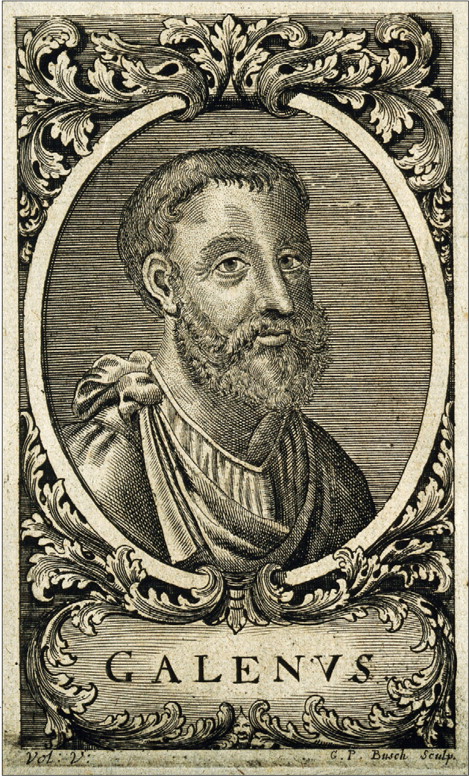
Galen
Roman-Greek physicianWikipedia
215
MENTIONS
90
EPISODES
72
PODCASTS
Search complete. 215 mentions across 90 episodes found for "Galen".
Nov 2, 2026

NickHOST
known in late Europe as Avicenna, whose canon of medicine became one of the most important medical synthesis ever produced and remained a foundational university text and part of Europe for centuries.
NickHOST
Avicenna inherited Galenic humoral physiology and Aristolian natural philosophy, yet his medicine cannot be reduced to either source, because he organized the body through a systematic account of elements, temperaments, humors, faculties, organs, spirits, causes, signs, and treatments.
NickHOST
creating a framework through which individual diseases could be understood in relation to the constitution of the entire organism.
NickHOST
Sexual function belonged inside this larger system rather than forming a separate private category.
NickHOST
The moral and legal question concerned the circumstances, partners, obligations, and consequences of sexual behavior rather than the mere existence of bodily enjoyment.
NickHOST
This distinction allowed physicians to discuss sexual pleasure pragmatically, yet it did not free the medical literature from the gender hierarchy, reproductive expectations, slavery, concubinage, and unequal social power of the societies in which it was written.
NickHOST
Medieval Arabic and Persian medical literature preserved arguments concerning whether women produced seed, whether female pleasure assisted conception, and how the reproductive contributions of male and female bodies should be understood, often drawing upon the disagreement among Hippocratic, Aristotelian, and Galenic authorities." The persistence of this debate shows that ancient physiology had not resolved the status of female orgasm.
NickHOST
Instead, the question became one thread inside a larger effort to reconcile inherited authorities.

Thomas BanburyGUEST
prior to the 14th century, there isn't much in the way of contemporary surgical writing.
Thomas BanburyGUEST
They're relying on older texts from ancient Greek medicine, so people like Galen and Hippocrates, and then a later tradition of Byzantine medicine.
Thomas BanburyGUEST
And this is mostly focused around the study of firstly anatomy, and then you would have specialised in a practical sense in various complaints to do with the exterior of the body.
Thomas BanburyGUEST
So this would have been things like bone setting, lancing boils, skin complaints, problems with the eyes in certain cases, anything that required the sort of physical manipulation of the body.
11 MINS LATER
Thomas BanburyGUEST
The reaction mostly seems to have been to turn back to established knowledge, so older forms of knowledge about epidemic diseases.
Thomas BanburyGUEST
And one of the benefits of this at this period is that there are highly, in certain sections of society, are highly literate and have a large corpus of classical texts that they can draw on.
Thomas BanburyGUEST
And so people turn back to writings by physicians such as Galen.
Thomas BanburyGUEST
on older plague outbreaks, so the outbreak in Athens, for example, or the Antonine Plague, which struck the Roman Empire.

Eleanor JanegaGUEST
So I sort of like went around looking at who are the really big sort of heavy hitter thinkers? You know, who are the theologians? Who are the philosophers who are writing about women? And then how is this disseminated through medieval culture? And I went to go look at who they were looking at.
Eleanor JanegaGUEST
So I had to do Plato and Aristotle and Galen and Hippocrates, because it's not just conceptions of gender and conceptions of women in the medieval period are as based on classical things as they are on any thinking that anybody is doing at the time, right?
Jason KingsleyHOST
Yeah, because they took a lot of their ideas, didn't they, direct from or indirect from the classical era, I guess.
Eleanor JanegaGUEST
Yes.

Stephen DaltonHOST
Suddenly, the merchant finds himself explaining why he would quite like to keep his own belongings.
Stephen DaltonHOST
Even more extraordinary is a story concerning Ptolemy III According to the later physician Galen, the king persuaded the Athenians to lend him precious official copies of plays by the great Greek tragedians.
Stephen DaltonHOST
He provided a substantial financial deposit as security.
Stephen DaltonHOST
Then, having obtained the manuscripts, he reportedly kept the originals and returned beautiful new copies instead.
48 MINS LATER
Stephen DaltonHOST
But Baghdad's intellectual life was not limited to mathematics.
Stephen DaltonHOST
Scholars studied medicine, astronomy, geography, philosophy, and literature.
Stephen DaltonHOST
They translated and debated works associated with figures such as Aristotle, Galen, and Euclid.
Stephen DaltonHOST
And they built upon those traditions, developing new ideas of their own.

Ralph HrubanGUEST
Yeah, wonderful question.
Ralph HrubanGUEST
And actually Galen, the famous physician from 2000 years ago, thought that the pancreas was just padding because it had so little growth structure.
Ralph HrubanGUEST
And everyone believed Galen for 1000 years until in the 1500s virsung anatomist discovered a duct and he said ah if the pancreas has a duct it must be producing something and that changed everything so the gross is not that exciting it's a tan yellow gland but microscopically it's extremely interesting composed mostly of these cells making our digestive enzymes the acinar cells they release their enzymes into small ducts that emerge and form bigger and bigger ducts as it goes down to the duodenum, and then scattered throughout our little islands of neuroendocrine cells named after Paul Langerhans, the Dutch pathologist, anatomist, who discovered them.
Ralph HrubanGUEST
And this is where insulin and glucagon are produced that help control our blood sugar.
Ralph HrubanGUEST
So it's really, as I mentioned, two organs in one.

speaker_0NARRATOR
This vapor theory had a certain intuitive appeal—it explained why people felt drowsy and physically heavy after large meals—and it persisted in various forms for nearly two thousand years, an extraordinary run for any scientific idea.
speaker_0NARRATOR
Galen, the Roman physician whose ideas dominated Western medicine for centuries after his death, proposed a somewhat different framework.
speaker_0NARRATOR
He suggested that the brain became moistened and heavy during rest, causing a withdrawal of what he called animal spirits from the muscles.
speaker_0NARRATOR
In Galen’s view, the muscles went limp because they were literally drained of the spiritual substance that animated them, much like a puppet going slack when the strings are released.
speaker_0NARRATOR
Medieval Islamic scholars, particularly the great physician and philosopher Avicenna, refined these classical ideas further.
speaker_0NARRATOR
Avicenna suggested that the brain actively directed the body to rest by recalling the vital forces inward, pulling the animating energy away from the periphery and concentrating it in the core.
2 HRS 11 MINS LATER
speaker_0NARRATOR
Hippocrates, writing around four hundred BCE in ancient Greece, observed that breathing changes during rest and noted that certain positions seem to promote easier breathing than others.
speaker_0NARRATOR
He also described a condition that sounds very much like what we now call disordered breathing during rest, noting that some patients who were very overweight had labored breathing that could be dangerous.

Sarah DavisHOST
Basic forms of germ theory were proposed in 1546, and then they were expanded on in 1762.
Sarah DavisHOST
But such views were basically ignored because everything was going back to Galenic theory and miasma, and that remained the dominant thought process of scientists and doctors at the time.
Doug RightHOST
Yeah, like, Galen wrote about this in 175 AD, basically meaning that this theory was completely unchallenged for, like, 1300 years or...
Sarah DavisHOST
Yeah, it's a bit out of date.
Doug RightHOST
It
Sarah DavisHOST
really is fascinating, seriously.
Sarah DavisHOST
And, you know, considering that they were relatively backward in a lot of other ways, in terms of medicine, obviously, going back to Galenic theory, the fact that they actually made that connection and moved forward, like, oh, cowpox.
Doug RightHOST
Cowpox will kind of knock you out.

speaker_2NARRATOR
The idea that the pineal gland could be an interface between the physical and the metaphysical is not new.
speaker_2NARRATOR
The Greek philosopher Galen, over 2000 years ago, already recognized its connection to spiritual perception.
speaker_2NARRATOR
Now, modern science is beginning to provide a basis for these ancient intuitions.
speaker_2NARRATOR
Traditional practices for activating the third eye, which include meditation, visualization and specific breathing techniques, may have neurophysiological foundations.

David Patrick HarryHOST
I literally lay out Plato's, citing the actual books here.
David Patrick HarryHOST
of what he's referring to and how this shaped the Western understanding of the human soul, along with virtue, a la Aristotle, and human flourishing, the Hippocratic Oath, and the Galenic medicine.
David Patrick HarryHOST
So Galen, if you're not familiar, one of the most important physicians.
David Patrick HarryHOST
This set the standard for how the West understood healing.

Philip DeFrancoHOST
And he actually worked with the late Egyptian-born Arab Nobel Prize winner Ahmed Zewail and responded to RFK's comments by saying that he thinks Ahmed would have disagreed with Kennedy and added, God rest his soul, he didn't have to endure this.
Philip DeFrancoHOST
And of course, RFK Jr. forgets that it was the Arab scientists of the Middle Ages who kept Aristotle, Hippocrates, Galen alive to hand it down to the Renaissance.
Philip DeFrancoHOST
You even had calls for RFK to be fired over this with the Council on American Islamic Relations saying, Robert F. Kennedy Jr.'s vile anti-Arab rant is a textbook display of unvarnished racism and bigotry.
Philip DeFrancoHOST
Saying his sweeping erasure of Arab contributions to humanity is not only maliciously false, but it also fans the flames of anti-Arab and anti-Muslim hate at a time when communities are already vulnerable to bigoted attacks from other public officials nationwide.
80 more episodes mention Galen.
Create an account to see the whole feed, search across every transcript, and follow the entities you care about.