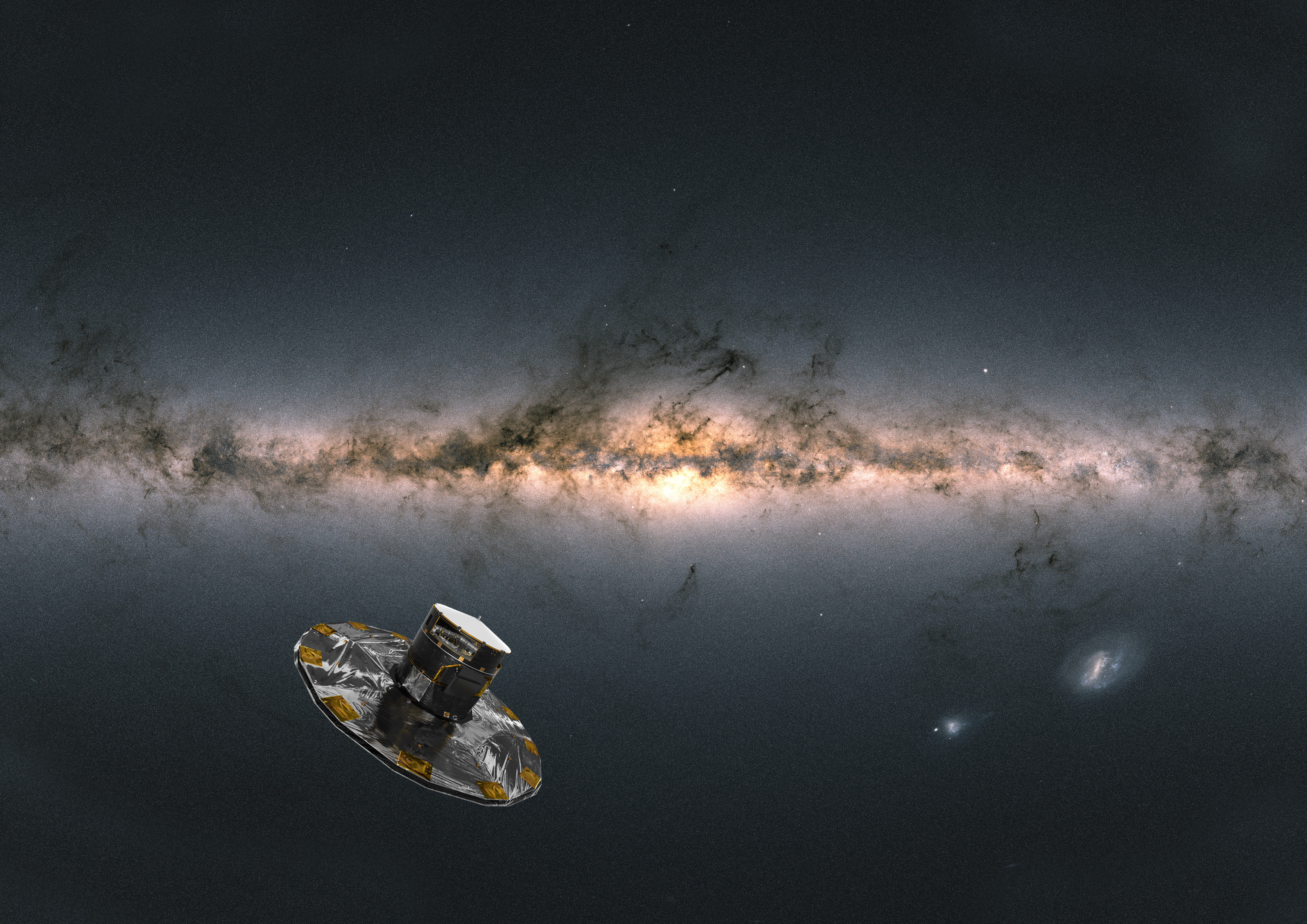
Gaia
SpacecraftWikipedia
69
MENTIONS
6
EPISODES
5
PODCASTS
Search complete. 69 mentions across 6 episodes found for "Gaia".
Oct 18, 2026

speaker_4GUEST
To get past the blur, you have to leave the atmosphere.
speaker_4GUEST
So in 2013, the European Space Agency launched a space observatory called Gaia.
speaker_3HOST
Oh, I've heard of Gaia.
speaker_4GUEST
Yeah.
speaker_4GUEST
By operating in the vacuum of space, Gaia has been able to precisely map the positions and parallax shifts of well over a billion stars.
speaker_4GUEST
It pushed reliable geometric measurements out from a tiny local bubble to distances of many thousands of light years.
speaker_3HOST
A billion stars.
speaker_3HOST
That is just...

David KippingHOST
The Earth physically shifts by 300 million kilometers over six months.
David KippingHOST
The Gaia spacecraft is a master of measuring parallax, and it has now done so for millions of stars.
David KippingHOST
But the further away an object is, the smaller its parallax will be, eventually becoming so small that we can't detect it, even with Gaia.
David KippingHOST
To get round this, astronomers need a new distance measure, a distance proxy.
David KippingHOST
And so that's where a special type of star enters the story, one called a Cepheid Variable.
22 MINS LATER
David KippingHOST
So if then Cepheids came along later, we would likely just dismiss it as a troubled method, especially given the fact that they are usually embedded within bustling galactic disks.
David KippingHOST
So does this mean that there's no crisis in cosmology then? Well, before we totally give up on that idea, I think we still want to improve our precision just a little bit more.
David KippingHOST
On the horizon, there are two big data releases from the Gaia spacecraft that promise to improve our parallaxes even further and thus will let us go back and recalibrate that distance ladder just a little bit better.

speaker_1ADVERTISER
Create your first Monday agent today at monday.com.
PeterHOST
This is Gaia BH1, the closest known stellar-mass black hole located in the Milky Way galaxy just over 1,500 light years away.
PeterHOST
And this is just one type of black hole.
PeterHOST
[laughs] So who wants to see 16 more types of black holes? Yeah, me too.
PeterHOST
We're about to get spaghettified by every flavor of black hole, from micro to super-extremal black hole.
PeterHOST
Gaia BH1 is a great starting point because we discovered it while completely ignoring it at first.
PeterHOST
In 2022, scientists noticed something strange while analyzing the European Space Agency's Gaia mission data.
PeterHOST
The star they were studying seemed to be orbiting something invisible.

Alex McColganHOST
But scientists have worked hard to solve this embarrassing gap in our knowledge.
Alex McColganHOST
So for unpredictable stars, how can you tell how far away they are? The answer is parallax, and that's what our first telescope, Gaia, used as it created a galaxy map over the course of 11 years.
Alex McColganHOST
Parallax is the principle that, depending on your point of view, things can appear to be in different places.
Alex McColganHOST
You can see an example of this right now by holding up your finger in front of your face.
Alex McColganHOST
Things can get a little imprecise.
Alex McColganHOST
But how then can we use this method to calculate the distance to a star? The secret is to widen your base viewpoint.
Alex McColganHOST
Just as the distance between your eyes can influence the effect of parallax on an object, Gaia viewed stars not just once, but multiple times over the course of a decade.
Alex McColganHOST
In that time, the face of our night sky will have changed, as we can see in time lapses like this one, with an exaggeration of 10,000 times.

Matt O'DowdHOST
April 25th of 2018 marks the beginning of just such a leap for much of astronomy.
Matt O'DowdHOST
In the early hours of the morning, the Gaia mission's second data release dropped.
Matt O'DowdHOST
Our understanding of our own galaxy will never be the same again.
Matt O'DowdHOST
[upbeat music] The Gaia satellite was launched in late 2013, entirely built and operated by the European Space Agency.
Matt O'DowdHOST
Its primary goal is to map the stars of the Milky Way with a scale and precision orders of magnitude greater than ever before.
Matt O'DowdHOST
Gaia's predecessor, Hipparcos, cataloged 120,000 stars.
Matt O'DowdHOST
Gaia blows this out of the water with positions, colors, and brightnesses of nearly 1.7 billion stars.
Matt O'DowdHOST
Gaia can see orders of magnitude fainter and further away than previous missions, but its greatest superpower is its precise astrometry.
Matt O'DowdHOST
So thank you.
Matt O'DowdHOST
Last week, we talked about the incredible wealth of data dropped by the Gaia mission.
Matt O'DowdHOST
You guys had a ton to say.
Matt O'DowdHOST
Superuser asks how Gaia compares to the upcoming LSST.
Matt O'DowdHOST
So the Large Synoptic Survey Telescope will indeed be revolutionary.
Matt O'DowdHOST
It does have some overlap with Gaia in that it'll measure light curves, so changes in brightness over time for billions of objects across the entire sky.
Matt O'DowdHOST
But Gaia is really optimized for extreme astrometry, phenomenally accurate position data that actually allows measurements of velocities.
Matt O'DowdHOST
LSST won't do as well in that regard, in part because it's on the ground in the Atacama Andes in Chile, rather than in space.