Fustat
CityWikipedia
84
MENTIONS
8
EPISODES
5
PODCASTS
Search complete. 84 mentions across 8 episodes found for "Fustat".
Sep 26, 2026

speaker_2NARRATOR
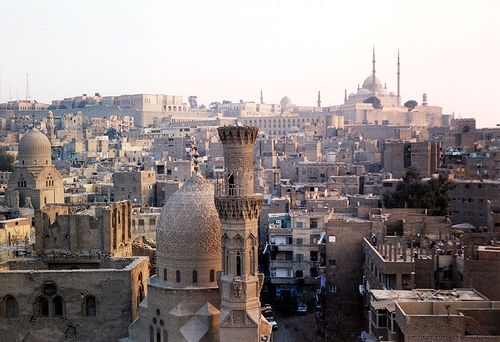
Beyond them rise the minarets of the Nahassin, a perfect gallery of Saracen art, and again beyond the turrets of Hakim's great quadrangle.
speaker_2NARRATOR
In front of the foreground stands Sultan Hassan, the largest and most imposing of the Mamluk mosques, and a little to the left one looks into the vast arcaded square of Ibn Tulun, with its queer corkscrew tower overhanging the billowy mounds that reveal where Fustat lay a thousand years ago.
speaker_2NARRATOR
Still more to the left a line of arches shows where the aqueduct that has brought water to the citadel for five centuries stretches to the Nile, and behind we can look down upon the cluster of ruined domes and minarets of the southern Karafa, the tombs of the Mamluks, and catch a glimpse of the old fortress of Egyptian Babylon and the mosque of the conqueror Amr.
speaker_2NARRATOR
Looking over the Mamluk minarets we can see the dim outlines of the cairns of Dahshur and the conspicuous form of Saqqara's step pyramid, separated from the Saracen domes by only fifteen miles of space but five millenniums of time.
J BevNARRATOR
There was a Muslim capital from the days of the conquest, and though it was not called Cairo, it was close to the present city, which is merely an expansion of the original town.
J BevNARRATOR
The history of its growth will appear as we study its several stages and monuments, and for the moment a bare enumeration of the successive foundations will suffice.
J BevNARRATOR
First rose the original Arab settlement Fustat, the town of the tent, in 641.
J BevNARRATOR
To this was added in 751 a northeastern suburb, the official residence of the governors and their troops, hence named El-Askar, quote, the cantonments.

AdamHOST
But it's something that he saw quite a bit.
AdamHOST
So in old Cairo of his time, in Fustat, one of the things he complains about often, he complained about many things, was that there were too many synagogues.
AdamHOST
So there was the synagogue for the Svardim, there was the synagogue for the Jews from Yemen, there was the synagogue for the Jews who came with the Crusaders or whatever.
AdamHOST
There was all these different communities and nobody could agree on what they should do.

BasilHOST
And here's the detail that matters most for tonight.
BasilHOST
Jawhar did not sack Fustat, Egypt's trading capital on the Nile.
BasilHOST
The army walked in.
BasilHOST
The city stood.
BasilHOST
We're coming back to it, and it's not going to end well the second time.
BasilHOST
Instead of taking over the existing capital, the Fatimids built a new one beside it, walls first, then palaces, barracks, offices, a royal enclosure that was never meant to be a market town.
BasilHOST
Fustat kept the commerce.
BasilHOST
The new city, first called Al-Mansuriya, got the government, and by 970, it had its own Friday mosque, the one building where the whole city gathers, a mosque that would eventually be called Al-Azhar, though not yet, not at its opening.
BasilHOST
That army conquered Egypt without so much as sacking its capital.
BasilHOST
The general Jawhar walked into Fustat and let the trading city go on trading, exactly as it had been.
BasilHOST
And on empty ground just north of that spared city, Jawhar drove stakes into the dirt and laid out the walls of a second city, a royal enclosure for the caliph, the army, and the government, and nothing else.
BasilHOST
That city didn't get its name until the caliph himself finally arrived to claim it in person, four years after the walls went up.
14 MINS LATER
BasilHOST
To make that decree stick in practice and not just on paper, he had shoemakers stop producing women's shoes across the city so that even a woman determined to defy him would find the ordinary business of walking through Cairo made difficult by simple decree.
BasilHOST
Merchants were told to open their shops at night and close them during the day, inverting the working rhythm of an entire capital because the caliph, for reasons nobody wrote down, preferred it that way.
BasilHOST
Imagine being a shopkeeper in Fustat, the same trading city Jawahar had spared 50 years before, hanging a lamp over your stall at midnight because the ruler of Egypt has decided that's when you do business now, with no explanation offered and none expected.
BasilHOST
Inspectors move through the markets checking compliance, the way inspectors always do once a ruler decides a private habit is now the state's business.

Daniel DavisonNARRATOR
A critical examination of these documents compels us to reject their evidence as inadmissible.
Daniel DavisonNARRATOR
After a long period of trouble and anxiety, the family of Maimon arrived at Fustat in Egypt and settled there.
Daniel DavisonNARRATOR
David, the brother of Moses Maimonides, carried on a trade in precious stones, while Moses occupied himself with his studies and interested himself in the communal affairs of the Jews.
Daniel DavisonNARRATOR
It appears that for some time Moses was supported by his brother, and when his brother died, he earned a living by practicing as a physician.
19 MINS LATER
Daniel DavisonNARRATOR
He received a pension and was introduced to the court of Saladin.
Daniel DavisonNARRATOR
The method adopted in his professional practice he describes in a letter to his pupil, Ibn Aknin, as follows, "You know how difficult this profession is for a conscientious and exact person who only states what he can support by argument or authority." This method is more fully described in a treatise on hygiene composed for Al-Fadl, the son of Saladin, who was suffering from a severe illness and had applied to Maimonides for advice.
Daniel DavisonNARRATOR
In a letter to Rabbi Samuel Ibn Tibbon, he alludes to the amount of time spent in his medical practice and says, "I reside in Egypt or Fustat.
Daniel DavisonNARRATOR
The king resides in Cairo, which lies about two Sabbath day journeys from the first named place.
BasilHOST
Picture a rope.
BasilHOST
Just a plain rope, stretched out across empty ground north of a city called Fustat, strung between a wide ring of wooden posts, and hung along its whole length with small bells.
BasilHOST
It's the 6th of July, 969.
BasilHOST
Somewhere along that rope, at every post, a crew of men is standing with tools in their hands, waiting.
BasilHOST
And then he did something the sources treat as remarkable.
BasilHOST
He didn't sack the capital.
BasilHOST
Fustat, Egypt's trading city on the Nile, stood exactly as it had stood before he arrived.
BasilHOST
The markets stayed open.
BaselHOST
Sometime around the end of June, 969, his forces crossed the Nile.
BaselHOST
What resistance the Iqshidid side still had left collapsed quickly, and Jawahar entered Fustat, Egypt's capital, its trading city on the Nile, the place the whole country had bought and sold out of for generations.
BaselHOST
And then, against every expectation anyone might have had, he didn't burn it.
BaselHOST
This is the detail I want you to actually carry out of tonight's episode, more than any single date, more than any dynasty's name, because it's the hinge the rest of this four-part story is going to swing on.
BaselHOST
So nobody dares resist the next time.
BaselHOST
Johar didn't do any of that.
BaselHOST
Fustat simply stood, untouched.
BaselHOST
The market stayed open.

Adolfo RoitmanGUEST
That deposit is known as the Genizah.
Adolfo RoitmanGUEST
For example, at the end of the 19th century there is another spectacular discovery of manuscripts in a synagogue in ancient Cairo, in Fustat.
Adolfo RoitmanGUEST
It is known as the Genizah of Cairo.
Adolfo RoitmanGUEST
Dozens of thousands of manuscripts were found, today most of them in the University of Cambridge.