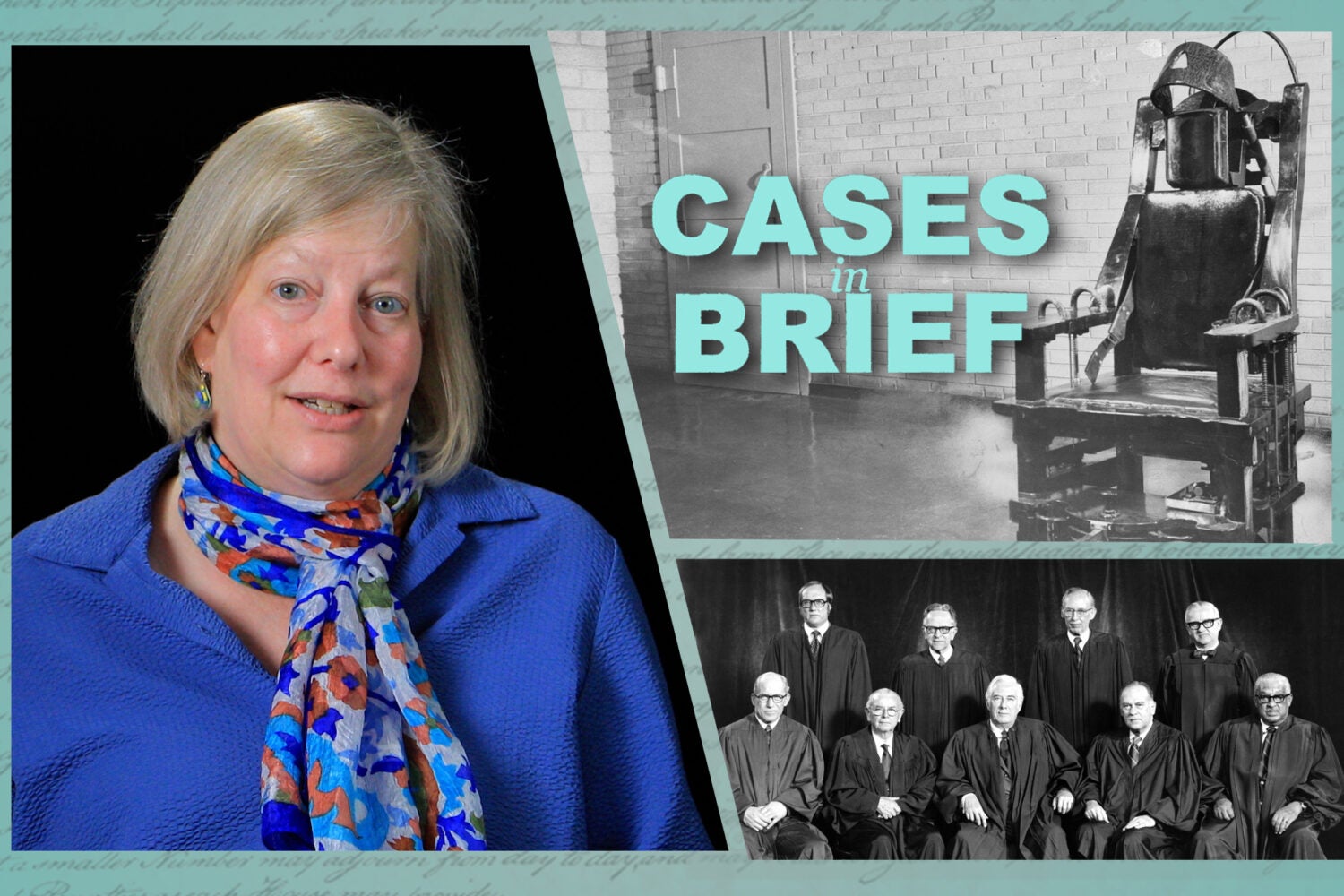
Furman v. Georgia
Case in courtWikipedia
9
MENTIONS
8
EPISODES
8
PODCASTS
Search complete. 9 mentions across 8 episodes found for "Furman v. Georgia".
Oct 25, 2026

HarleighHOST
The death sentence is not a per se violation of the Constitution as it has deep historical roots and is supported by contemporary societal standards, evidenced by the 35 state legislators that reenacted capital punishment statutes after
Stephanie PonzaneliHOST
Furman v. Georgia.
HarleighHOST
And the rule of law that you will need to know is the death penalty for the crime of murder is not in of itself a cruel and unusual punishment that violates the 8th and 14th Amendments.
HarleighHOST
A capital sentencing statute can be constitutional if it provides clear objective standards to guide the sentencing authority's discretion, includes a bifurcated trial, and guarantees automatic appellate review of the sentence's proportionality.

CalebGUEST
And Texas started carrying them out again in 1982.
CalebGUEST
Before that, capital punishment had been stalled around the country for four years with the 1972 ruling in Furman v. Georgia.
CalebGUEST
They held capital punishment laws violated the Eighth Amendment prohibition on cruel and unusual punishment.
CalebGUEST
To put this into context, the state that comes closest to Texas when it comes to carrying out executions is the state of Florida, and they are way behind us with 142 executions, though it appears they are trying their best to catch up.

Darren MarlarHOST
The Chair and the Gas Chamber 1982-1999 Nobody was executed in the United States for nearly ten years before Utah put Gary Gilmore in front of a firing squad in January 1977.
Darren MarlarHOST
In 1972, in Furman v. Georgia, the Supreme Court had struck down the death penalty laws as the states were applying them.
Darren MarlarHOST
And in 1976, in Gregg v. Georgia, it let the rewritten laws stand.
Darren MarlarHOST
Most of the states that wanted to start again went back to the chairs and gas chambers they already had.

speaker_6NARRATOR
Then the law changed.
speaker_6NARRATOR
In 1972, the United States Supreme Court decided Furman v. Georgia, effectively invalidating the death penalty statutes then being used across the country.
speaker_6NARRATOR
Existing death sentences could no longer simply be carried out under those laws.
speaker_6NARRATOR
McDuff was among the Texas prisoners whose sentences were converted to life imprisonment.

HagenHOST
The most significant Supreme Court case on the issue for a long time was in Furman.
HagenHOST
So this is Furman v. Georgia, 1972.
HagenHOST
Furman was the fellow who'd been sentenced to death, brought an Eighth Amendment challenge.
HagenHOST
The Eighth Amendment prohibits cruel and unusual punishment.

Carol SteikerGUEST
Because there are nine people on the Supreme Court, and every single one of them wrote his own opinion in this case.
Carol SteikerGUEST
So there are nine different opinions in Furman v. Georgia.
Ramtin ArabloueiHOST
Wow.
Ramtin ArabloueiHOST
That's not, that's not, like-

Joe GettyHOST
Scumbag.Uh, yeah, yeah.
Joe GettyHOST
Um, a- a- and I was really interested to dig back into Furman v. Georgia in 1972.
Joe GettyHOST
It was a five to four ruling in which the liberal Supreme Court at that time utterly invented laws.
Joe GettyHOST
I mean, just they...
Jack ArmstrongHOST
I'm, I, at this point, I think against the death penalty, but I'm not revolted by it.
Jack ArmstrongHOST
That's interesting that you're revolted by it.
Joe GettyHOST
So one of the offshoots of the Furman v. Georgia thing was that the states wanted to make absolutely sure that what they were doing didn't look cruel.
Jack ArmstrongHOST
Doesn't look cruel.

Paul CallanGUEST
And that's only happened recently.
Paul CallanGUEST
The Supreme Court banned any executions between 1972 and 1976 with Furman v. Georgia.
Paul CallanGUEST
And then it was reinstated, the ability to do the death penalty was reinstated in 1976, but with limitations saying you need to bifurcate the trial, you need a separate trial on the penalty and building in more protections for the accused.
Ashleigh BanfieldHOST
You know, notwithstanding, you're an incredible lawyer, you know, and I know some very, very good attorneys, many after this many years in the business.