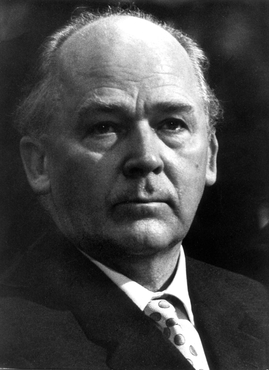
Fritz Strassmann
German chemistWikipedia
17
MENTIONS
6
EPISODES
5
PODCASTS
Search complete. 17 mentions across 6 episodes found for "Fritz Strassmann".
Oct 30, 2026

Scott ManleyHOST
And so there were some other scientists who were brilliant chemists working in Germany.
Scott ManleyHOST
Fritz Hahn and, or Strassmann and Lietzmettner, Orofrisch, they were all like looking at what happened when you hit uranium with the neutrons.
Scott ManleyHOST
And they were actually on Fermi's side.
Scott ManleyHOST
They wanted to prove he was right.

Philip BallGUEST
So then in 1938, this is the crucial sort of step to what comes after.
Philip BallGUEST
In Berlin, two German scientists, Otto Hahn and Fritz Strassmann, they discover that actually in the radioactive decay of uranium, you don't just get an alpha particle coming out here or there.
Philip BallGUEST
Sometimes what you can get is, as they decay, neutrons can be given off, and a neutron can sort of hit another nucleus and can split it apart.
Philip BallGUEST
And they found that this process seemed to be giving an entirely new chemical element that was much lighter than uranium.

Chris CoffinNARRATOR
Some of the complex results of bombarding uranium with neutrons formed an intriguing puzzle that kept various investigators busy for several years.
Chris CoffinNARRATOR
In 1939, the German chemists Otto Hahn and Fritz Strassmann and the physicists Lisa Meitner and Otto Frisch were able to announce a solution.
Chris CoffinNARRATOR
The absorption of a neutron by a certain uranium nucleus, later shown to be that of the relatively rare isotope uranium-235, can result in a splitting or fission of the nucleus into two parts with separate weights that place them somewhere near the middle of the periodic table.
Chris CoffinNARRATOR
The announcement of this discovery created quite a stir among physicists because a nuclear process of this nature must release a very large amount of energy.

John KiriakouHOST
These sabotage missions would become vital to the Allies winning the war.
John KiriakouHOST
Germany had been trying to build a nuclear bomb since Otto Hahn and Fritz Strassmann discovered fission in Berlin in December 1938.
John KiriakouHOST
But their efforts stalled.
John KiriakouHOST
When the war ended in May 1945, Germany hadn't even built a working nuclear reactor or made any fissile material or produced any meaningful amount of enriched uranium or plutonium.

Anish SherinHOST
And in Germany especially, there was little appetite to revisit a story that rejected so poorly how a brilliant scientist had, had been treated because of her religion, her gender, her gender, and her accent.
Anish SherinHOST
It took until 1966 for a, a measure of, of correction to arrive when Hahn, Meitner, and Strassmann were jointly awarded the US Enrico Fermi Award, formally recognized all three as co-discoverers.
Anish SherinHOST
And in 1997, scientists named a newly discovered chemical element meitnerium in her honor.
Anish SherinHOST
Meitnerium in her honor.
Anish SherinHOST
The person who, who worked towards it, the struggle, the hard work.
Anish SherinHOST
So what's, what the story teaches us, you know? Th- there, there are, uh, at least four lessons in, in the discovery of nuclear fission, you know.
Anish SherinHOST
Lesson one, evidence matters, right? Hahn and, uh, you know, Strassmann's chemical results were, uh, crucial because they gave scientists evidence that uranium had produced unexpected lighter element.
Anish SherinHOST
A theory cannot simply wish evidence into existence.
Anish CharyanHOST
In November 1938, the two met in secret in Copenhagen where Meitner suggested further experiments.
Anish CharyanHOST
Hahn and his colleague, Fritz Strassmann, should try out a uranium sample.
Anish CharyanHOST
When Hahn and Strassmann ran those experiments back in Berlin, they found something baffling.
Anish CharyanHOST
Uranium bombarded with neutrons seemed to be producing barium, a much lighter element.
Anish CharyanHOST
The result didn't make sense under any physics anyone understood at that time.
6 MINS LATER
Anish CharyanHOST
Award was announced during the war and presented in 1945.
Anish CharyanHOST
Meitner did not share the prize.
Anish CharyanHOST
Neither did Fritz Strassmann, who had played a, a crucial role in the experimental work.