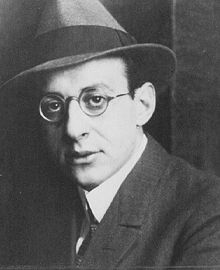
Fritz Perls
German psychiatrist and psychoanalystWikipedia
18
MENTIONS
14
EPISODES
12
PODCASTS
Search complete. 18 mentions across 14 episodes found for "Fritz Perls".
Sep 24, 2026

Bob CookHOST
compassionate.
Bob CookHOST
If you go onto YouTube and watch some of the original Fritz Perls videos, Not only will you see somebody who isn't necessarily compassionate, but Forgive me, people watching this might say, well, he is.
Bob CookHOST
But somebody who would argue, actually, about the importance of maybe a different style of therapy.
Bob CookHOST
So when you say good self-therapist, I think Fritz Perls, when you see his videos, it's interesting to think, interesting to look at the style.
Bob CookHOST
But we are going back to the 1960s, aren't we? We're now in 26, so I think therapy has moved on quite a while.
Simon BaileyHOST
But when did Carl Rogers make his core conditions? That was in the 50s, 60s?

Beulah LevinsonGUEST
So I'll tell you about that now.
Beulah LevinsonGUEST
So although that was so magnificent for me, one day an American friend of my husband's came in and brought a book called In and Out of the Garbage Pail by Fritz Perls.
Tracey CartwrightHOST
[laughs] In and Out of the Garbage Pail.
Beulah LevinsonGUEST
That's his book.
Beulah LevinsonGUEST
So here we now come to the focus on watching the body.
Tracey CartwrightHOST
Mm.
Beulah LevinsonGUEST
And the beauty of Fritz Perls, whose, uh, videos I watched, and they were absolut- he was hysterical and very naughty, and, but absolutely brilliant.
Tracey CartwrightHOST
I like the sound of him.

Warwick PhippsHOST
What of course we're referring to and looking at is the work of Richard Bandler and John Grinder, their work in NLP or neuro-linguistic programming in the 70s in California.
Warwick PhippsHOST
And really what they were looking at, they began by considering who are the most efficient, effective and unusual therapists with unusual skills And of course they looked towards Fritz Perls, they looked towards Virginia Satter and then Milton Erickson later And so they began to model and look at what are the communication patterns, what's occurring and orientating around really rapid change.
Warwick PhippsHOST
And since that time NLP and various applications have really become very popular and established in various fields that go beyond psychology, psychotherapy into coaching, leadership and so on.
Warwick PhippsHOST
But the main aspect, and we could unpack it further at another time, but the main thing in looking at NLP is the notion or the assumption that we don't experience reality directly, we represent reality.

Michelle MastersGUEST
It's in the book.
Michelle MastersGUEST
It's, um, it's, it's a Fritz Perls exercise, actually, he was a psychoanalyst, where you use three chairs.
Michelle MastersGUEST
Originally, it was for when people have had a difficult experience with another human being.
Michelle MastersGUEST
So you have a chair for you and a chair for them, and you sit down in your chair and replay the experience, you know, the whatever the bad interaction was, the way you and God and everyone know it actually happened, right? And then you stand up, you leave yourself in that chair, and you go sit down in the other person's chair and just feel what it's like to be in their body, which is a huge eye-opener, typically.

SofíaHOST
Fue la versión más pura y más extrema de estar presente que realmente he vivido en toda mi vida.
SofíaHOST
No sé si Freud, no sé si Perls, que-- [ríe] Fritz Perls, que fue quien inventó o quien investigó, no lo inventó, quien investigó sobre la psicología gestáltica alguna vez hizo treinta y dos kilómetros.
SofíaHOST
Pero si lo hizo, de fijo, de fijo, también terminó gritando "cierre" en algún kilómetro.
SofíaHOST
Ahora la parte más honesta de este episodio.

Doug LisleHOST
So for 10, 15 minutes, she talked to Carl Rogers, who was a sweet guy.
Doug LisleHOST
And then she talked to Fritz Perls, who was a weirdo gestalt guy who was actually a pretty smart guy, but half psychodynamic and lost in space.
Doug LisleHOST
And then the third one was Albert Ellis, I believe, one of the mainline people that did effectively CBT, except kind of armory version of it known as rational emotive therapy, which is CBT with a New York edge.
Doug LisleHOST
And so...

Christopher CortmanGUEST
Yeah, anything that is unfinished.
Christopher CortmanGUEST
You know who wrote about that was a guy named Fritz Perls, and he had the school of gestalt therapy, which I really like because it's about closure.
Christopher CortmanGUEST
People come into our offices with something that's not done.
Christopher CortmanGUEST
And it might be, you know, a breakup that just happened, but it could also be, as so many people brought in over the years, they were molested when they were a little girl, or they were raped in their 20s, or they had an abortion that they never talked to anybody about and it still bothers them.

Edmund SprungerGUEST
I was watching Carl Rogers.
Edmund SprungerGUEST
I was watching Fritz Perls, Virginia Satir, films about Piaget.
Edmund SprungerGUEST
One thing led to another.
Edmund SprungerGUEST
I was in my own psychotherapy and I ended up doing a master's in social work at the University of Michigan because it was right there.
4 more episodes mention Fritz Perls.
Create an account to see the whole feed, search across every transcript, and follow the entities you care about.