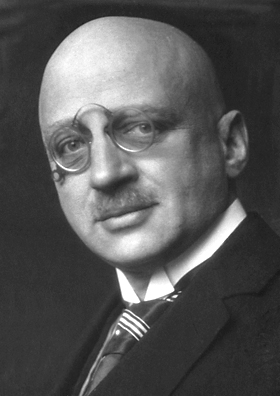
Fritz Haber
German chemistWikipedia
34
MENTIONS
15
EPISODES
14
PODCASTS
Search complete. 34 mentions across 15 episodes found for "Fritz Haber".
Sep 24, 2026

Kory StamperGUEST
Dyes became a byproduct of attempts at chemical experiments in the 1800s, really.
Kory StamperGUEST
Dyes became chemistry as opposed to something that, you know, your local dyer did with plants in the backyard.
Kory StamperGUEST
And as that happened, then any sort of main center of academic chemical inquiry became a place where color was made.
Kory StamperGUEST
And in particular, that ended up being Germany for most of the 1800s.

Didi AllesweissHOST
That tension is haunting.
FerdinandHOST
I'm talking about Fritz Haber.
FerdinandHOST
Have you ever heard about him?
Didi AllesweissHOST
Yes.
FerdinandHOST
Yeah, right.
FerdinandHOST
That's the man.
FerdinandHOST
Fritz Haber.
FerdinandHOST
At the beginning of the 20th century, humanity had a problem, and it was nitrogen.

Hank GreenHOST
But he gave up the effort after the experiment caused a huge explosion that killed one of his lab assistants.
Hank GreenHOST
Eight years later, the German chemist Fritz Haber, probably the closest the world ever got to a literal evil genius, did just what Le Chatelier was trying to do.
Hank GreenHOST
And in contrast to Le Chatelier's despair at the death of his assistant, Haber, had no problem at all with the fact that his procedure, now known as the Haber Process, was used to make chemical explosives which killed hundreds of thousands of people in World Wars I and II.
Hank GreenHOST
But just to prove that there aren't clear winners and losers in science, the Haber Process also saved uncounted millions of lives because the ability to fix nitrogen has made chemical fertilizers possible and basically revolutionized modern agriculture.
Hank GreenHOST
And that the way to achieve balance is to compensate for change, not just to stop completely.
Hank GreenHOST
You also learned and saw that chemical equilibrium can be affected by the concentration of substances, their temperatures, and if they're gases, they're pressures.
Hank GreenHOST
Finally, you learned about Le Chatelier's principle of chemical equilibrium and about his failed attempt to do what Fritz Haber eventually did, invent an efficient process to produce ammonia.
Hank GreenHOST
This episode of Crash Course Chemistry was written by Edie Gonzalez, the script was edited by Blake DePastino, and our chemistry consultant was Dr. Heiko Langner.

Geoffrey DrummGUEST
Yeah.
Jesse MichelsHOST
And so, um, one interesting connection that I, I remember hearing you make on Danny Jones is that Fritz Haber, who is-
Geoffrey DrummGUEST
Yeah
Jesse MichelsHOST
... responsible for modern fertilization techniques-
Geoffrey DrummGUEST
Yeah, so-
Jesse MichelsHOST
Is that right?
Geoffrey DrummGUEST
So Fritz Haber-
Jesse MichelsHOST
Yeah

speaker_0NARRATOR
He connects it
speaker_1NARRATOR
to his study of Fritz Haber, ammonia synthesis, and what he sees as a lost science of ancient alchemy.
speaker_1NARRATOR
Building on that point, both Michaels and Drum acknowledge how much remains unproven, but also how much may still be waiting underground.
speaker_1NARRATOR
What's Drum's ultimate goal here? He says it's not certainty, but progress.

Paul HawkenGUEST
And, um, and so, you know, out of that came artificial fertilizers and pesticides.
Paul HawkenGUEST
And they, you know, Fritz Haber, you know, uh, basically was looking to make a better bomb.
Paul HawkenGUEST
Was not interested in agriculture so- whatsoever.
Paul HawkenGUEST
He was making nitrates to make better, cheaper bombs.
Dave ChapmanHOST
Yeah
Paul HawkenGUEST
... uh-
Dave ChapmanHOST
I, I, I believe that, that Fritz Haber was also, uh, central to the development of the, uh, chemical weapons used in World War I.
Dave ChapmanHOST
He, you know, he was-
Hank GreenHOST
So with the phosphorus and nitrogen cycles, we have introduced fertilizers, lots and lots of fertilizers, the main ingredients of which are, you guessed it, nitrogen and phosphorus.
Hank GreenHOST
The story of how we learned to synthesize nitrogen into ammonia for fertilizers and chemical weapons is a very, very interesting one involving an evil lunatic, and I suggest as soon as this is over, you watch this video on Fritz Haber, the guy who made all of this happen during World War I. You've heard of too much of a good thing, right? Well, through the miracle of synthetic fertilizers, we're able to grow much, much more food than we ever have before, and as a result, ecosystems all over the world are being bombarded by these incredible amounts of nitrogen and phosphorus.
Hank GreenHOST
This takes us into the next chapter in our exploration of ecology, the human impacts on the biosphere.
Hank GreenHOST
Sometimes out of our desire to make nature better, sometimes out of stupid human selfishness, and most often both, we've ended up really messing up the environment in more ways than we can count.

Jeffrey DrumGUEST
So I started looking into the industrial scale production of ammonia.
Jeffrey DrumGUEST
And over here on the left, we have the original apparatus that was designed by Fritz Haber, Nazi scientist who was researching and studying Egypt, and then he produces this apparatus for the industrial scale production of ammonia.
Jeffrey DrumGUEST
Just take a look at the configuration of this apparatus on the left.
Jeffrey DrumGUEST
You will see three distinct chambers that are connected by connecting shafts, and the third chamber is elevated above the first two.
Darren GrimesHOST
Yep.
Jeffrey DrumGUEST
Okay, so this guy could have configured this apparatus in any way, but it is literally designed as an homage to the place from whence it came, because this modern chemical reactor operates on the exact same principles of physics that were involved in the operation of the Red Pyramid, and it was producing the exact same chemical.
Jeffrey DrumGUEST
So I have an idea that old Fritz Haber, in his e- research and trips to Egypt, also went inside the Red Pyramid, saw the chemical staining, smelled the ammonia, and did the exact same thing that I did when I returned, which was attempt to reverse engineer the structure.
Jeffrey DrumGUEST
And instead of writing a book and putting it on a YouTube channel, they made it a secret, and now it is our industrial scale production called the Haber process for the manufacture of ammonia, starting with methane gas, which is exactly what they did in the ancient Egyptian pyramids.

Spencer KlavanGUEST
So we are now at the brink of a new 500-year period, which will be just as turbulent in its initiation as anything before our sense, but will perhaps settle out, God willing, into something actually quite beautiful.
Spencer KlavanGUEST
I think all the time in this connection of, I think his name is Fritz Haber, the German scientist who develops the technology basically for, they called him the man who drew bread from the air because he found this chemical process that was able to fertilize soil in this new way.
Spencer KlavanGUEST
And so he's responsible for a lot of our agricultural technologies that we now still use.
Jeremy BoreingHOST
And

LucyHOST
The society and its research institutes were involved in weapons research, experimentation, and production in both the First and Second World Wars.
LucyHOST
During World War I, the group, and in particular, a guy named Fritz Haber, was responsible for introducing the use of poison gas as a weapon.
LucyHOST
Yep.
AmandaHOST
Yep.
5 more episodes mention Fritz Haber.
Create an account to see the whole feed, search across every transcript, and follow the entities you care about.